

Glory to Ukraine!
Glory to the defenders of Ukraine and the entire modern civilization!
Today in the issue:
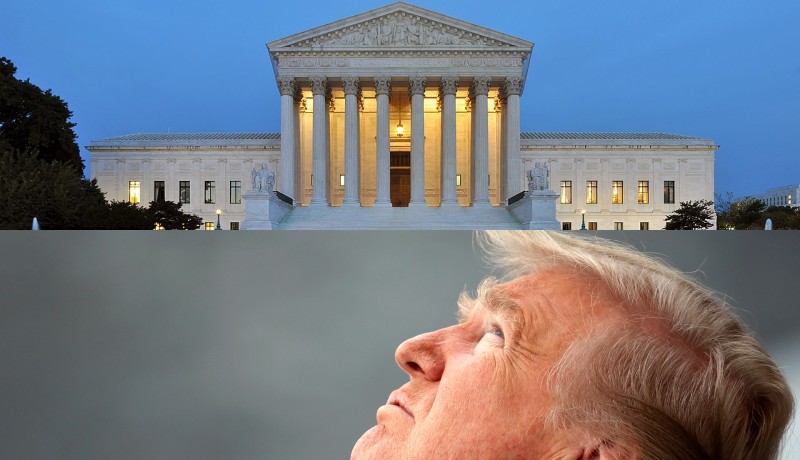
- A crushing and very painful defeat for Trump in the US Supreme Court
- Trumponomics: real economy grew in 2025 by only 2.2% compared to 2.8% in 2024 – the worst indicator since 2020
▶ On Friday, Donald Trump suffered a very painful legal and political defeat. Perhaps the most painful. He not only lost a case in the US Supreme Court on a crucial issue for himself regarding tariffs but this defeat dealt a very painful blow to his main foreign policy concept, practically destroying this concept.
The Supreme Court’s decision to declare Trump’s tariffs illegal needs to be explained in more detail to understand how the Court reviewed the case and why its decision was expected.
Last spring, the 47th president began introducing tariffs – on imports from Canada and Mexico, on aluminum, on cars and auto parts, on all imports from China. On April 2, 2025, he staged a TV show in the White House Rose Garden, declaring this day as America’s liberation day and signing an order to impose tariffs on imports from almost the whole world. He always stated (and continues to state now) that tariffs are paid by other countries for the right to sell their goods in the US. This is a lie that only those who do not understand the essence of tariffs can believe. A tariff is a duty paid by the person importing the goods into the country. If an American buyer imports goods into the country, the duty for their import is paid by that American buyer, not by a foreign state. If, for example, Trump set a 15% tariff on a TV made in South Korea, it means that the American retail chain that imports TVs into the country must pay customs 15% of their cost. And then it includes this money in the retail price at which it sells the TVs in the US. And the American buyer reimburses it for what it spent by paying the tariff. No foreign state, no foreign company has any relation to paying Trump’s tariffs.
Trump justified the introduction of at least 70% of his tariffs using the International Emergency Economic Powers Act (IEEPA). This law provides the president with the ability to temporarily ban the import of specific goods and services from, or export to, a particular country if that country’s actions threaten U.S. interests. In other words, this law allows the president to impose sanctions against another country. In this case, the president must declare an emergency due to hostile, unfriendly actions by another country. For example, Biden’s Executive Order No. 14024 on April 15, 2021, declared an emergency due to the malicious actions of the Russian government against the national interests of the U.S., its allies, and partners. All subsequent sanctions against Russia are based on this order (including sanctions imposed by Trump against Rosneft and Lukoil).
However, the IEEPA does not grant the president the right to set customs tariffs on imports from other countries. It cannot, in principle, because a customs tariff is a tax paid by the American taxpayer. The president and the executive branch as a whole cannot impose taxes. This is the exclusive prerogative of Congress—the elected representatives of citizens in the legislative branch. This is clearly stated in Article I of the Constitution, which outlines the powers of Congress as the legislative branch.
This is precisely why, shortly after Trump imposed arbitrary tariffs, a group of several small American companies specializing in selling imported goods in the U.S.—from wines to educational games and toys for children—filed a lawsuit demanding that the tariffs imposed by Trump, supposedly based on the IEEPA, be declared illegal, as this law does not give the president the right to impose customs tariffs, i.e., set taxes.
A specialized federal court on international trade quickly reviewed the case, and a panel of three judges fully and unanimously granted it. Trump instructed the Department of Justice to appeal to the appellate court, where the appeal was rejected by a panel of three judges, although one sided with the president. Then, the 47th president demanded the Department of Justice to appeal to the Supreme Court. In early November of last year, the Supreme Court heard the appeal, represented by a very skilled attorney, Georgetown University professor Neal Katyal, who has extensive experience in various Supreme Court cases. During these hearings, it was evident that all nine Supreme Court justices agreed that customs tariffs are taxes, and taxes fall under the legislative, not executive, branch.
Nevertheless, it took the Supreme Court another three and a half months to make a decision. It is now clear why it took so long. Obviously, the conservative (Republican) Chief Justice Roberts wanted to craft a decision that as many conservative (Republican) justices as possible would agree with, and this took time. Roberts himself, along with justices Gorsuch and Barrett, appointed by Trump during his first term, joined the three liberal justices and voted for the decision written by Roberts: Trump’s imposed tariffs are illegal, as the IEEPA does not allow the president to impose customs tariffs, which are taxes. Three more judges, the most politically driven Republican judges Alito and Thomas, along with another Trump appointee, Kavanaugh, voted against the decision.
The 47th president was enraged. He gathered journalists and declared the court’s decision disgraceful, the six judges who made it a disgrace to the country, and the three judges who voted against it heroes.
For the second time in the past two months, the Supreme Court decided on a principal issue for Trump not in his favor. In December, seven justices (Alito and Thomas dissenting) ruled that the federalization of the National Guard and its deployment to Chicago (and therefore to all other cities) was illegal. Now, six justices have ruled that most of the tariffs imposed by Trump are illegal.
Both of these decisions are very painful for the president. But the decision on the illegality of tariffs is especially painful. Tariffs were the cornerstone of his foreign policy strategy with most countries around the world. In Brazil, his ideological ally, the far-right former president Bolsonaro, was condemned for an attempted coup – a 50% tariff on imports from Brazil. India’s Prime Minister Modi did not nominate Trump for the Nobel Peace Prize – a 25% tariff on imports from India. Yes, precisely for this reason, and not because India was buying Russian oil – they are now reducing their purchase of Russian oil not because of Trump’s tariffs, but because of the EU’s decision to prohibit European countries from buying petroleum products made from Russian oil, and the sale of such products to the EU had become a significant part of Indian refineries’ business since 2022. Now this dirty business has closed. Vietnam delayed permitting the construction of Trump’s golf club and attracting funds for the construction – let’s raise the tariff on imports from Vietnam. Gave the permit – lower the tariff. Canada doesn’t want to become the 51st state of the USA – let’s impose tariffs on all imports from Canada. European countries do not recognize US claims to Greenland – let’s impose additional tariffs on imports from there. And so on.
Now the 47th president will not be able to use his tariff blackmail.
Yes, he still has the tools to introduce temporary tariffs. Already on Friday, he issued an order to introduce a 10% tariff on all imports entering the USA starting February 24. And by Saturday, he raised that tariff to 15%.
Based on the international trade law, which gives the president the right to temporarily impose customs tariffs up to 15% if there is a need to correct the balance of payments. But such tariffs can only be in force for 150 days – 5 months, and can only be extended by Congress if it passes the relevant law. Therefore, the new Trump tariffs will be in effect until July 24, 2026, after which they will automatically cease. The adoption of a law by Congress to extend them is absolutely excluded. While it’s conceivable that Republicans in the House of Representatives might pass such a bill (though even that is problematic), finding the necessary 60 votes in the Senate for such a bill is impossible. Among the 53 Republican senators, there is at least one (Senator Paul) who is a proponent of free, fundamentally duty-free trade, and he will not vote for such a law. Finding 8 Democrats in the Senate who would vote for such a law is impossible.
Here’s what else is important to add.
The simple response to all remarks that Trump will not comply with the Supreme Court decision is that he not only will comply, but is already doing so. All tariffs overturned by the court’s decision have not been collected since the publication of the decision.
The Ministry of Finance is obliged to return to importers all the money illegally collected from them in the form of tariffs. Since the court’s decision does not explicitly state that this must be done, the Trump administration will litigate the issue. Lawsuits have already been filed by major importers, such as the hypermarket chain Costco, for the refund of this money. Trump may have chances to delay in legal battles, but there is no chance of winning in court—funds will have to be returned sooner or later.
Justice in the USA works. This includes the Supreme Court. Yes, it is more politicized than ever, with a politicized Republican majority of 6:3. But there are evidently enough judges within this majority who remain judges and do not become politicians when it comes to assessing compliance with clearly formulated laws. They make decisions based on the law rather than political expediency or ideology.
And the fact that justice works is a very significant deterrent to all attempts by the 47th president to establish authoritarian rule in the country. In its decision on Friday, the Supreme Court clearly demonstrated that the president cannot do what he wants, that laws must be followed, and that all established norms must be strictly adhered to.
▶ And more on tariffs and the economy. Trump claimed that tariffs were necessary to reduce the negative balance in foreign trade. Nobel Prize-winning economist Paul Krugman, for example, believes that such an objective is meaningless and that a negative foreign trade balance does not hinder the development of the American economy. This is also the opinion of most leading economists.
Economic data published at the end of the week indicate that Trump’s economic policy is not working. In the fourth quarter of 2025, GDP grew by only 1.4%. Overall, for 2025, GDP grew by 2.2% compared to 2.8% in 2024. This speaks for itself about what Trumponomics represents compared to Bidenomics. An economic growth rate of 2.2% in 2025 is the worst since 2020 when there was a pandemic.
Last Wednesday, Trump claimed that his tariffs reduced the trade deficit by 78%. Again, he not only lied but spread absolute misinformation. On Friday, real data were published showing that the trade deficit decreased by 0.2% in 2025 compared to 2024.
The deficit in trade with China did decrease by 32%. But obviously, the deficit in trade with other countries increased, as the overall deficit hardly changed.
On Tuesday evening, marking the fourth anniversary of the full-scale Russian invasion of Ukraine, the 47th president will deliver a State of the Union address at a joint session of both houses of Congress. He will, of course, talk about how America is thriving like never before under his leadership, that its golden age has arrived, and so on, and so forth… And the Republicans will repeatedly stand up and give him ovations. Some Democrats will not attend the session. And some who do come may begin to leave the hall early…
I promised to discuss possible interesting occurrences in this year’s elections in Texas. We will do this next week.
There are 1063 days left in the story titled “Fear: Trump in the White House” © (the title of Bob Woodward’s book, published in 2018).
Thank you to everyone who read this. Take care of yourselves and your loved ones. Take care of each other, help each other. Health to everyone.
Ultimately, what happens in the world depends on us. Whether we fight against evil, do Good, remain mere observers, passively wait, and believe that someone somewhere will decide for us, or fight against evil and do everything possible to ensure Good prevails.
We must not let evil win. The victory of evil would mean the end of the world we live in. We cannot allow this. Especially now.
Ukrainian Friends, I embrace and love you all. Take care of each other, I ask you very much.
Ukraine is and will always be.
And evil will be defeated and punished. And this will certainly happen.
