
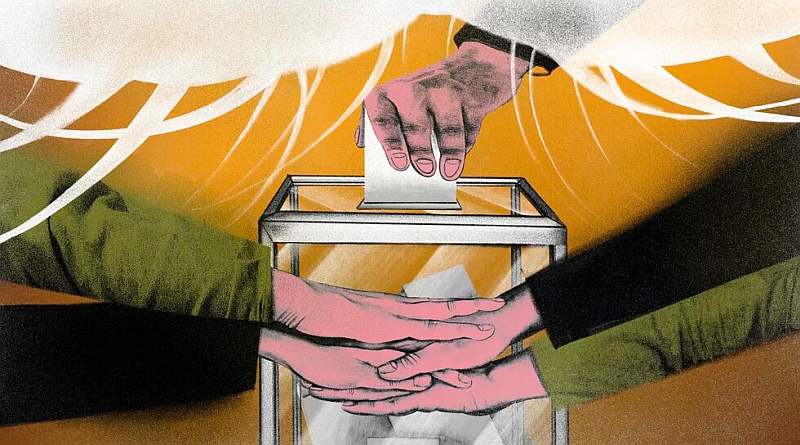
Has it already begun? The statement by the recent commander-in-chief, now (for now) the Extraordinary and Plenipotentiary Ambassador of Ukraine to the United Kingdom, has stirred countless explanations, interpretations, and predictions. What is Valeriy Zaluzhny doing: hinting to the leadership that they should treat him with more respect, burning bridges behind him, or thus declaring his intention to go into opposition, and consequently start a political campaign with a quite probable perspective of occupying a well-known office? Or is it all of this together?
Let me remind you, it was about direct accusations against the president for disrupting the 2023 counteroffensive, as well as his demonstrative incitement of an SBU investigative team against the commander. And yet Paul Manafort himself approached him with cooperation proposals (not directly named, but the famous lobbyist and political consultant is not hard to identify), and he sent him away. How much clearer can it get! Zaluzhny, in any case, is not a child, it is hard to assume that he suddenly lost his nerve. No, his candid interview, and to a foreign media outlet at that, is a deliberate (though, possibly impulsive) act. Perhaps he was pushed by some signals from the Office, perhaps he was informed that someone else also has chances to become the number one alternative to Zelensky — a position Zaluzhny had occupied for a long time without additional effort, by the mere fact of his existence. Understanding what really happened is the task of professional analysts and intelligence officers; what is more important for us is something entirely different: the rivalry of the main candidates for the next elections, at least at this moment, has finally surfaced. It’s the shot from the starting gun, louder than the explosion of a “Kalibr”.
And now attention: what are Ukrainians likely to vote for once the conditions arise? Not who, but what? You can say what you want about the current head of state, but when he went to the elections seven years ago, he offered an understandable program. Vague, populist, ridiculous, but a program. Some of it was formulated in words, some didn’t even need articulation, but stemmed directly from the on-screen image of the candidate. These were: a change of elites; an agreement with the enemy; the improvement of a neglected country; prosperity as a direct consequence of the incorruptibility and democracy of an imaginary teacher who rides a bike to work. Knowing the hero a little, one can assume that he sincerely believed in it himself, but now it doesn’t matter.
What demagoguery will the new leader propose, whoever he may be? We understand that nothing but demagoguery works on the path to the main seat of the state, and not only in our country. But once seated, you become somewhat of a hostage to it — if not in actions, then in further promises. Hence, the content of demagoguery does matter. And now the next question: who forms this demagoguery? A political consultant? Oh, please! A political consultant can only extract from the subconscious of the common people their subconscious desires and ideas, and then tell them what they want. This is the deep essence of democracy: not in procedures, not in electoral systems, but in the omnipotent collective subconscious that brings to life sometimes Reagan, sometimes Trump, sometimes Havel, sometimes Orban, sometimes Yushchenko, sometimes Yanukovych. Sometimes Hitler. Sometimes Putin. Each nation at each particular historical moment has its own subconscious.
The subconscious of Ukrainians cannot be healthy. It has never been healthy, nor could it be, in the last thirty-five years after so many collective traumas experienced over at least the last century, give or take. All right, it’s unhealthy, but to what extent? We are proud of our resilience, and rightfully so. But we forget about the unfortunately established tradition of other, less impressive manifestations of collective action — from Novy Sanzhary, through the pro-Russian anti-Maidan events in the East, up to today’s beatings of members of the TCEC.
We (I say “we,” although it concerns a small circle that claims reflection and generalization) place our hopes on “horizontal connections” that protect us from tyranny and allow us to organize effective protests, and this is true. However, horizontal connections are also “each to their own,” it’s the godfather who can’t refuse you and with whom you can “sort things out,” and without this informal, hidden fabric of relationships, our society cannot function. “Horizontal connections” can work against something or someone, but can they work for something, towards something? Does this fit their function?
In the world, the normal embodiment of normal horizontal connections are some charitable organizations, “Alcoholics Anonymous,” individual political parties and civic movements — individual ones! Clearly, this is not our path: I can’t recall a single party, regardless of its sincere support locally, that wasn’t founded for a specific political project, a specific leader and wasn’t funded by a specific magnate or group of magnates, although locally they might not suspect this, or rather, not think about it. A party as an organism created to protect group interests does not exist until group interests exist, not counting the group interests of different state structures, but they can do without a party, they have an apparatus. Therefore, there are no parties that will offer a clear program for protecting interests — left, right, centrist, whatever, as long as it’s logical.
Political scientists claim: “there” people vote for the program, and “here” for the leader. But come on, I say again and again: everywhere (!) people vote for the subconscious, it’s just that “there,” it is sometimes more structured, and not always even then, while here it is mythologized, chaotic. But mythology can also be structured by explaining to the masses what they want, what exactly they mean by their confused images. It may seem absurd, but we all live like this, for this reason, we read books and websites — not to learn new things, but to organize our own thoughts. As one of my friends writes: “I listen to NN’s vlog in the morning to understand what I think about it.” The difference is that on an individual level, you can turn on criticism, and on a collective level, just avoid touching taboos and prejudices. This is the work of propaganda, PR, and at the election stage — various candidates: to tell the community, region, nation what it wants.
What do Ukrainians want? First and foremost, security. Peace, physical safety, the ability to return home where there is somewhere to return to. This, undoubtedly, is in the first place. What else? Justice. However, justice is understood differently here: some see it as equal opportunities, some as the absence of poverty, others, conversely, as the absence of wealth according to their own perception of richness, and some as a specific Ukrainian-style meritocracy (where climbing the social ladder entitles one to benefits). Prosperity. Of course, prosperity! Elderly people want pensions raised two or three times and all corrupt officials imprisoned; civil servants want salaries; employees want protection; entrepreneurs want no oppression and bribery, and if they’re going to be squeezed dry, at least let it be predictable and without surprise inspections. However, due to the diverse and mostly pre-modern economy, entrepreneurs are unlikely to have a common platform. All together, they want paradise on earth, and preferably by yesterday. Almost forgot: no Moscow affiliation, as the main pro-Russian electoral base has partly converted and partly remained behind the line. Last but not least: freedom, this advantage of ours remains relevant, so no restrictions on freedom in exchange for a fridge. To reconcile these ideas into one, it would be necessary to slightly modernize the class structure, which in itself is one of the primary conditions for forming a responsible electorate — an ouroboros (hint: this is a snake devouring its own tail)!
And all this should be communicated appetizingly by the candidate for leadership. If he simply promises peace, which every living person in Ukraine dreams of, it’s not enough. He must paint a picture of a shining city on a hill, accompanied by impressive details like “4 thousand dollars for a teacher” or “spring plantings” for thieves, but no more — no step-by-step explanations, no complicated arguments (regardless of whether he has them or not), because it doesn’t work with myths. Today it might be: “a power plant and a boiler in every yard” — just for example. So the new leader must be the wizard of the Emerald City, where the ability to enchant is more important than logic. Are you knowledgeable about economics? Never mind, I’ll learn. Do you have resources? I’ll find them or get help. Do you have a team? Doesn’t matter, I’ll gather fresh faces and train them in Truskavets. Do you have an enemy? No worries, I’ll negotiate. In seven years, nothing has changed in our subconscious in this regard, except for exhaustion and even greater hope for a miracle.
Now, the question is: is there a demand in society for a strong hand? Not for a smart technocrat who will “sort out” the chaos, not for a public favorite who will enchant with ballads of a bright future, but for a strict De Gaulle, Pinochet, Lee Kuan Yew? Yes, the character of a Suntown fairy tale won’t suffice anymore. Now fit existing and hypothetical candidates into this image. What I’m sharing is not political science, which requires special knowledge and constant reliable information in large quantities. It’s more like anthropology.
And there is another illusion that was recently on the agenda: “The guys will come and set things right.” They will not: these guys—let’s not forget, girls too!—have partly perished, and it was precisely those who could have driven further positive change who have died, as they felt responsibility more acutely. And those who remain are exhausted not only by the trials of an unprecedented war but also by the challenges of returning. They find that they are needed by no one, and apart from their close ones, ultimately, no one is waiting for them but a cold, indifferent bureaucracy and the phobias of those who somehow managed to sit it out.
Does someone have a chance of success who, instead of building castles in the air, repeats the legendary phrase of a well-known leader: “I can offer nothing but blood, toil, tears, and sweat”? In our version: “Total mobilization, turning the country into an armed fortress until the enemy perishes or melts in the sun.” They have a chance if they can counterbalance the absence of hope with powerful charisma, the authority of a potential “father of the nation.” Once again, it’s about magic. But who a person will really turn out to be as soon as they sit in the chair, we cannot know.
