
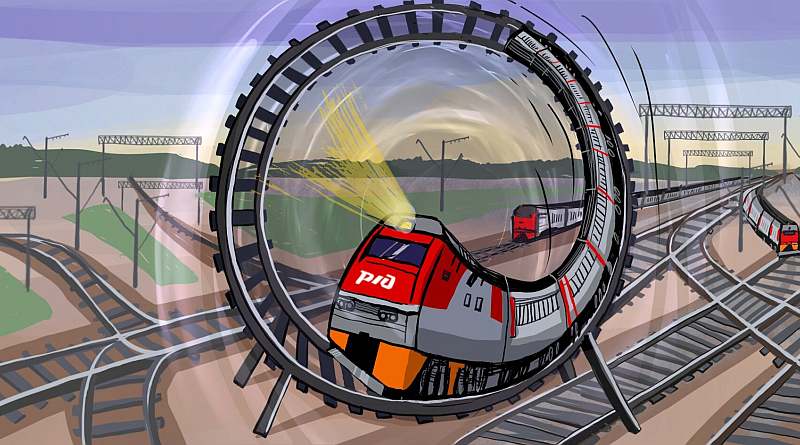

While the US is deploying troops to Iran, and it is being revealed what new ideas Medinsky has come up with, let’s take a closer look at Russia’s railways, which objectively are a real backbone of the Russian Federation.
We can state that there have emerged non-overlapping information streams on railways, “grandeur” and “reality.”
The “grandeur” stream positions Russian Railways as a global company, capable of laying tracks all over the planet in Russia’s interest.
The “reality” stream, which spiteful tongues might call “bankruptcy,” even in a softer version, speaks of large-scale problems, excluding truly large development projects.
That’s why comrade Dmitriev is frantically dancing in front of the American side with some investment ideas. Because without unblocking connections with the world and an influx of resources, things are getting increasingly grim.
1. In the “grandeur” stream, you can find such news.
Two weeks ago, Russian Prime Minister Mikhail Mishustin visited Brazil. There was a lot of discussion and a lot of puffed-up chests.
At the same time, a deputy head of Russian Railways was in Brazil. He held meetings with Brazilian counterparts, following which the Russian media fervently spread the news: the official stated that Brazil is terribly interested in the Russian experience in railway management! Zero specifics.
While hypothetical locomotives are traversing Brazil, a subplot is developing concerning the hypothetical construction of the railway line Kyzyl (the capital of Tuva) – Kuragino (Krasnoyarsk Territory).
There is no railway in Tuva; the republic is not connected to the Russian network. The project for constructing a railway line of about 400 km was initially developed back in 1978. Thirty years later, in 2008, the first official documents of intent were signed.
In 2011, Putin personally drove the first spike, opening the construction of the Kyzyl-Kuragino line. Right after his departure, the spike was stolen, and the symbolic piece of railway became a monument to a long-term project.
Since 2018, a legend began to develop that the road construction would be entrusted to Ruslan Baisarov, the owner of the Elegest coal deposit (reserves – 855 million tons of coking coal).
In 2019, Shoigu proposed involving the army in the construction, with the project estimated at 192 billion rubles. But the pandemic intervened, and in 2021, the construction was officially postponed… until 2026.
From the end of 2025, discussions were re-energized with a new flavor – to involve the Chinese and extend the railway through Mongolia to China. The project was now estimated at 2 trillion rubles. The Chinese were intended to be intrigued by an “African” scheme: they build the infrastructure and in return get access to rare earth metal deposits.
However, a logical conflict arose. Moscow officially declares a course for the extraction and processing of rare earth elements within the specially created Angara-Yenisei scientific-production cluster in the south of the Krasnoyarsk Territory (the nearest explored deposits of rare metals and rare earths are the Ulug-Tanzek and Arystan deposits in Tuva). The Chinese are not interested in processing anything in Russia, and Moscow planned to limit the export of valuable raw materials.
Against the backdrop of Russia already abandoning the construction of the North Siberian railway, the lobbyists of the Kyzyl-Kuragino branch fiercely argue that these projects are fundamentally different, and the cancellation of one due to lack of funds should not mean the cancellation of the other.
Hypothetically, the Chinese can be replaced by Americans, but to do this, one must escape the deadlock.
3. Meanwhile, the leadership of the RZD branch in Yakutia dreams aloud about extending the branch from the Nizhny Bestyakh station (opposite Yakutsk across the Lena) towards Magadan, ritually adding that this will increase access to the Arctic ports of Tiksi and Naiba on the sacred “Northern Sea Route.”
There is no money. There is no project. How this is related to the NSR is a mystery. But content for discussion is created.
Overall, a semi-religious discourse with elements of magic has already formed in Russia: to give weight to any matter, one must randomly insert phrases about the NSR and rare earth elements.
Several other RZD projects are also being talked about—developing the “Eastern Polygon,” building a high-speed line between the capitals, etc. Some of them are intended to provide the appearance of hectic activity…
4. Reality, however, is somewhat different.
According to official data, RZD is mired in debt. The total debt is about 4.4 trillion rubles. As a result, by the end of 2025, the Russian government began frantically discussing measures to save the railway lifeline.
To start, RZD reduced the investment program to 713 billion (planned 891 billion for 2025, executed at 860 billion). But even this is in question. Costs will be cut—freezing salaries, reducing personnel, and relocating administrative centers from expensive cities to more modest ones.
Simultaneously, there is a discussion about restructuring debts. The main creditor, VTB, immediately dismissed manipulations with papers that seemed like an attempt to ultimately hang unsecured debt on the bank.
The sale of non-core assets is being considered. Among them is a tower in Moscow-City, valued at around 220 billion rubles. However, market specialists point out that it will be difficult to find a buyer for such a piece. Unless it’s renamed “Trump Tower Moscow.”
Also, from March 1, the Russian government is increasing the rail freight tariff by 1%. Formally to strengthen measures against terrorism. In fact, to help the sinking locomotive a little. Businesses are not pleased.
Moreover, the government is looking for 65 billion in direct budget support. The Ministry of Finance is hysterically shouting that it won’t provide the money.
At the same time, the authorities indicated that in 2026, RZD must increase freight traffic to 1 billion 132 million tons. In 2025, it was 1 billion 116 million tons. So the growth is small, but it is important to change the trend. Because last year there was a loading decline, officially by 5.6%. RZD blames the companies for this, specifically stating that 30.7 million tons of coal, for which quotas were reserved, were not presented for shipment.
January did not add optimism—a decline of 4%. Coal, metals, and scrap metal are dragging down, while fertilizers and grain slightly mitigate the situation.
Various minor troubles are coming from all sides. For example, Kazakhstan has complicated the use of Russian railcars within the country.
Altogether, this will mean a shortfall of resources for budgets at different levels.
5. Meanwhile, international stories are emerging.
Since 2008, Armenian railroads have been under a concession to Russian Railways (managed by the South Caucasus Railway, a subsidiary of Russian Railways) for 30 years (with the option to extend for another 10 years).
As soon as the creation of the Trump transport corridor was discussed, there arose the need to revive two sections of the track—to the border with Turkey and to the border with Azerbaijan (towards Nakhchivan). These sections are short, and the cost is negligible on a global scale.
But the Russian side was not overly enthusiastic, despite the fact that Mr. Pashinyan personally requested it from Putin.
As a result, Pashinyan voiced a brilliant idea: why not sell the concession to some third country equally friendly to Moscow and Yerevan? For example, Kazakhstan. Because Russia is toxic, and international railway users might hesitate due to the involvement of a Russian entity, causing Armenia to lose its advantage.
It sounds somewhat mocking toward Russia, but it’s actually correct. The new route will require investments. And Russia, even if it wanted to, doesn’t have the resources. However, it can’t refuse such a leverage of control either. Therefore, the Russian Foreign Ministry, represented by Zakharova, says that Moscow will study the idea of the Trump road but wants more details…
Overall, through discussions, plans, and expectations, a grand positivist picture of development and progress is created. But the numbers indicate a decline and the rise of problems that will have to be solved with extraordinary efforts at the highest political level at the expense of less influential petitioners.
A thousand cuts work slowly but surely.
