
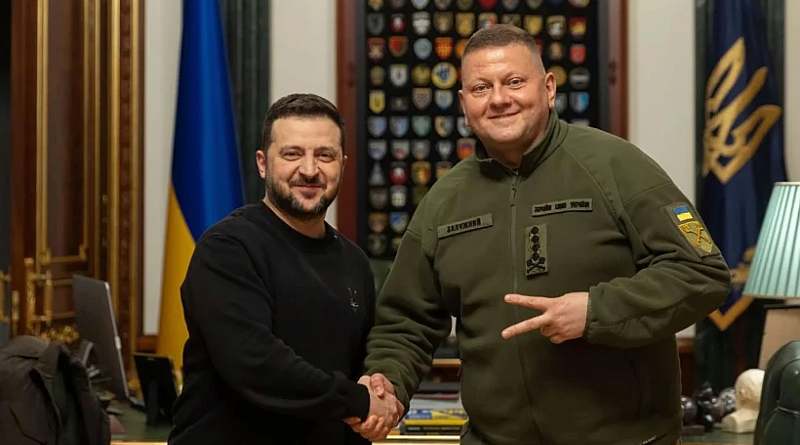
Samya Kullab and Susie Blann, The Associated Press / translated by Radio Lemberg
The former Commander-in-Chief of the army, considered Zelenskyy’s main rival, spoke to AP about the rift between them.
02/18/2026 (interview conducted on 02/02/2026)
Since he was removed from his position as Commander-in-Chief of the Ukrainian army in 2024 and appointed as the country’s ambassador to the United Kingdom, Valerii Zaluzhnyi is considered the main political rival of President Volodymyr Zelenskyy.
The 52-year-old Zaluzhnyi refuses to discuss his political ambitions, stating that he does not want to risk harming national unity during the war with Russia, which is nearing its fourth anniversary. However, as a sign of his possible desire to run for president—after the end of the war—Zaluzhnyi publicly revealed for the first time the deep rift between him and Zelenskyy in a recent interview with the Associated Press.
Tensions arose soon after the full-scale Russian invasion began in February 2022, and the two men often clashed over how to best defend the country, Zaluzhnyi said. The strained relations reached a boiling point in September 2022 when dozens of SBU agents raided Zaluzhnyi’s office, he told AP.
Zaluzhnyi claims this previously unknown incident was an act of intimidation. This incident risked exposing their rivalry at a time when national unity was paramount.
The Security Service of Ukraine stated that no search was conducted in Zaluzhnyi’s office, though they acknowledged that the address was part of an investigation unrelated to him. Zelenskyy’s office also declined to comment on the story. AP could not independently verify Zaluzhnyi’s account of the raid.
Even years later, this revelation threatens to polarize public opinion in Ukraine at a critical point in the war. Russian forces are making slow, gradual advances along Ukraine’s eastern frontline, and both sides maintain incompatible demands in negotiations, while the US pressures them to reach a peace agreement.
Zaluzhnyi said that during the 2022 raid on his office, he called [Andrii Yermak] Zelenskyy’s chief of staff, warning that he was ready to involve the military to stop the raid and protect the command center: “I will fight with you and I have already called reinforcements to the center of Kyiv for support.”
According to Zaluzhny, although the almost crisis situation at the beginning of the war has passed, differences between Zaluzhny and Zelensky on how to defend the country persisted. Zaluzhny also said that he often questioned the president’s military strategy.
The dispute over the 2023 counteroffensive, which ultimately failed, was particularly acute, said the former general. Although Zaluzhny’s popularity among the public was bolstered by several successes on the battlefield, Zelensky dismissed him from the position of commander-in-chief in February 2024 and later announced that he would be sent to London.
This move was widely seen by political analysts as an attempt by Zelensky to limit Zaluzhny’s potential as a political rival by removing him from daily affairs in Ukraine.
Polls consistently give Zaluzhny a slight edge over Zelensky in a hypothetical race. Zelensky’s once strong popularity has waned as the war drags on. A corruption scandal involving several of Zelensky’s top officials undermined public trust, according to lawmakers and civic activists. Recently, Zelensky made reshuffles in his leadership team to try to restore trust.
The US is increasing pressure on Russia and Ukraine to end the war. Although an agreement remains elusive, Zelensky has agreed in principle to a plan outlined by US President Donald Trump, which provides for elections after the war ends and with security guarantees.
“I know how to fight”
One evening in mid-September 2022, when Ukraine was conducting an effective counteroffensive in the northeast, Zaluzhny, then commander-in-chief of the army, left a tense meeting at Zelensky’s headquarters and returned to his office in Kyiv.
Several hours later, dozens of SBU agents appeared at Zaluzhny’s office to search the premises, said Zaluzhny. At that time, more than a dozen British officers were present, he said.
According to Zaluzhny, the SBU agents did not explain what they were looking for, and he claims that he did not allow them to review documents and computers.
The raid was a clear threat, said Zaluzhny. In the presence of the agents, he called then Zelensky’s chief of staff Andriy Yermak and issued a stern warning: “I told Yermak that I would resist this attack because I know how to fight.”
Zaluzhny then called then SBU head Vasyl Malyuk to ask what was happening. According to Zaluzhny, Malyuk said he knew nothing about the raid and promised to investigate.
Later, he learned that Malyuk’s agency had approached the Kyiv district court two days earlier for a search warrant at the address where Zaluzhny’s office was located. The agency allegedly sought to search a nightclub, which, according to the investigation, was run by a criminal organization, according to a court document obtained by AP.
However, the nightclub mentioned in the materials had been closed at this address before Russia’s full-scale invasion, said two employees who work at the new location of the club to AP.
The SBU stated that it checked several addresses as part of an investigation into organized crime, unrelated to Zaluzhny. In the statement, the agency noted that one of the addresses mentioned in the criminal case turned out to be a “recently established hidden backup command post” of Zaluzhny.
The statement said that the SBU did not conduct a search at this address and that the situation was clarified after a conversation between Malyuk and Zaluzhny.
Zaluzhny believes that the search warrant was a pretext and that the SBU could not have confused the location of the country’s main military command center.
Diluted Striking Force
The 2023 counteroffensive faced broad criticism from military experts for being overly ambitious and delayed, giving Russian forces time to strengthen positions.
Zaluzhny says that the plan he developed with NATO partners failed because Zelensky and other officials did not allocate the necessary resources for it.
The initial plan envisaged concentrating enough forces in a “single fist” to reclaim the occupied part of the Zaporizhzhia region, where an important nuclear power plant is located, and then advancing south to the Sea of Azov. This would have cut the land corridor used by the Russian army to supply Crimea, which it illegally annexed in 2014.
Success required significant force concentration and tactical surprise, Zaluzhny said. Instead, he claims, forces were scattered over a broad area, diluting their striking power.
His account of how the counteroffensive diverged from the original plan was confirmed by two Western defense officials who spoke on condition of anonymity because they are not authorized to discuss media relations publicly.
A Diplomat with Political Intentions?
Zaluzhny’s office at the Ukrainian embassy in London reflects his years as a general. The walls are adorned with posters of military aircraft, army medals awarded to him, and children’s drawings of battle scenes. On a mahogany desk sit toy drones.
Behind his desk, screens display real-time broadcasts from drones flying over the battlefield in eastern Ukraine.
Key observations by Zaluzhny about Ukraine’s military strategy are that it relies on an unrealistic amount of troops and is poorly organized in terms of developing and implementing new technologies on the battlefield. He follows developments closely but says he has not been involved in military decisions since Zelensky removed him from the position of commander-in-chief. Zaluzhny said that after this, they had “absolutely friendly” discussions during two meetings.
Some analysts say Zaluzhny’s absence from Ukraine’s daily political affairs may weaken his popularity.
Meanwhile, an Ipsos poll published last month showed support for Zaluzhny at 23% in hypothetical future elections compared to 20% for Zelensky, making him the president’s main competitor.
Many Ukrainians see him as a figure capable of changing the system, said Volodymyr Fesenko, a political analyst from Kyiv. “People will vote not only for Zaluzhny but also against Zelensky, blaming him for the failures of his presidency,” he explained.
Zaluzhny avoids discussing politics, fearing to incite division among Ukrainians, he says. “Until the war ends or martial law is lifted, I do not discuss it or do anything towards it,” he said.
Despite his restraint, several election campaign consultants, party officials, and political insiders continue to reach out to Zaluzhny and offer assistance in developing his campaign.
Zaluzhny said that one “quite well-known” American political consultant contacted him in the spring of 2025. An official close to Zaluzhny, who spoke on condition of anonymity because he was not authorized to comment publicly, told AP that it was Paul Manafort, who led Trump’s 2016 presidential campaign before being convicted in 2018 of crimes including secret lobbying for the former pro-Russian president of Ukraine Viktor Yanukovych.
“I thanked him for his attention to me but said I did not need his services,” said Zaluzhny.
Manafort, whom Trump pardoned at the end of his first term, did not respond to calls and messages from AP.
On the cover: Kyiv, Ukraine. February 8, 2024. Photo: OP
