
Olesya Zhihalyuk, BBC News Ukraine
On February 24, Russia’s full-scale invasion of Ukraine will cross into its fifth year. Today, this war increasingly resembles an endurance competition – who will adapt faster to the new conditions, who has more resources, and who can withstand pressure longer.
This transformation, as well as the challenges faced by the Russian and Ukrainian armies in 2026, are analyzed in an article for the magazine Foreign Affairs by American military expert Michael Kofman, a fellow at the Carnegie Endowment for International Peace and a specialist in Russian and Ukrainian armed forces.
Strategies of the Sides
According to Kofman, Ukraine is building a strategy to make the war too costly for Russia.
It’s not just about the front line. Kyiv is simultaneously trying to minimize its territorial losses, increase Russian losses to a level that Moscow cannot compensate, and hit the economy – primarily the energy infrastructure.
The calculation is that if the financial cost of the war becomes prohibitive, the Kremlin will have to reconsider its demands in negotiations.
Moscow acts differently. The Russian leadership hopes that constant pressure on the front will sooner or later lead to a breakthrough, or that attacks on Ukrainian infrastructure will undermine the country’s economy and force the population to leave the cities. The Kremlin also counted on a weakening of Western support for Ukraine.
However, as Kofman notes, none of Moscow’s bets have yet produced a decisive result. Russian offensive actions are progressing slowly and at a high cost, and Western assistance to Ukraine has proven more resilient than the Kremlin anticipated.
The Russian Army Advances – But Does Not Conquer
The Russian army continues to press along the entire front line. It has learned to operate in small assault groups, bypass positions, and gradually “gnaw” through defenses. This provides some territorial gains – but does not ensure a strategic breakthrough.
The cost of advancing each kilometer remains colossal. By December 2025, the number of irreparable losses – killed and severely wounded – began to outpace the monthly recruitment of new recruits, which also declined.
“This does not mean that Moscow is running out of people,” Kofman notes. “But if the current losses continue, the Kremlin may need to reduce the intensity of offensives or cut the number of directions in 2026.”
Without changes in Russian troop tactics or ineffective management of Ukrainian defense, Moscow’s hopes for breakthroughs will fade.
The paradox is that Russia appears to be the offensive party, but in reality, it is not approaching a political victory.
It can capture territory, but it does not change the global logic of the war.
Ukraine Does Not Win – But Does Not Lose Either
The counteroffensive in Kupiansk showed how Ukrainian units skillfully use tactical innovations, writes Kofman.
Instead of deploying assault regiments to fill gaps or conducting costly counterattacks, the army employs new combat methods. The constant use of technology helps compensate for the shortage of personnel, the analyst notes.
In his opinion, the main task for Ukraine is to maintain the combat capability of the troops at the front. Even a war with active use of drones requires large human resources.
This is where the army encounters problems. Soldiers are exhausted, and the Armed Forces of Ukraine find it increasingly difficult to replace losses of drone specialists.
“Thousands of servicemen have long been without leave. In the most difficult areas, infantry remains without rotation for months. When combat operations shift to units and specialists with drones, restoring losses becomes more challenging because such soldiers require much more training and special skills,” writes Kofman.
Meanwhile, Ukraine experiences problems with force management: new units are formed without a sufficient number of officers, personnel, and equipment.
The command policy, which effectively prohibits retreat, sometimes creates salients on the front, risking Ukrainian troops to encirclement.
“To reduce losses and outpace the Russian army, Ukraine must solve problems with human resources and troop management. The country suffers from exhaustion,” Kofman adds.
At the same time, he believes that ending the conflict on acceptable terms for Kyiv will be extremely difficult.
Ukraine needs further Western support — especially in intelligence, technology, and armaments — as well as stronger economic pressure on Russia.
War in 2026
In 2025, both sides paid special attention to the maritime and air theaters: attacks on commercial shipping in the Black Sea, attacks on the Russian “shadow fleet,” demonstrative violations of NATO countries’ airspace.
If the current situation persists, such campaigns are likely to expand, the author of the article believes.
However, as Kofman emphasizes, even small changes can trigger a chain reaction: Starlink blockage already affects tactical management and drone use.
According to the expert’s assessment, in 2026, Ukraine will need to stabilize the front, find cheap and scalable ways to protect infrastructure, and increase economic pressure on Moscow.
However, a breakthrough, in his opinion, is possible only if Kyiv can not just exhaust the enemy, but control space deeper beyond the front line and regain the advantage in drones. Currently, Russia dominates in long-range strikes over 30 kilometers — and this imbalance needs to be eliminated.
Kremlin’s Political Bets Failed
Kofman also notes that in 2025, President Vladimir Putin was betting that pressure would break the Ukrainian defense and diplomacy would weaken U.S. support. Both proved false: the U.S. adapted the assistance format, and European countries took on part of the financing.
The further course of hostilities will directly determine the framework of negotiations.
The main question remains unchanged: what will prove more resilient — the Russian offensive or the Ukrainian defense? Events of the past year show that Moscow’s military prospects have not improved, while economic pressure on the Kremlin is increasing.
As Kofman emphasizes, war is not only a clash of armies but also a contest of will and endurance. Washington shows impatience, seeking an agreement by summer, but artificial deadlines cannot be imposed. It’s not just about territory. Moscow aims to subjugate Ukraine and destroy it as an independent state with its own identity.
Ukraine is tired but unbroken, the analyst believes.
There are serious challenges ahead, but time is increasingly not on Russia’s side. The main problem for the Kremlin remains unchanged: the mismatch between actual military capabilities and overall political goals.
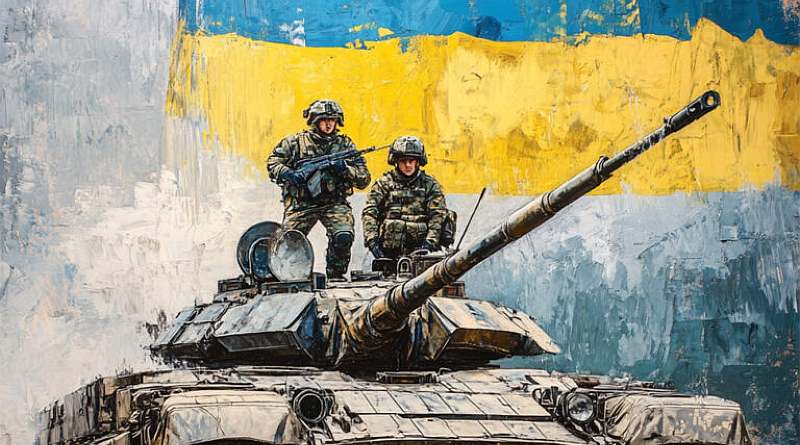
Illustration: War on the Rocks
