
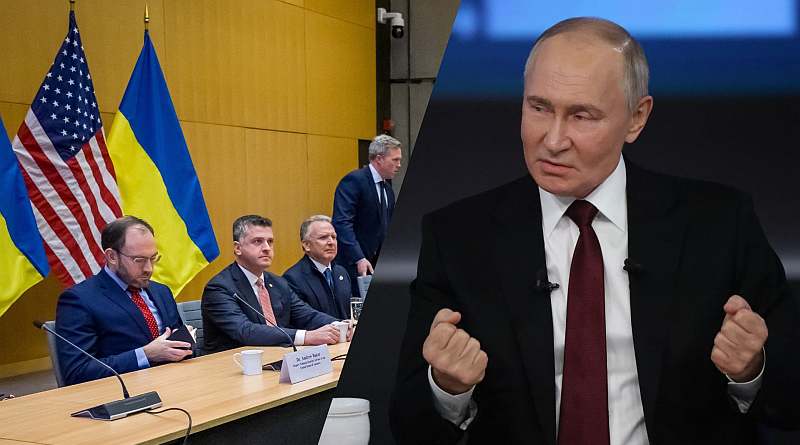

Understanding this allows us to roughly forecast the development of the negotiation process, particularly to answer the question of whether the war will end this year.
Russia’s key goals have remained unchanged since 2014: limiting Ukraine’s sovereignty, exerting decisive influence on its domestic and foreign policy, establishing the “Russian world” with the Russian language and the Russian Orthodox Church, and restricting the army, dismantling military production, and prohibiting NATO cooperation. None of these demands can be achieved through the occupation of Donetsk region or bombing power plants. These are political demands, and therefore, if they can be achieved at all, it’s only through negotiations.
When we calculate how many years it would take to occupy the entire country at the current pace of the war, we miss the main point: for Putin, territories themselves are not crucial. He views the advancement of the Russian army as leverage to achieve his political goals. Therefore, it is not critical for him that the army hasn’t managed to capture the entire Donetsk region in four years. Slow progress, according to the Kremlin’s plan, along with other elements of an attrition war, is meant to push Ukraine to capitulate on Russian terms.
Hence the role of Medinsky: his task is not to find a way out of negotiation deadlocks but to convince that further resistance is pointless. For Putin, negotiations are a way to cement his victory. He probably genuinely wants the war to end quickly, but only in the form of Ukraine’s capitulation. In his logic, the only thing that can be negotiated are the terms of this capitulation.
In this concept, it is important for Putin that negotiations continue. He will not exit them on his own initiative and will participate under any circumstances. Even if Russian generals are blown up or shot in Moscow every week, this will not affect Russia’s participation in the negotiations.
However, the problem is that Russia’s true goals today are unattainable either through military means or negotiations.
Militarily, Russia can still try to capture the remaining parts of Donetsk region. But then the question arises: what next? One can talk for years about Kharkiv, Dnipro, or Odesa, trying to cross the Dnipro and Southern Bug, but with current resources, it is unrealistic. Theoretically, the Russians can increase mobilization, but this carries unacceptable political risks for the Kremlin. If Putin hasn’t done this over the past four years, it’s unlikely he will do so now.
Even in the case of hypothetically imposing shameful capitulation terms on Ukraine in negotiations, there is no adequate way to control their subsequent implementation. The previous experience of Ukraine implementing the Minsk agreements demonstrated this clearly. Without a radical change in power in Kyiv to an openly pro-Russian one, any agreements to end the war practically won’t work. And the Russians understand this well. All ideas about “external management of Ukraine by the UN,” which Lavrov mentioned a few days ago, reflect the recognition of the negotiation process’s futility.
Thus, Putin cannot refuse negotiations since they are the only way to achieve the “SVO goals.” At the same time, signing any peace agreement, even one most favorable to Russia, but without mechanisms for its enforcement, will bring Russia nothing but the need to prepare for a new war. And starting a new war after a formal end might prove more difficult, especially if Ukraine receives security guarantees from the US and allies. Therefore, it is simpler for the Kremlin to continue the war, spending the remaining funds of the Russian budget on its maintenance.
At this stage, the war has no political resolution that could be achieved through negotiations. Therefore, unfortunately, the most likely scenario for 2026 remains the continuation of the war with parallel imitation of negotiations.
Collage: Channel 24
