
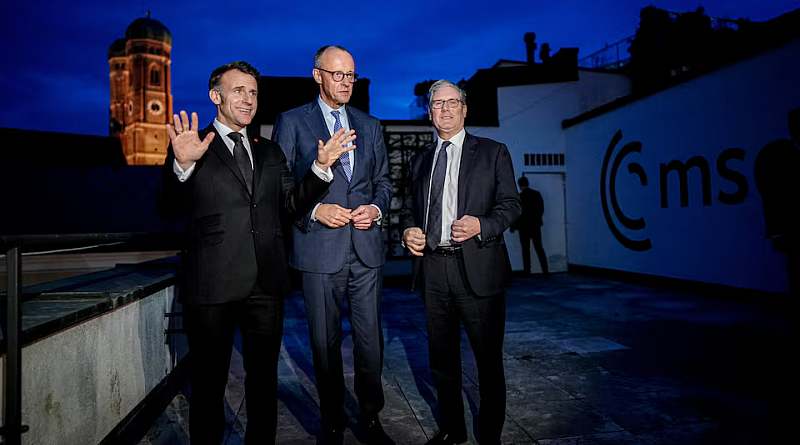

To wrap up the story with the Munich conference, let me gather a few points that we somewhat lost focus on.
1. I consider the speech by French President Emmanuel Macron to be the most underrated. There are many reasons for the underestimation and stereotypes.
Firstly, Macron is the world champion in making beautiful statements; he is truly a strong orator. Through his gestures and rhetorical techniques, he saves/earns colossal amounts of money for France. Therefore, his speeches are usually taken with a grain of salt, focusing solely on what he does.
For example, “no sooner said than done,” Macron called for everyone to more actively pressure the Russian “shadow fleet.” One wonders, what stopped him before, in the summer? What stops now from exerting systematic pressure instead of episodic urging?
Also, it was Macron who initiated the story about foreign troops in Ukraine two years ago. At this conference, MP Oleksiy Honcharenko posed him a fair question: “So, where are they?” Macron delivered a beautifully argued response “because it’s not the right time, kisses, hugs.”
Nonetheless, the conference went on in an auto-training mode for Europeans, “we are strong, we are rich, we are wow.” In this regard, Macron’s speech became an important part of the atmosphere. I think Rubio took this into account and structured his speech to maintain the mood.
Secondly, Macron will be the President of France only until May 2027. Macron’s personal rating is currently low, and in a year he will be leaving (he can’t run and it’s not clear if his policies will continue) – so why listen to him?
Stylistically, what Macron says resembles the speeches of former NATO Secretary-General Jens Stoltenberg in the last year of his tenure. The closer Stoltenberg got to his departure (being a master of public rhetoric and a true political shark), the bolder and brighter his speeches became. Notably, he pushed the idea of a $100 billion NATO fund for Ukraine. I wrote at the time that these were just nice noise effects before his exit and nothing more.
But for Stoltenberg, everything was already clear regarding subsequent employment. The Norwegians had been waiting for several years for him to stop dealing with NATO nonsense and start serious business at home. So Stoltenberg had no special motivation to maintain any vector.
Macron, however, has different motivations. At the end of his presidency, he will only be 49. He can still shine for the next 20 years in the top tier at a supranational level because he has already achieved everything in France, and it’s too early to move to the private sector with a pension package.
A preliminary path for him towards a position like “Minister of Defense of Europe” within the trend of federalization (with increased supranational powers) was outlined.
How it will turn out – we’ll see, but the logic he presents fits perfectly into the role of the “main European for defense.”
The thing is, the French are very cunning. They hide a high-tech, self-sufficient (!) global-level military industry behind smelly cheese and elegant cinema.
The French are cool engineers and large-scale industrialists, even though they pretend to be Cinderellas. However, the external environment is deteriorating for them. Plus, there is internal uncertainty. They are becoming vulnerable. The Chinese and Russians effectively filter out the charm and then bulldoze French positions in the same Africa.
France needs pan-European resources, and the battle for them has already begun. In the current position, Macron acted wisely by launching a network of formally pan-European defense projects, but with France at the core and with a hint that, as usual, the Germans will pay.
Thirdly, we often give in to the general mood of ridiculing Macron because he is objectively under the greatest pressure from global opponents. This is related not only to France’s ambitions, which exist in the format of a soft empire with overseas territories on all continents. It is also related to the powers of the President of France.
De facto, he is one of the strongest (semi)monarchs on the planet. Humorously, the President of France is also the Co-Prince of Andorra by position. But, as they say, he is (not) loved for other reasons.
He has an oceanic and space fleet, nuclear power stations, networks of influence. He can almost single-handedly authorize an air-sea nuclear strike and make many decisions inaccessible to other world leaders.
There’s not much point in outright destroying the Chancellor of Germany or the Prime Minister of Britain. The system will produce another. It’s worth attacking the tradition and system to make it start faltering.
The French have much more tied to the first person. Therefore, Trump, the Russians, and Erdogan regularly engage in personal attacks on Macron to undermine his ability to make quick strong decisions.
Given the above, Macron is motivated to fight for the pan-European project as a variant of his personal future. If the EU succeeds in the battle for subjectivity against the US, Russia, and China, Macron organically becomes one of the continent’s leaders.
If unsuccessful and the EU is undermined in its current form, Macron may claim the position of frontman for Europe’s reassembly on a revised basis.
In the worst-case scenario, he is already positioned as a lobbyist for a set of pan-European projects. So, for various reasons, it is interesting to record what he says.
2. Macron’s main message is that a united Europe must fight for the status of a geopolitical pole. This is uncharacteristic for Europe, but it is a requirement of the times. Practically, it means carving out this status in the struggle with other poles. “To be respected.”
To engage in negotiations with global players, Europe must ensure a strong position. And force consideration of European interests in the construction of a new security architecture.
Macron rightly points out that over the past year, Europe, along with partners from Canada, Norway, Japan, Australia, and New Zealand, has come a long way. Which should not be underestimated.
Today, Europe provides the lion’s share of financial support for Ukraine.
Europe finances the production of our goods, gives its own, and buys weapons for us from the US.
Europe is a key element of our defense, apart from living force.
Macron repeatedly uses the word derisk. A synonym in context is sovereignty and security.
Over the year, Europe has conducted a derisk procedure for the main processes of supporting Ukraine. The US can no longer threaten Europe with the collapse of support and chaos at the borders. They can cause harm, that’s true. But a year ago, the damage would have been shocking. Now there are options.
Europe is rounding off the energy derisk from Russia.
The next step is derisking the European model and removing main dependencies on the US.
What does this include in the defense sector? Macron lists:
• European nuclear deterrence (France, Germany, Sweden). The UK has strong ties with the US, so it’s on the side. For the same reason, the hands of the Poles are tied, who would not mind securing a place in the European nuclear narrative.
• A combat aviation platform with armaments (France, Germany, Spain).
• The new generation SAMP/T missile defense system (France, Italy, Britain).
• The JEWEL early warning space system for missile launches (France, Germany).
But this list is far from complete.
What this means is no more consumers for F35/F47, no more Patriot, etc.
Macron repeatedly emphasizes the need for unified European standards in the defense industry. This inherently makes France a favorite in this race, as the French possess many self-contained developments.
All of this is extremely ambitious and cannot help but cause significant heartburn in the US. Because a number of wealthy European countries (Denmark, Belgium, the Netherlands, Norway, Finland, to a large extent Germany, and others) are tightly “hooked” on American weapons. To restructure aviation and air defense takes decades and astronomical sums of money.
Macron also encourages Europe’s independence in AI issues, cloud research, critical minerals, space, clean technologies, and so on. In addition, he insists on the need to remove foreign social networks to reduce interference risks. For this, he is personally attacked by Trump, Vance, Rubio, Musk, so France is seeking approaches to Durov.
Overall, at the slogan level – it’s great. At the level of practice – there are nuances.
3. How does this concern us?
Macron openly says words that make people in Ukraine faint: how will we, Europe, COEXIST with aggressive Russia? He repeats the word coexist several times. It is not derogatory – it reflects the real situation.
Macron’s quote: “Geography will not change.” Moreover, Russians are actively mastering the European perimeter in the Mediterranean and North Africa, communicating with all villainous forces. A European strategy must be proposed.
Suppose Macron succeeds. Europe embodies the idea and carves out the status of a geopolitical power. Instead of a soft economic-cultural outline, a hard defense-security border emerges.
Where will it run? Will Ukraine be inside the European perimeter or outside the fence?
The Germans honestly say: guys, we like you, but you’re outside the fence. We will support you, you can count on it. Here’s money, Patriots, a bunch of irises, defend yourselves. No EU.
Macron creates an impressive fog. And just like the straightforward reptiloid Ischinger, but in a slightly different form, makes it clear that he does not expect a quick end to the war.
As a result, a configuration may arise in which Ukraine will be assigned the role of a periphery between geopolitical centers. A kind of space between the millstones, a wild field where elephants stomp.
Alternative approach – Chinese. It states: since there are too many of these Ukrainians, they are aggressive and stubborn, let’s spread them out into different shelters on formally Ukrainian territory, let them bark at each other, guarding logistical routes.
4. For a straightforward simplification, let’s look at the situation from Kharkiv again.
It’s ideal to live on a peaceful border. In Zakarpattia, it’s great. You can monetize four borders.
But living on a burning frontier is a specific role with colossal costs. No one in their right mind would want the frontier to run through their home.
Hence, Ukrainians, taught by spilled blood to cautiously handle beads and mirrors from outsiders, and to extract specifics from empty talk, INEVITABLY strive to push the frontier away from their territory.
The first option – conditional Kharkiv becomes the center from which a European veil is cast approximately to the Urals. And if anything burns, it’s somewhere on the Volga. This is the ideal scenario.
The second option – under the influence of an irresistible force, we turn around and begin to fight for the restoration of the Berlin Wall. So that, in the end, conditionally Kharkiv peacekeeping garrisons are stationed in Berlin, Plzeň, Salzburg, and Trieste. Let the wild alpine tribes fight.
Naturally, this is exaggerated. But that’s the logic. We are not at all satisfied with the role of the periphery, the main task of which is to burn.
Therefore, with full awareness of the scale of European aid, there remains a request – if not de jure, then de facto to be within the perimeter that generates European geopolitical power.
We have already existed in the mode of a wild field, shifting the frontier from west to south and east for 400 years. Then the reverse process occurred. The back-and-forth turmoil of the first half of the 20th century is too traumatic.
5. Therefore, we are formally interested in Europeans participating in the negotiation process.
Macron already quietly sent his diplomatic adviser Emmanuel Bonne to Ushakov in Moscow. With a public position: Europe must participate in discussing the security architecture that concerns it. What was actually discussed is not disclosed. Russian propaganda traditionally covered the visit in an extremely mocking manner as an act of desperation.
In those same days, French Foreign Ministry representative Brice Roquefeuil visited Minsk to explore the possibility of reviving relations with Lukashenko. Belarusians confirmed the visit only after a leak in the French media and in a correct form.
So Macron practically copied the moves of the US, only at the moment he has little to offer.
In Munich, Macron openly said: you can discuss “peace” all you want, if you wish, but without Europe, nothing will happen…
In general, nothing changes for now.
China adheres to a splendid formula for settlement:
1) respect for Ukraine’s sovereignty and territorial integrity;
2) ending the war through diplomacy by eliminating the “root causes of the conflict”;
3) peace based on respecting the security interests of all parties.
The main negotiations are conducted by the Armed Forces of Ukraine, the Security Service of Ukraine, the National Guard, and other structures of Ukraine’s Defense Forces. European privateers might get more actively involved in trimming down the Russian “shadow fleet.”
Since the president instructed to prepare the air defense – it’s a reason for everyone to prepare.
Get water. Pre-emptively fry cutlets. And manage to fall asleep before the shelling begins 🙂.
