
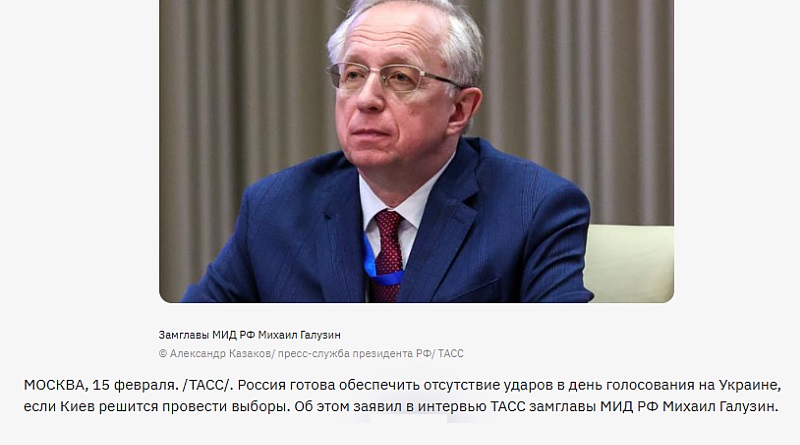
In this statement from the Russian Ministry of Foreign Affairs about their willingness to “ensure no strikes on voting day,” it showcases both Russia’s misunderstanding of democratic elections and their insidious plans to “internalize” the conflict. In other words, what has not been accomplished since 2014: turning the conflict into an internal Ukrainian issue.
Firstly, elections are not just about voting day. It’s about the campaign, agitation, and discussions. All stages are important. Democratic standards must be observed, with both internal mutual and competent external observation.
Without this, elections are not elections but a Russian-style sham.
By the way, this became a trap for Russia in Minsk. They demanded “elections” in the temporarily occupied territories, “of course, democratic.” And this is where they were caught.
Democratic elections require security at all stages; freedom of candidacy and campaigning; unobstructed and free voting. The Copenhagen Document of 1990, those very “OSCE standards,” by which it is determined whether elections are free and fair. Meaning whether they are elections whose results must be respected, or “elections” recognized only in “Moscow.” Hence the requirement—”security first.” It all makes sense for democratic countries—and Russia remains with its understanding of Minsk as “foisting Trojan horses under our control onto Ukraine.” And without security—sanctions, pressure, and the need to seek a way out.
There was talk of peacekeepers then. Unfortunately, in 2019 Yermak was sent to the negotiations, who quickly agreed to read the agreements in the Russian way. And when it fell through after protests in Kyiv, the Russians were very offended.
But they are stubborn and constantly strive to bring their designs to fruition.
Therefore, secondly, they demand the holding of “elections” precisely during the war, i.e., under martial law.
Besides the impossibility of holding elections democratically under such conditions, several other factors come into play. The impossibility of voting (at least full voting), let alone candidacy, for the military. Complications for refugees voting abroad: during the war, they are unlikely to return, and organizing the voting of over 6 million overseas is a non-trivial task. Questions will also arise for IDPs.
All this, combined with undemocratic processes, calls into question something extraordinarily important: the legitimacy of the elections. Recognition of them as honest and fair both in the world and, most importantly, by Ukrainians themselves.
And finally, thirdly. Considering all these circumstances, the Russians dream that at least some of them will trigger an internal conflict in Ukraine.
Especially considering the “preparation” already launched by the authorities: “sanctions” against Poroshenko, monopolization of the information space, the “go” command to the collective “state bureau of repression” and the like. All this plays into the Russian scenario of discord and division.
Therefore, the task of Ukrainian diplomacy is not to agree to “elections” without a choice, hoping to “win” them, then “navigate” to remain in chairs, but to communicate the dangers of this scenario to partners.
The only possible path to legitimate, democratic, free, and fair elections is through straightforward logic. First—security. This means a ceasefire; lifting martial law; conducting all preparatory work to create the right conditions (however long it takes, but let the experts decide—there’s a whole working group in the Rada). And only after that—elections.
European elections. Under close international observation, mutual control, and in accordance with all democratic standards (without “sanctions,” pressure, and falsifications).
Such elections pave the way to lasting peace, revival, and Europe.
It’s clear that Russia disagrees. Not for this did they lose over a million of their own dead and maimed and ruin their own economy and future.
But Russia needs to be forced into this. How? Well, you are the government. You said you know. So, do it.
Can’t do it? Well, the proposal for a unity coalition and rescue government hasn’t been withdrawn. Enough of resisting, clinging to your autocracy, and letting yourself, and all of us, be led to a disaster staged by Russians.
UPD: I’m consciously not writing about the second part of the statement by the sector head of the Russian Ministry of Foreign Affairs about “external management.” It’s an old Russian trick—to add something absurd and unfeasible to the demands, to later present dropping it as a “great compromise” and “gesture of goodwill.”
