
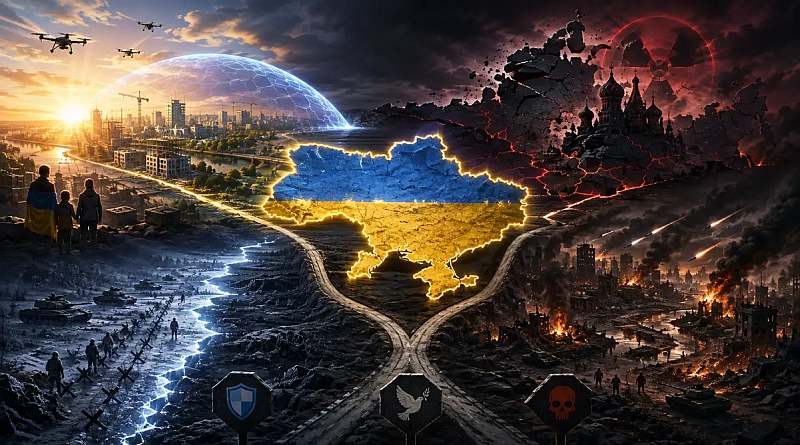

PoByeda.
We laughed at the attempt by American envoys to paint a victory for Putin by changing the borders of two Ukrainian regions. But if we think seriously: what could be considered a victory for Russia at this point?
What could Russia gain in the worst-case scenario for us and the best for itself to consider it a victory? I remind you, a victory in a war can be considered a result after which the country’s position becomes better than it was before the war.
So, suppose Ukraine is further devastated (its economy and infrastructure); more Ukrainians, both military and civilian, are killed; an occupation or collaboration regime is established over this ravaged country. But, as Ukrainian history shows, besides collaborators, there will be insurgents who will weaken the authority with their actions.
So, what will all this give Russia, besides an additional burden on its already weakened economy and overloaded regime? Will it compensate for Russian human losses (the largest since World War II)? Will it restore the destroyed infrastructure and weakened economy? Will it help attract investments for their restoration?
Why should the West lift sanctions from Russia or even invest in its recovery, strengthening their already direct enemy? To stop the war? It has been stopped – at the doorstep of the West.
The Russian threat to NATO will become much more obvious if the Russian army reaches the borders of the Alliance along Ukraine’s current western border. This will force at least some NATO countries (those closest) to mobilize for their own defense, which will increase the threat of direct confrontation with the Alliance. And Russia has not yet recovered from the exhausting war with Ukraine.
Beijing’s support for the current war against Ukraine can be considered, in particular, a way of gradually weakening Russia and increasing its dependence on China. Thus, after the “victory,” it would be better to complete its mission with a weakened neighbor rather than to strengthen it again for some reason.
In the world after the “victory,” Russia is seen as a country still feared for its crimes in Ukraine, but which is no longer trusted anywhere for the same reasons. It no longer has the world’s second army and is certainly not a reliable partner. Russia is a wounded beast better put down than waiting for its last convulsions, which can still be dangerous.
If victory is when things are better after the war than they were before, Russia’s last such victory was the annexation of Crimea: new territories, no punishment, and a convincing narrative for many in the world about “return.” Since then, its situation has only worsened: it was not possible to fully capture Donbas in 2014–2022, and Ukraine could not be quickly subdued with a massive strike afterward.
Our victory today is already the mere absence of a Russian victory and the factual impossibility of it in the future. Before the war, Russia seemed capable of changing its position in the world for the better. Now – no. In this respect, our position, despite the terrible price, has become better.
But the fact that a Russian victory is already impossible does not guarantee that we will not suffer a defeat. We still have much to do to not lose. And then, to ultimately win.
Illustration generated by AI
