
Ivo Daalder / Translation by iPress
The former US ambassador to NATO and senior fellow at the Belfer Center at Harvard University, Ivo Daalder, argues that Jared Kushner’s attempts to propose a new “security architecture” for Europe stem from a faulty diagnosis: the current order has not collapsed – it is being systematically destroyed by Russia. From the Baltics and Moldova to Georgia and Ukraine, Moscow has violated principles it pledged to respect for decades. According to the expert, new mechanisms for consultation, transparency, or arms control will not stop aggression if the Kremlin does not intend to adhere to agreements. Therefore, the US should not seek a new order, but protect the existing one – by arming Ukraine, strengthening sanctions against Russia, and reinforcing European security guarantees. Jared Kushner does not understand the problem he is trying to solve.
Jared Kushner believes the problem is with the European security order. In reality, the problem is Russia’s attempt to destroy it by force.
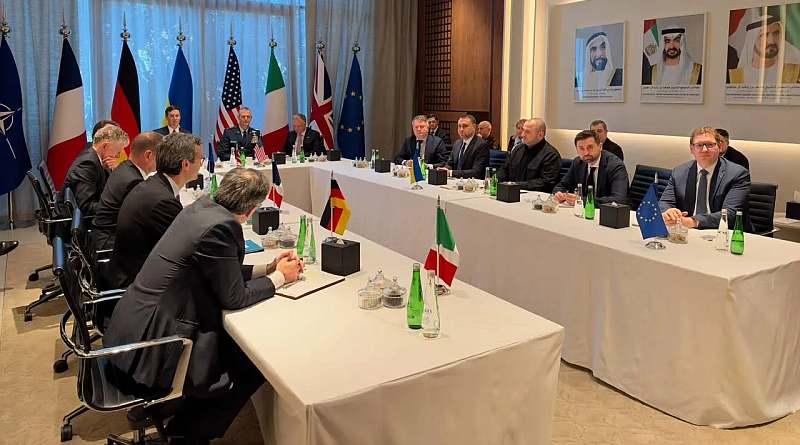
Jared Kushner does not understand the problem he is trying to solve. He believes the war in Ukraine is a result of issues with the European security order: that old agreements supposedly failed, and thus something new must be created. For this reason, when Ukraine, Russia, and the United States met in Abu Dhabi on November 10, Kushner’s focus was on a new “security system” for Europe. “Obviously, something is not working,” a senior US official told Politico. “We need to create something new that will work under current conditions.”
Today, something indeed isn’t working. But the problem isn’t with the European security order. The problem is that Russia is trying to destroy this order by force.
Kushner’s ideas about a new security order, including those in the joint statement he agreed upon with Europeans on November 10, contain nothing new. Continuous security consultations. Crisis communication. Military transparency. Risk reduction of escalation. Respect for sovereignty and territorial integrity. Each of these principles is already part of the existing European security order, enshrined in the Helsinki Final Act of 1975, the Paris Charter of 1990, the Treaty on Conventional Armed Forces in Europe, the Vienna Document, and other agreements. Moscow signed them all.
Like Molière’s Mr. Jourdain, who was surprised to learn that he had been speaking prose all his life, Kushner discovered the Paris Charter – and seemingly believes he’s the one who wrote it.
However, the problem isn’t the Paris Charter. The problem is Russia. For 35 years, Moscow has been undermining the order it pledged to recognize as its own:
- Baltic States. In January 1991, less than two months after Mikhail Gorbachev signed the Paris Charter, Soviet troops and tanks stormed the TV tower in Vilnius, killing 14 unarmed civilians. A week later, Soviet special forces attacked the Ministry of Internal Affairs of Latvia in Riga, killing five more people.
- Moldova. In 1992, Russia’s 14th army supported separatists in Transnistria in a war against the government of newly independent Moldova. At the OSCE summit in Istanbul in 1999, Moscow promised to withdraw its troops by the end of 2002. Over two decades later, about 1,500 Russian soldiers remain in the country against Moldova’s will.
- Chechnya. Two wars – the 1994-1996 conflict and the one that began in 1999 – claimed the lives of tens of thousands of civilians. Grozny was razed to the ground. The second war was instrumental in Putin’s rise to power.
- Georgia. In August 2008, Russia invaded Georgia and then recognized Abkhazia and South Ossetia as “independent.” Russian troops still occupy a fifth of Georgia’s territory.
- Ukraine. In the 1994 Budapest Memorandum, Russia committed to respecting Ukraine’s borders in exchange for Kyiv’s renouncement of the world’s third-largest nuclear arsenal. Twenty years later, Russia annexed Crimea and invaded Donbas. In 2022, it initiated the largest war in Europe since 1945.
- Arms Control. Russia secretly deployed a missile banned by the Intermediate-Range Nuclear Forces Treaty. In 2007, it suspended participation in the Treaty on Conventional Armed Forces in Europe, and in 2023, it withdrew from it. It circumvented the Vienna Document requirements, concentrating troops under the guise of “exercises” – as was the case around Ukraine in 2021. It also withdrew from the Open Skies Treaty.
All this happened not because Europe lacked hotlines or transparency measures. It happened because Putin never recognized the post-Cold War order. In 2005, he described the dissolution of the Soviet Union as “the greatest geopolitical catastrophe of the century”. In Munich in 2007, he made it clear that he rejected the post-Cold War order. In December 2021, he demanded that NATO withdraw its forces to the positions they held in 1997 and promised never to accept Ukraine into the Alliance.
And it’s not just about NATO. As I have already written, Putin fears not a military threat from neighbors the most, but a political one: successful, prosperous democracies on Russia’s borders that might inspire Russians to demand the same. That’s why he suppressed dissent at home—imprisoned and killed opponents, closed independent media, declared civic organizations as “foreign agents,” and rewrote the constitution to allow himself to rule until 2036. Abroad, he supported authoritarian leaders: aiding Alexander Lukashenko in brutally suppressing protests in Belarus in 2020 and sending troops to Kazakhstan in January 2022 to quell an uprising.
That’s what Putin means when he talks about the European “security architecture.” He doesn’t want a new order. He wants to destroy the current one—and with it, the right of neighboring states to independently choose their governments and alliances.
In January 2022, Washington and NATO responded to his demands with proposals for transparency, arms control, and risk reduction. A month later, Russia invaded Ukraine. Kushner’s list closely resembles the responses given to Putin then. Moscow rejected them at the time. It will reject them now. That’s why the talks in Abu Dhabi will lead to nothing.
There is only one way to end this war. If Russia stops shooting, the war will end. If Ukraine stops shooting, Ukraine will cease to exist.
When Iraq seized Kuwait in 1990, Washington didn’t offer mediation between Baghdad and Kuwait City. It didn’t propose a new security system for the Persian Gulf. It called aggression aggression, rallied the world against it, and achieved its cessation.
This is the approach the United States needs now. To abandon a strategy that has yielded no results for almost two years. Stop posing as an impartial mediator between the aggressor and its victim. Stop pressuring Ukraine and Europe alongside Moscow to force them into concessions. Instead, defend the European security order, as every American president from Truman to Biden has done. Arm Ukraine so that Russia cannot win on the battlefield. Strengthen sanctions so that Russia cannot afford to continue the war. Back up European security guarantees for Ukraine with American power. Make it clear: aggression doesn’t pay off.
Until Kushner, Vitkoff, and Trump understand this, there will be no ceasefire, no end to the war. We do not need a new European security order. We need the United States with the will and capacity to defend it when a state like Russia tries to dismantle it.
In the image: Negotiators from the US, Europe, and Ukraine at a meeting in Abu Dhabi, November 9, 2026. Photo: Rustem Umerov/X
