
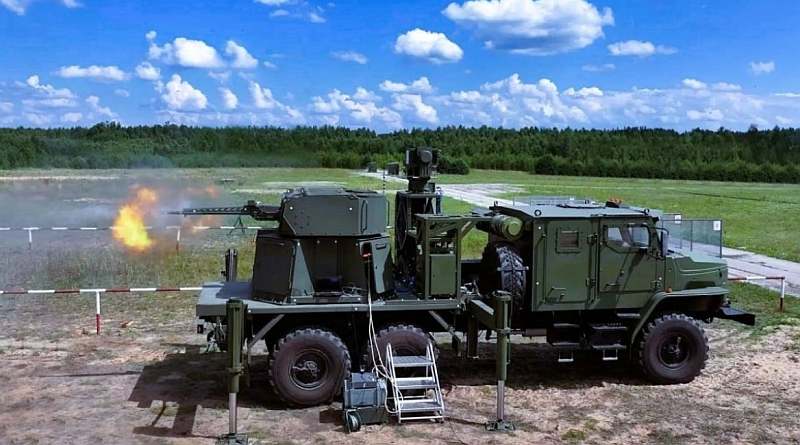

Russia has developed an analogue of “Skynex”! Whoa, hold your horses, what?
So, Russia has presented a mobile version of the ZAK-30 “Citadel” anti-aircraft artillery complex, primarily designed to combat UAVs, strike drones, and generally subsonic, slow-moving targets.
A few details about the system:
Chassis – heavy army truck “Tornado-U”;
Range for engaging aircraft-type UAVs – up to 1,000 m (for “Skynex” up to 4,000 m); Range for engaging fpv-drones – up to 800 m (for “Skynex” over 1,000 m); Ammunition load – 300 shots (for “Skynex” 252 shots); Fire control – automated, with remote control option.


And now, the most interesting part…
The weapon is a 30-mm automatic cannon of an unspecified type, but it’s most likely the 2A42, adapted to the “Spica” module. Here, several questions arise about the accuracy of this cannon, widely used from Russian BTRs and BMPs to Mi-28 attack helicopters. It is not accurate. Compared to “Skynex,” which involves a reliable and highly accurate 35-mm Oerlikon Mk3 cannon.
Of course, the “mount” that has been added to the 2A42, especially from the “Spica,” will help compensate for the barrel’s sway, but accurate firing at small targets from 800 meters?
And then another interesting point follows.
It is stated that the 30-mm AP uses ammunition with programmable air detonation, which increases the likelihood of hitting small UAVs without direct hits. This leads to the main comparison between the ZAK-30 “Citadel” and “Skynex,” which uses AHEAD technology.


AHEAD is well-documented, known for the principle of ejecting pre-formed tungsten sub-projectiles in front of the target.
About the Russian ammunition, it is known to have a shrapnel core and programmable detonation, but open technical data on the number, mass, and configuration of sub-projectiles is insufficient for an objective comparison. Therefore, it can’t be stated that the Russian projectile is worse or better than AHEAD. But considering the inaccuracy of the 2A42, questions about the effectiveness of such a system already arise.
Therefore, calling the ZAK-30 “Citadel” an analogue of “Skynex” is unprofessional.
Yes, Russia is currently attempting to create a number of solutions to combat low-flying, slow-moving targets, but limitations in technical, technological, and engineering solutions mean that in none of its products can it even approximate the parameters of Western counterparts.
Nevertheless, attempts and the adversary’s desire to solve their short-range air defense issues should not be dismissed and should be viewed as prospective challenges, rather than problems of today. For the present day, this is too raw, unverified in terms of parameters and capabilities, with many questions about its real characteristics and quality of execution.
In the image: Mobile version of the Russian anti-aircraft artillery complex ZAK-30 “Citadel.” Photo from open sources.
