
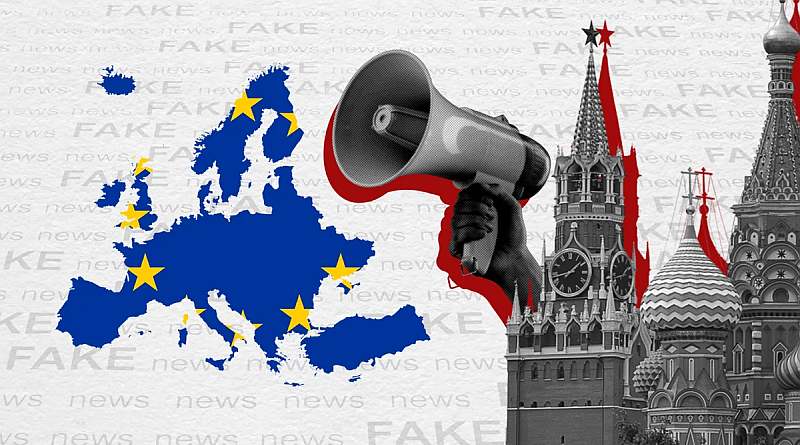
In 2022, the Russian presidential administration led by Sergey Kiriyenko created a large-scale disinformation network called Doppelgänger, which spreads fake news about Ukraine and Western countries. Hundreds of people are involved in the operation: from professional propagandists and deepfake designers to agents organizing provocations in Europe.
This is according to an investigation by The Insider, which studied internal documents and correspondence of the network’s participants.

Who runs the Russian disinformation network
The initiator of the creation of Doppelgänger was Deputy Head of the Presidential Administration of the Russian Federation Sergey Kiriyenko. Among the key project curators are Alexander Kharichev, responsible for disinformation about Ukraine, and Sofia Zakharova, who coordinates the spread of fake news in Western countries.
The “Social Projecting Agency” (SPA), headed by Ilya Gambashidze, became the direct executor of the campaign. The team uses fake websites of well-known Western media, false publications, and bot networks to promote Russian narratives and present fictional stories as journalistic materials.
According to the investigation, hundreds of people are involved in the work. Some fabricate texts in different languages, while others create deepfakes and staged videos. Using artificial intelligence, propagandists determine topics that may provoke the greatest social resonance in a particular country.
Fake news about Zelensky and attempts to influence Western politics
One of the directions of the campaign was spreading false information about Ukrainian President Volodymyr Zelensky and his family. In particular, internal Kremlin reports included reactions to fake news about expensive jewelry and clothing of First Lady Olena Zelenska.
Additionally, resources associated with Doppelgänger spread fake news in 2023 about the alleged purchase of real estate in Cannes, Dubai, and Madrid by then Defense Minister Oleksii Reznikov and his close ones. These messages appeared amid real corruption scandals involving procurement for the Ukrainian army.
The network also worked on discrediting Ukraine in European countries. In early June 2024, its participants were tasked with preparing materials for discreditation ahead of the parliamentary elections in France and the Olympic Games in Paris. Among the proposed topics were threats of terrorism and infections.
Fake videos, screenshots, and photos in the ASP are called “augmented reality” or “special messages.” The ASP developed a separate guide for creating fakes, which includes video manipulation and staged shoots. Propagandists could add elements to frames using computer graphics, replace faces with deepfakes, revoice videos according to pre-written scripts, and use chromakey.
Another method was creating staged videos with actors who recreated the necessary scenarios. Such materials were filmed both in other countries and in Russia, where props were used to mimic German, Italian, or British environments. If necessary, the filmed scenes were further processed with computer graphics to give fabricated stories the appearance of real events.
From Fake Websites to Sabotage in Europe
The initial Doppelgänger campaigns covered at least Germany, Italy, and the United Kingdom. Russian structures created counterfeit websites of well-known publications, promoted them through paid advertising, and left fake links in comments under real articles. Ads on Meta services were paid through the ASP and a related group of companies called “Structure.”
After the breakup of Yevgeny Prigozhin’s troll factory in 2023, the Doppelgänger network began to expand rapidly. Earlier that year, the Kremlin launched a separate campaign against Ukraine, initially called “Uganda.” Its main tasks were to discredit the Ukrainian military-political leadership, divide the elites, demoralize the Armed Forces of Ukraine, and disorganize the population.

At the same time, the activities of structures associated with the project were not limited to informational operations. According to The Insider, people connected to Harichev and the SPA participated in organizing training camps in Europe. There, operatives were trained for various operations — from interfering in elections in Moldova to provocations and sabotage in Western Europe. Specifically, in the Balkans, neo-Nazis and football fans learned to operate drones and attach explosive devices to them.
Illustration from public sources
