

Relays in Kyiv for reactive “shaheds” and unimplemented solutions of the previous command.
In principle, some groups in the GS and MO don’t really like me, not because I say something untrue, but more because there is a tradition in the army not to talk about one’s own mistakes and those of senior officers. The army is a caste system with incredible experience in ignoring obvious problems. And considering that the same team was responsible for innovations in recent years, a lot of mistakes have accumulated.
And we will talk about the next mistake. Since the current situation has begun to highlight them most vividly.
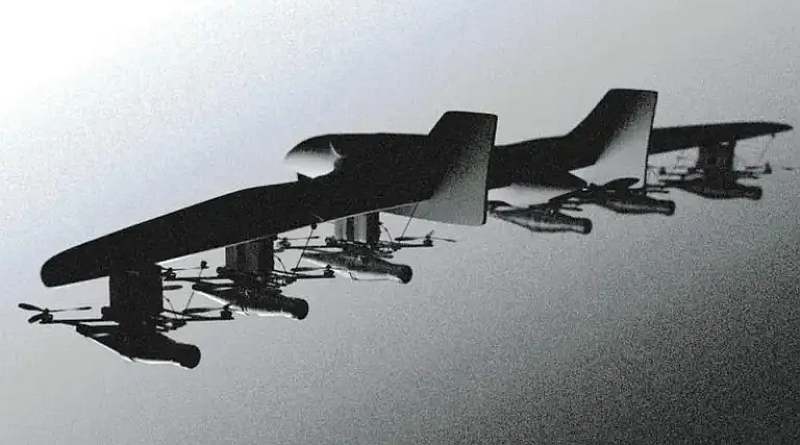
As you’ve seen in my posts and comments, I was skeptical about placing interceptor drones on carrier drones. Meaning, having a large drone fly for hours with interceptors under its wings and dropping them from a height towards an enemy drone. This method would allow interceptor drones to reach the needed altitudes faster and conserve battery power to have a larger reserve for acceleration. Both advantages are very necessary now with the emergence of reactives. And for some reason, I didn’t promote this idea. Maybe Marco didn’t understand this topic, right?
No, dear ones. I understood perfectly. I believe in these solutions.
I didn’t believe that the previous command could implement it. As the classic says, don’t shoot the pianist, he plays as he can. And our pianist has started drinking, so it’s funny to demand anything fitting from him.
The topic of “mules,” i.e., drones with the function of carrying useful loads for various tasks, has been discussed among specialists for a long time. Even in the GS, some people would come and say: Well, come on, dear ones. Well, you are colonels and generals. You are people with a strategic level of education. Surely, you know the history of mastering the skies. Attack aviation appeared first (in our case, FPVs fulfill this task), with the task of striking ground equipment and structures. Bombers also appeared (in our case, “baba-yaga” drones fulfill this function). To counter them, the function of interceptor fighters was formed (in our case, interceptor drones fulfill this function).
What did aviation do in response?
Correct, it started flying above the ground (F-111) or climbing to high altitudes (U-2), i.e., countering high-altitude targets, which are now analogs of the “Geran-4,” and targets flying while taking cover with the terrain (Banderol, Geran-5).
To counter such means, the next step in evolution was made. AWACS aircraft (A-50), high-altitude carrier aircraft with anti-aircraft means (MiG-31), and radio reconnaissance and jamming aircraft appeared.
And so the system became balanced. AWACS aircraft could see much farther than ground-based systems and complemented the picture from ground detection systems. Low-flying targets ceased to be a problem. The speed and altitude of targets became secondary because the systems detected them from afar and had time to react, and height was no longer a saving grace. And EW/Electronic Attack aircraft also guaranteed non-kinetic counteraction to the systems.
And which of our drones perform these functions?
Ah, damn, none. We sit and wait while Russia takes the first steps, and then we will catch up because that’s the path of innovation leadership of the General Staff.
These proposals were submitted to the General Staff. We explained the necessity. But… Everything stalled because our leaders thought about the problem and realized they couldn’t implement it for the following reasons:
1. They do not know how to implement it in the drone component, and they are not ready to provide opportunities to drone specialists because there is a structure—well, there’s a colonel, colonel, general, why are you trying to tell us how to do our work? And who cares that we ourselves don’t know how. There’s subordination and hierarchy.
2. They do not have people on staff who can take on the implementation of such projects.
3. They do not want to change the existing EW/EA/ABM system because then they would have to change staff structures, introduce positions for UAV specialists and their commanders, provide support, develop functional tools, create the necessary software, organize an effective “friendly/foe” system so our air defenses don’t shoot down our own drones during missile-drone attacks, and many other nuances.
And what does management do when they cannot implement necessary decisions? That’s right. They effectively pretend these decisions don’t exist and that there is no need to do this, and just generally, go to hell. Did we meet the needs for Bukovel? Yes. Did we create yet another program duplicating existing coordination programs? Yes. Did we sign the order for the unit to deploy to the combat zone? Yes. Well then, we’re great, so we efficiently distributed “Bohdanas” among our friends, gained a bit of military pension experience, and everything’s fine, we keep serving. Until, of course, everything collapses, and the RF overtakes us, but there people are also good at wasting time, their experience spans years.
Just as a marker. As you know, triangulation is used to detect radio sources. But it has some limitations on accuracy.
Therefore, our partners, at the time when “Rubicon” was introduced, provided us with more modern EW tools that worked by the TDoA method. This was an extremely necessary tool for us because it was necessary to counter “Rubicon”. And the tool is awesome, as the Intelligence Service took it and quickly integrated it in limited numbers for their tasks.
What did the General Staff do? They started figuring out how and whom to send for training to England. Then looking for someone who knew the language. Then how to arrange a business trip. Then something else. And the process stalled. Every three months, General Staff representatives would come to the Intelligence Service and say, “In short, do for us what you did for yourselves, but for the entire army!”
To which they received the reply: Get lost, we have a limited number of specialists, and you have a collective of people who should be doing this per your staffing lists. It’s your task, so get to work and do it.
Well, and the corresponding result. The resources the army desperately needed lay idle in warehouses for a year. The army even asked to distribute them directly to brigades, saying they would figure it out themselves, find someone to send for training and sponsors to pay for trips out of pocket, but no dice. Who the hell is responsible for innovations here? We are! Well, there it lies in our warehouses. And the higher leadership, in principle, “forgot” about “Rubicon” when boasting about their super-efficient management. Just blocked communication on the topic “What are you doing about combating Rubicon?” You can check the General Staff page for 2025, you won’t find anything on this topic.
The development of “mules” should proceed step by step. First, lift means into the sky that would carry SIGINT antennas. Because we need to detect sources of radiation/data exchange where terrain or buildings obstruct it. Yes, you’re right, we need such means to detect insurgent relays.
These means need to be linked/coordinated with other coordination systems.
Then do the same with radars, both classical and synthetic. Integrate with classical ground detection systems.
Then deploy “mules” with interceptor drones.
Then drones with EW means, because the Russians are already making CRPA with 16-24 antennas, and to counter them effectively, they need to be suppressed from above, not just below. All this needs to be coordinated into a universal system.
And then this will build a stable and effective detection-counteraction system in conjunction with ground means.
Do you know what was done from this?
Nikita
Igor
Havronia
Ulyana
Yakov
Yes, nothing. People realized they couldn’t pull off such a project, and they buried it, waiting for Russia to do it, and then copy it. Meanwhile, they awarded each other for everything possible.
The commander-in-chief arrives at the brigade, gets photographed, approaches the brigade commander like a father, and asks: What do you need help with?
He says: We lack means against drones.
Commander-in-chief: Hmm, we’ll sort it out now.
Calls Kyiv: Yes, allocate two “Bukovels” here and… – turns to the brigade commander. – Are there any Dambs? How many do you need? Aha, and five Dambs. Good, good, – turns to the brigade commander. – They’ll be here in a week, they’ll issue them today.
– Thank you, Commander-in-chief!
And everyone is satisfied. The brigade commander. And the commander-in-chief, well, because he’s doing something, people are grateful, everyone is working. And the people in Kyiv responsible for all this, they perform, they do everything, the right people, here’s a couple of “Bogdans” for you.
And such a system existed for years. Doing what it could, within its intellectual capabilities, and ignoring as much as possible what fell outside the limitations of those intellectual capabilities.
And now we’re here. And Mark reads how various cosmonauts write about interceptor drone carriers and laughs to himself. You can’t build a Ferrari at AvtoVAZ. What are you talking about? If you’re saying this without understanding the conditions under which all this is happening, then you’re amateurs. Strategy is worthless without tactics. Unfortunately.
There are even preliminary developments at manufacturers. They didn’t develop because no one will create complex expensive means that the General Staff and Ministry of Defense don’t need. This isn’t FPS games, here you need conditions, specifications, functionality, interaction, and other requirements. All of which the manufacturers were never given.
So why was Marko not impressed with GS innovations, really. Need to think again — why is that. Why did I criticize the REP/REB service? Indeed.
Although… Why think. Look out the window and see for yourself. There are amazing markers of the overall efficiency of this system outside right now. Well, I hope it satisfies everyone, but not me.
Because the Russians have made their evolutionary step in the functions of the sword. And we remain at the 2024 level in the functions of the shield.
P.S. If the word “mule” becomes common in the world of drones, please remember who mentioned it first 😉.
On the cover: Mother drone with 6 FPV drones on board. Photo: UNITED24
