
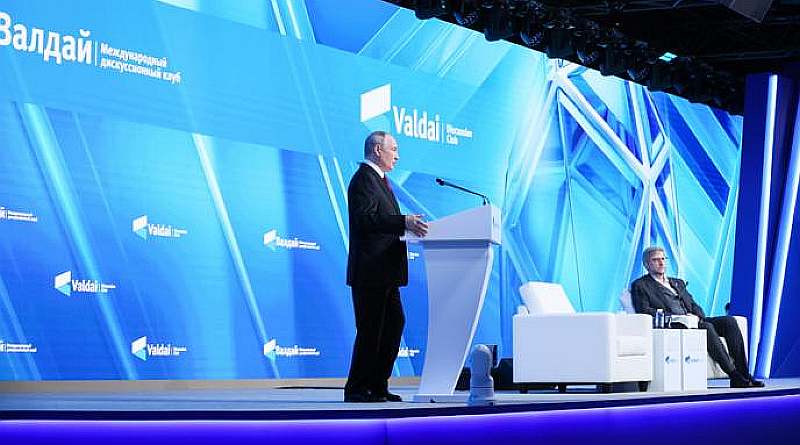
At the request of Putin’s security service, the Valdai Club meeting was moved from Sochi to the Moscow Region due to the threat of attacks by Ukrainian drones, reported Financial Times. This year, at the Valdai meeting, the head of Russia, Vladimir Putin, threatened the world once again, stating that Russia “did not start the war,” and that it was a response to NATO’s actions and Ukraine itself. What else did Putin say, and how did Ukrainian analysts interpret his speech? Read on to find out.
The Russian leader Vladimir Putin said on October 1, in response to questions at the Valdai discussion club, that Ukraine should remain a neutral state.
According to him, this is because it is written in the declaration on the basis of which Ukraine “gained independence.”
“The declaration states that it is a neutral state. We have always… believed that Ukraine is a neutral state. And then suddenly they amended the Constitution with the goal of joining NATO. But that is a completely different story, including for the security of the Russian Federation. And this is also one of the reasons for the ongoing conflict,” Putin stated.
The leader of Russia is referring not to the Act of Declaration of Independence of Ukraine adopted on August 24, 1991 (this document did not contain a direct reference to neutral status), but to the Declaration of State Sovereignty of the Ukrainian SSR adopted a year earlier, on July 16, 1990.
At that time, still a Soviet republic, Ukraine declared its intention in this document to become a permanently neutral state in the future, which would not participate in military blocs.
Ukraine continued to adhere to this principle for more than two decades. The provision on the “irreversibility of the Euro-Atlantic course” was added to the Constitution in February 2019 — five years after Russia’s war against Ukraine began in February 2014, occupying Ukrainian Crimea and part of Donbass.
Russia’s aggression was cited as the reason for this decision by Ukraine’s fifth president Petro Poroshenko.
Putin on nuclear weapons
Russia’s leader, Vladimir Putin, in his speech at the Valdai club session compared nuclear weapons to a rifle hanging on the wall. The leader of Russia described the situation in Europe and the world as “very dangerous,” again accusing Western countries of aggressive intentions and providing a historical overview, contemplating the reasons and consequences of the USSR’s collapse.
Putin warned that in the current international situation, such a scenario is possible that would lead to “fatal consequences.” He reminded that several countries possess weapons “capable of destroying all living things,” evidently referring to nuclear weapons. “Can we be sure that such weapons will not be used?” Putin posed a rhetorical question and answered it negatively.
He compared this weapon to a gun hanging on a theater stage, which, according to a well-known saying, must fire during the play. “The laws of survival apply not only in the natural world but also in social communities,” Putin noted, stating that Russia might be forced to resort to extreme measures. At the same time, he mentioned that it is necessary to ensure that this gun does not fire.
Putin stated that wars will continue to exist but called for them to be conducted “humanely” and for a new convention on warfare to be developed considering the development of artificial intelligence. He recalled Soviet officer Stanislav Petrov, who in 1983 did not act according to protocol after receiving a signal about a nuclear attack. According to Putin, artificial intelligence would have acted differently.
Speaking about the war in Ukraine, Putin repeatedly said that Russia “did not start the war,” and it was a response to the actions of NATO and Ukraine itself. He has reiterated this argument multiple times. Most countries of the world consider the Russian invasion of Ukraine an unprovoked armed aggression.
“If it comes to a direct attack”
Putin speaks against the backdrop of rising tensions in relations between Russia and European countries. Responding to questions about recent threats from Moscow regarding the Kaliningrad region, Putin said, “This is not intimidation. It’s a response to attempts to intimidate us.”
“If it comes to a direct attack on the Russian Federation, the question of using all means will inevitably arise,” Putin said. He noted that Russia has fewer forces and means than Europe, and therefore Moscow will use its “competitive advantage” in case of war. At the same time, Putin declared that Russia “threatens no one.”
Putin also responded to questions about possible strikes on military enterprises in Europe. According to him, Moscow considers the involvement of Western countries in strikes on Russian territory as a threat. He stated that Russia will not necessarily strike Europe but will “monitor threats.”
How NATO assesses the nuclear threat from Russia
Latvian Defense Minister Raivis Melnis told Radio Liberty that he does not currently see an immediate nuclear threat, and the main concern is Russian hybrid attacks. “At the moment, I do not see a direct threat,” said Raivis Melnis.
When asked if the risk of using nuclear weapons against the Baltic countries has become real, NATO Secretary General Mark Rutte answered on September 30, “No, it has not.”
Rutte stated on September 29 that the alliance’s responses to Russian hybrid attacks are not always public.
“Regarding the word ‘hybrid’ – I have repeatedly said that it sounds somewhat soft and innocent. Ultimately, it involves ‘gray zone’ tactics: these can be drones, sabotage, or even cyberattacks,” Rutte said in Brussels.
He emphasized that NATO has all the necessary response options.
Russia’s Statements on Kaliningrad and NATO’s Reaction
Russia warned NATO countries that Russian military forces might use all means, including nuclear weapons, if there is an attempt to cut off the Russian Kaliningrad region from the rest of the country. On September 28, Reuters reported this, claiming to have seen the text of the relevant document. Later, the information was confirmed by a NATO spokesperson to Radio Liberty.
The Russian Embassy in Belgium published a text dedicated to the “escalation of the military-political situation around the Kaliningrad region” by NATO countries. It mentions that Russia is concerned about “provocative statements” regarding Kaliningrad and NATO exercises practicing offensive operations.
The message indicates that this increases the risk of “direct armed confrontation,” with “Russia ready to use its entire arsenal of weapons available to defend its territory in the event of attempts by NATO countries to isolate the Kaliningrad region from the rest of the country.” The text does not mention nuclear weapons, but the reference to the “entire arsenal” apparently points to this possibility, writes the Russian service of Radio Liberty.
NATO spokesperson Allyson Hart told Radio Liberty that Russia engaged in “irresponsible nuclear rhetoric,” noting that the Alliance had already given a formal response, condemning the threats of force. She also pointed out that NATO’s actions do not threaten Russia, and emphasized: “We have everything necessary to defend every inch of allied territory, and we remain strong, ready, and capable of countering any threat.”
Ukrainian Analysts on Putin’s Speech
Vadym Denysenko, head of the “Business Capital” analytical center, wrote on his Facebook page:
“The essence of Putin’s speech is very simple: Ukraine must surrender, Europe must negotiate with the Russian Federation to avoid a major war. In essence, we heard nothing new, and the quintessence of the speech boils down to the points that:
– Russia will continue the war as long as Putin deems necessary;
– everyone thinks Russia will capture Donbas in a year and a half, so why defend it;
– if anyone tries to capture Russia, there will be a nuclear strike (spoiler – there won’t be);
– let’s negotiate and there won’t be a major war.”
Denysenko also noted:
“Putin has a very strong eschatological mindset, and he views the next six months as a kind of battle of ‘good and evil,’ where he will defeat everyone and achieve the main goal of his life – the collapse of NATO and the EU. This won’t happen. But he believes in this, and it is an important psychological aspect for understanding how the situation will further develop.”
Head of the Board of the Institute of World Politics, Viktor Shlinchak, notes on Facebook :
“Apart from the traditional and already overused phrases (about the root causes of the war, NATO expansion, the ousted Yanukovych from Ukraine, and the evil Europe that wants to kill angelic Russia), Putin described how he sees the future world. And this – at least something new from this entire stream of elderly consciousness.
The first and foremost. Putin practically said – don’t expect a quick return to some “normality,” conflicts will continue, and the world has entered a long period of restructuring. Why is this important? Because it means that Moscow no longer sells the illusion to the world that we will soon see substantial peace negotiations. Russia will live in a new reality – and this means trying to fight and threaten (or not) with all kinds of weapons, including nuclear.”
Analyst Shlinchak also wrote:
“Putin’s political technologists wrote his speech as if we don’t exist at all. Because he is not at war with us. Because we, as Putin says, are ‘controlled by the West’ (one would say, if only that were true). And I truly believe that in his talks, there is more trading about his place at Trump and Xi’s table than about what he plans regarding Ukraine. The question is, are they ready for this and do they understand the consequences?
In the mind of the tsar, it’s all about where he stands, where is the bowing of heads before the Russian onslaught, and where is his recognition as a world leader. He is fighting for this now, killing hundreds of thousands of lives. Isn’t the price too high for the grandeur of a thug from the back alley?
100 km from where Putin was speaking, a fire broke out at a chemical plant
A major fire occurred at the Krasnozavodsk chemical plant in the Moscow region on October 1st. Local residents claim that at least one powerful explosion preceded the fire, reports RusNews.
The news Telegram channel Shot wrote that during the explosions and fire, seven people died and one of the plant’s buildings was completely destroyed. A Telegram channel close to law enforcement Mash reported that 44 people were inside the plant, 40 of whom were evacuated, and the search was ongoing at that time.
According to the channel “Caution, News”, the preliminary version suggested it was a “technical incident.”
Krasnozavodsk is located 100 km from Istra, where Vladimir Putin spoke at the Valdai Forum on the evening of October 1st.
This year, the Valdai Club meeting was moved from Sochi to the Moscow suburbs. This decision was made due to security concerns amid intensified Ukrainian drone attacks, according to Financial Times, citing four sources. The venue change was conducted at the request of Putin’s security service, two of them added.
According to FT, the move reflects growing Kremlin concerns that Putin could be at risk from Ukrainian drones.
The Krasnozavodsk Chemical Plant is part of the state corporation “Rostec” and fulfills orders from the Russian Ministry of Defense, the Ministry of Internal Affairs, and other security agencies. The plant specializes in signal and lighting devices, aircraft protection means, and anti-terrorist tools. In 2025, this plant was subjected to strikes from Ukraine.
Source
Copyright © 2021 RFE/RL, Inc. Reprinted with permission from Radio Free Europe/Radio Liberty
Photo: Occupying media
