
The Russian drone shot down by NATO fighters over Lithuania may seem just another episode of the great war. Especially since, according to the preliminary version of the Lithuanian authorities, the drone was not intended to attack Lithuania. It was flying to Ukraine and deviated from its course. But such “accidents” best demonstrate how the geography and nature of the war are changing.
Putin started this war with the belief that it would remain solely a Ukrainian problem. Russia would bomb Ukrainian cities, destroy Ukrainian infrastructure, seize Ukrainian territories, and NATO countries would watch what was happening from the sidelines and argue among themselves about how much weaponry could be given to Kyiv without provoking Moscow.
However, war does not recognize those political borders invented for it in offices.
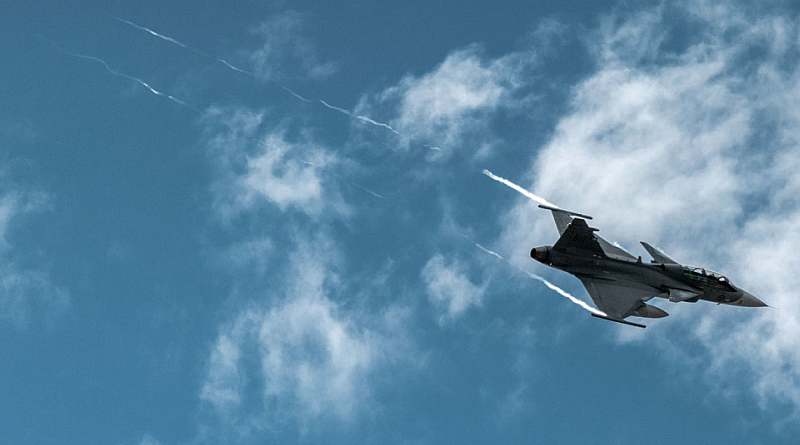
The Russian drone entering the airspace of a NATO country is not the first occurrence. But it is the first time it was destroyed by an Italian fighter on a North Atlantic Alliance mission, not by Ukrainian air defense. This is not yet a confrontation between Russia and NATO. But it’s already a situation where the consequences of the Russian war are directly eliminated by NATO forces.
And here a simple question arises: how many more such episodes must occur for Europeans to finally understand the obvious?
You can talk as much as you like about the need to avoid escalation. You can convince yourself that the war exists somewhere between Kharkiv and Donbas, and that the main thing is not to let it approach the borders of the European Union. But Russian missiles and drones are not obliged to respect this psychological boundary. They can lose control, deviate from the course, end up over the territory of a neighboring state. And at some point, it may become impossible to confidently say whether the next violation was an accident or a test of NATO’s readiness to defend its own space.
This is why the significance of the Lithuanian episode is not in one downed drone. The significance is that NATO did what its member countries’ citizens should expect: detected a threat and destroyed it. Without endless and pointless discussions about whether Russia will be irritated by the mere fact of resistance.
Putin has built his policy for many years on the West’s fear of direct confrontation with Russia. And this fear truly existed and continues to exist. But the longer the war continues, the more opportunities for such a confrontation Russia itself creates.
Lithuania did not send a drone to the Russian border. It was a Russian drone that ended up over Lithuania.
NATO did not start a war in Europe. Russia started a war against Ukraine.
And with each passing day, the distance between Russian aggression against Ukraine and the necessity for NATO countries to defend their own territory becomes ever smaller.
On the screen: On the night of September 15, NATO fighters shot down a drone over Lithuania for the first time. Photo: NATO
