
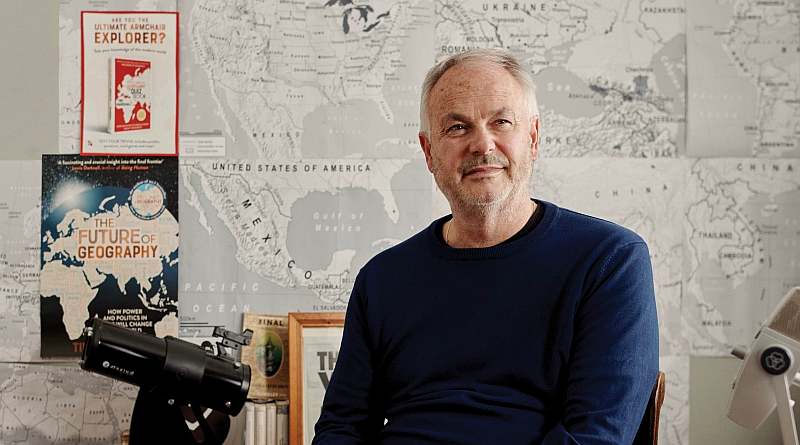
Tim Marshall is a British journalist and author who specializes in foreign policy and international diplomacy. He has thirty years of experience covering conflicts such as the Balkan wars, wars in Afghanistan and Iraq, as well as the events of the Arab Spring.
Marshall is the author of several books where he explains global processes through the lens of geopolitics. Notably, his book “Prisoners of Geography,” published in 2015 and updated eleven years later, became a bestseller. In it, the author reveals how geographical positions influence the politics of states and their international relations.
Tyzhden spoke with Tim Marshall about the main thesis of this book — the role of geography in shaping the behavior of countries, as well as what might change its impact: technologies, political will, alliances, or societies’ ability to adapt. We specifically address Russia, the future of European security, and Ukraine’s war experience.
— In your book “Prisoners of Geography,” you start from the idea that geography limits a state’s choices. Mountains, seas, rivers, plains, resources, and the location of neighbors determine what a country can or cannot do. But doesn’t this concept create a dangerous temptation to perceive aggressive state behavior as almost inevitable? If geography helps explain why Russia seeks to control the space around it, where does its influence end and the political leadership’s responsibility for choices begin?
— The map does not lie, geography simply “is.” Whether rightly or wrongly, the location “encourages” aggressive or indeed defensive strategies — this does not change the reality of topography. Russia’s geography partly explains, but by no means justifies its behavior. Political leaders are responsible for their actions. If both Ukraine and Russia were modern liberal democracies, it is doubtful that geography would prompt Moscow to initiate its illegal aggression, as liberal democracies generally do not fight one another. However, Russia as a dictatorship, as it mostly was and will be, does not offer compromise, morality, and legality supremacy over territorial ambitions.
— You say that technologies do not cancel, but rather change geography. Then aren’t we on the verge of a moment when technologies — drones, long-range missiles, satellite reconnaissance, artificial intelligence — begin to alter the strategic value of territory? If a country can strike far beyond the frontline, how important does physical distance remain?
— Drones, particularly long-range ones, are a good example of why geography remains crucial. What’s the difference between considering a range of 20 miles and 1000 miles when designing and refueling a drone? Just the distance, and in both cases, it’s about the geography of the target. Yes, technologies have not changed the strategic value of territory, but they have changed which parts of it are valued more.
For example, just as during World War II, Russia relocated a significant part of its industry beyond the Urals, now it must analyze where it can place facilities beyond the range of drones. The further they are located, the more time defense systems need to detect and attempt to neutralize them. Moreover, drones have changed logistical lines. Instead of one large supply line that can be targeted, there are numerous small points from which drones can move smaller volumes directly to where supplies are needed. All this continues to be based on geography.
— Has the Ukrainian experience prompted you to reconsider something in your own view of states as “prisoners of geography”? If so, what exactly and why?
— No, it has only strengthened my convictions. For example: if to the west of your “fortress cities” there were vast mountain ranges and rivers, you could at least consider a chance of retreat from them for tactical reasons. Considering that to the west of them there is practically nothing to stop a rapid advance by Russia now or in ten years, you have little choice but to defend them.
— You predict that without strong guarantees, Russia may return—and among the potential next targets, you mention Estonia, Georgia, and Moldova. Does this mean that today’s war in Ukraine actually determines the future security architecture of the entire Europe?
— Yes, the outcome will have a significant impact on the security architecture. Imagine that Ukraine suffers a devastating defeat, and then the Europeans fall apart. At what point would Germany, under the leadership of “Alternative for Germany,” start appeasing Moscow? How would Hungary react upon seeing Europe allow aggression to prevail? Would Portugal fight for Estonia, and so on? That is why for non-Ukrainian Europeans, the outcome is of great importance. Russia will end this war strong enough to start a new one in X years. That is why the security conditions in the final agreement are so important, and Europe must take a principled position on this issue.
— So if you look at Russian policy through a geographical lens, the question arises: will Russia ever be able to build a security model that does not involve controlling or dominating neighboring states? Or does its geographical position shape strategic thinking so strongly that conflict with neighbors will actually be reproduced regardless of the individual leader of the Kremlin?
— As I have already mentioned, if Russia becomes a liberal democracy among the family of European democracies, the issue of territory will lose its significance. There is little reason to believe that this will happen in the foreseeable future. Therefore, it will continue to try to dominate and control. This is not pessimism, but a probable reality, based on the example of the last 500 years. All said may seem negative, but it does not mean that Ukraine cannot defend itself, end the war, and prepare for a future in which sufficiently strong deterrence allows maintaining peace.
