
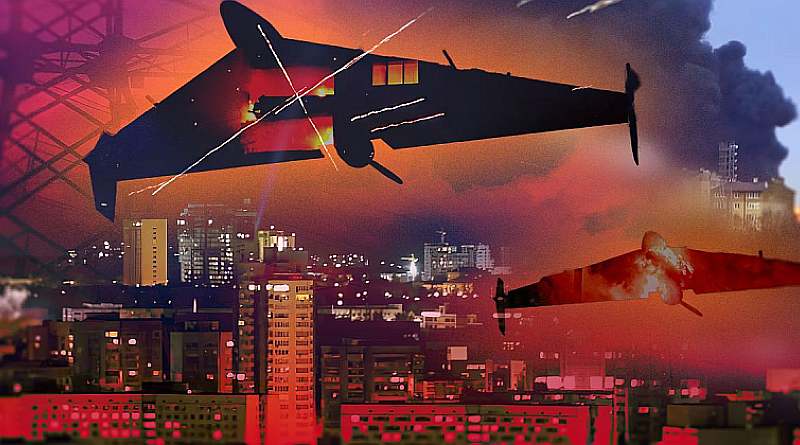
Germany is under attack but does not know how to respond. The news that a Russian military intelligence officer (GRU) and a Belarusian are suspected in the sabotage at Leipzig airport last month, which nearly turned deadly, highlights both the defense gaps and the lack of deterrents. The Russian (who entered from Turkey and then left for Serbia) was immediately identified upon arrival as connected to the GRU. However, German authorities lacked the resources for surveillance. (Many will be outraged that a person with such a background was allowed to enter the Schengen area at all.)
The Belarusian (whose name is also not disclosed under German data protection laws) entered through Latvia. Nothing was known about his intelligence connections, but he had convictions in Lithuania and Finland. So why let such a person in at all? Most likely, he was a “one-time” agent hired to do the dirty work: attaching a powerful plastic explosive weighing 1.8 kg to drones targeting a Ukrainian transport plane carrying 25,000 liters of aviation fuel. A terrible disaster was narrowly avoided by pure chance.
In West Germany, which I remember from my youth, attacks of this type were common. In the 1970s and 1980s, the leftist Baader-Meinhof gang carried out numerous deadly bombings, shootings, and kidnappings against military, industrial, and other targets. The authorities responded with great (some say excessive) determination: large-scale surveillance, suspect hunts, and raids on suspected hideouts were organized, supported by anti-terrorism laws that expanded police powers and ensured high-level inter-agency cooperation.
However, the Baader-Meinhof group (also known as the “Red Army Faction”) did not pose an existential threat to the German state. It had some support from the “Stasi” secret police in East Germany, but was little more than a “footnote” in the Cold War struggle. The wave of Russian state terrorism currently engulfing Europe is quite different. It is part of a grand plan to dismantle NATO and destroy the US-led security order that has guaranteed safety, freedom, peace, and prosperity to Western Europe since the late 1940s (and has covered almost all of Europe since the 1990s).
However, Germany (as well as other countries, including Spain, France, and Belgium) do not take the threat seriously. In 2024, Germany took no action when American intelligence exposed a Russian assassination attempt on Armin Papperger, CEO of Germany’s largest arms company “Rheinmetall.” This sent a clear signal to the Kremlin: you can continue to attack us.
Currently, the German authorities have closed the Russian consulate in Bonn and the cultural (read: propaganda) center “Russian House” in Berlin; strengthened travel restrictions, and called on the EU for tougher sanctions. This is by no means sufficient. At the Riga Conference last week (an annual Latvian security event), among over a hundred diplomats, intelligence officers, politicians, officials, and security experts, I found not a single participant who believed Germany’s response would deter future Russian attacks. So they will continue.
The policy of deterrence—and its absence—in this “below-threshold” war was the main topic of the conference. How can Germany and other European countries make Russia realize that the tactics of violence, lies, bribery, and intimidation will cost it too much?
Let’s forget about “standard” reactions. The solution: retaliate in concert with allies. Disable a Russian provincial bank via a cyberattack. Launch a few drones so an airport has to shut down. Block “intermediaries” helping to circumvent sanctions by filing lawsuits and denying visas. Seize Russian central bank assets and transfer funds to Ukraine.
All of this is neither easy nor risk-free. But the alternative is more attacks, ever worsening.
Collage: TSN
