
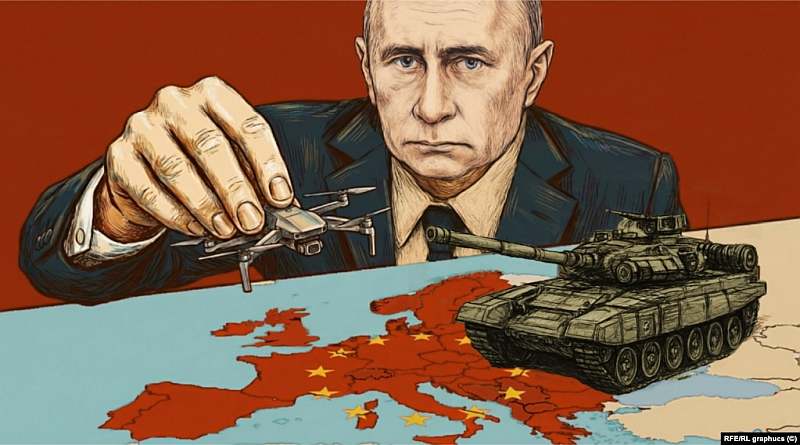

In the last few days, there have been too many strange happenings around NATO’s eastern flank to consider them separately.
The Pentagon urgently asked the Polish Minister of Defense to postpone a visit to the US due to a situation requiring “urgent NATO security measures.” If Washington believes that the minister should remain in Poland alongside the military, there may not be many reasons for this.
Simultaneously, Russia suddenly imposed a curfew in areas near the Estonian border, close to Narva. Latvia and Poland have repeatedly scrambled fighters to intercept Russian drones over their territory.
Meanwhile, Zelensky “accidentally” meets with the CIA director at an Irish airport, where they converse face-to-face without witnesses.
The US is also becoming more active. They are not only posting about “peace in exchange for diesel.” Much more importantly, for the first time, the Trump administration approved a military aid package for Ukraine worth $2.68 billion. And this is not symbolic help: the list includes missiles, anti-drone systems, radars, spare parts, and more.
This is why the war is called “hybrid”—it’s hard to determine when it started and whether it has really ended.
According to European media, since the beginning of 2026, NATO’s eastern wing countries have scrambled fighters 570 times to counter Russian drones. Five years ago, such activity would almost certainly have prompted at least NATO consultations under Article 4 of the treaty, but today, this is already a daily routine.
For five years, Russia has simultaneously claimed it is fighting against NATO and assured that it does not plan to attack European NATO member countries. This is also the logic of hybrid warfare: gradually intensify attacks while allowing Europeans to convince themselves that it is not yet a reason to respond more harshly.
However, there is an important nuance: the war continues regardless of whether you want to participate in it or not. And the sooner you start responding, the more chances you have not to lose.
It is evident that NATO was not created to counteract hybrid warfare. Therefore, against the backdrop of external militarization, we see almost complete helplessness against sabotage in airports, explosions at military factories, attacks on critical infrastructure, assassination attempts, election interference, and more.
So the sooner Europeans accept this reality, the better. Because Russia is no longer asking whether Europeans are ready to fight. It is gradually accustoming them to the idea that war could be nearby, but without a declaration of war, without tanks crossing borders, and without a formal moment when one can say: “now it has begun.”
And the longer NATO searches for the line between a “hybrid attack” and “war,” the more chances that Russia will define this line itself.
Illustration: Radio Liberty
Copyright © 2021 RFE/RL, Inc. Reprinted with permission from Radio Free Europe / Radio Liberty
