
Olesya Zhigalyuk, BBC News Ukraine
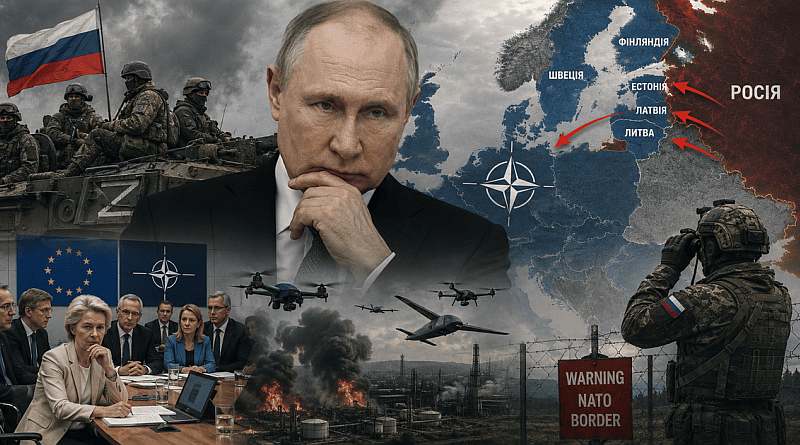
If Russia is really preparing for war with NATO, is Europe preparing for a threat that Moscow is not yet able to realize? This question is posed in Newsweek’s analysis.
Amid Belarus’s military exercises near the Suwalki Corridor and warnings from European intelligence, the publication explores whether Russia has enough resources for a direct confrontation with NATO.
At the same time, CNN explains why European countries are preparing even for the worst-case scenario despite Russia’s problems with its army, economy, and technologies.
The Russian army is already exhausted by the war in Ukraine
The first problem for Moscow is obvious: the war in Ukraine has already taken a huge toll in terms of people and equipment, Newsweek points out.
According to the Center for Strategic and International Studies (CSIS), from February 2022 to June 2026, Russia lost about 1.4 million military personnel. Up to 450,000 of them may have died. The International Institute for Strategic Studies (IISS) estimates the number of Russian casualties at more than 300,000.
And the situation is not improving.
In 2026, Russia loses approximately 30-34 thousand military personnel monthly, while recruiting about 27 thousand. The IISS also notes a decline in recruitment rates since the end of 2025.
More importantly, what is the Russian army achieving at the cost of these losses?
According to CSIS, during major offensive operations this year, Russian troops advanced an average of only 50-90 meters per day. Newsweek compares these rates to the Battle of the Somme — one of the largest and bloodiest battles of World War I.
In April and May, Russia even lost more territory than it gained.
This is crucial for a potential war with NATO. If the Russian army faces such difficulties in a war against Ukraine, a direct confrontation with a much more powerful coalition would be a completely different challenge.
Russia is increasingly dependent on China
There is another problem — Moscow is increasingly tied to Beijing.
According to Bloomberg, over 90% of sanctioned technologies are supplied to Russia through China. In 2024, Chinese goods accounted for 57% of Russian imports.
Meanwhile, China is significantly less dependent on Russia.
The US Congressional Commission explicitly pointed out that this dependence actually works “one way.”
A telling example is the “Power of Siberia-2” gas pipeline story. In May 2026, talks between Vladimir Putin and Xi Jinping did not lead to the expected agreement. The more Moscow needs Beijing, the more opportunities China has to set its own conditions.
Moreover, Xi Jinping has not promised Russia direct military support and continues to advocate for a negotiated end to the war.
Analysts from the Royal United Services Institute (RUSI) emphasize: a major war between Russia and NATO does not align with China’s interests. It would increase the risk of nuclear escalation, hit the European market, and could complicate Chinese plans regarding Taiwan.
The Russian economy “cracks” under the pressure of war
The war is costly for Moscow not only in human resources.
In the first quarter of 2026, the Russian economy contracted by 0.3%. The government already lowered the growth forecast for the entire year from 1.3% to 0.4%.
On September 11, the Central Bank kept the key rate at 14%, and inflation stood at 6.3%.
At the same time, Ukrainian strikes on Russian oil refineries affected export revenues from oil products. In August, they fell by 32%.
To support the oil refining sector, Moscow has already paid companies almost 916 billion rubles in subsidies.
The liquid funds of the national welfare fund are also decreasing. By mid-2026, they amounted to about $48 billion compared to $117 billion before the full-scale invasion.
The difference with NATO is also huge. In 2025, Russia spent about $190 billion on defense. The combined defense expenditures of NATO countries amounted to $1.58 trillion.
Nuclear Weapons Deter
The only thing that fundamentally changes the picture is nuclear weapons.
On February 5, the START-III treaty ceased to be in effect. For the first time since the 1970s, Russia and the USA were left without mandatory restrictions on strategic nuclear arsenals.
Russia also suspended participation in the inspection system back in 2023.
But the nuclear factor works both ways.
NATO includes three nuclear states – the USA, the United Kingdom, and France. Five more Alliance countries host American B61 nuclear bombs.
In March, French President Emmanuel Macron announced the strengthening of the French nuclear potential and consultations with the United Kingdom and Germany. Meanwhile, the United Kingdom is purchasing 12 F-35A fighters capable of carrying nuclear weapons.
At the same time, the Russian nuclear program also faces challenges.
SIPRI highlights difficulties in modernizing the Russian arsenal. In 2025, another test of the “Sarmat” missile failed. Among the reasons for the program’s issues, the institute cites sanctions and the war against Ukraine.
Russia Lacks Modern Technologies
Another weak link for Russia is the production of modern microchips. The country does not have sufficient domestic capabilities, so it tries to circumvent sanctions and obtain necessary computer equipment through intermediaries and unofficial channels. These components are particularly needed for the creation and modernization of strike drones.
Here, Russia significantly lags behind the USA in terms of technological resources. Private American investments in artificial intelligence alone totaled $285.9 billion in 2025. Additionally, the Pentagon requested another $53.6 billion for the development of autonomous systems and drones in the 2027 fiscal year budget.
There are also problems with Russian claims about creating autonomous drones. A study by the Center for Strategic and International Studies (CSIS) of one of Russia’s leading drone manufacturers showed that Moscow’s declared capabilities do not fully match what has actually been deployed.
Russia talks a lot about drones capable of operating autonomously and working in “swarms,” but in practice, there is still no large-scale application of such systems.
If Russia Is Weaker, Why Is Europe Preparing for War?
Despite all the problems of the Russian army and economy, Moscow may still try to test NATO’s strength, writes Newsweek.
According to American intelligence estimates, the most dangerous period for the Alliance could be from the fall of 2026 to 2029. However, a large-scale ground invasion is considered the least likely scenario.
CNN highlights that Moscow may escalate gradually—from sabotage and cyberattacks to drone or missile strikes—without immediately starting a full-scale war.
In such a scenario, the Suwalki Corridor holds particular significance. If Russia, with Belarus’s support, attempts to seize a small piece of NATO territory, the question arises how the Alliance will respond and whether it will be ready to enter into direct military confrontation with a nuclear state.
NATO Secretary General Mark Rutte states that the Alliance is rehearsing such scenarios and will respond to an attack. Meanwhile, CNN notes the uncertainty regarding the U.S. reaction in the event of a limited conflict.
Thus, the main question for Moscow may not be whether Russia can defeat NATO in a major war, but whether it can find a weak spot in the Alliance and test its readiness to act together.
As Newsweek cites Chatham House analyst Keir Giles, “the only way for Moscow to know if Article 5 works is to test it.”
Collage: TSN
