
Zoryana Stepanenko / Radio Liberty
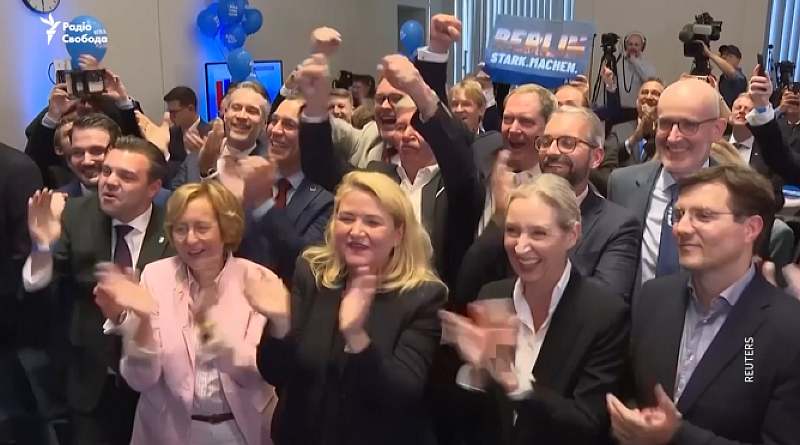
On September 20, regional elections in Germany concluded with yet another victory for the “Alternative for Germany.” In Mecklenburg-Vorpommern, located in the east of the FRG, the far-right party finished first with a result of 38.3% of the votes. Slightly behind them were the Social Democrats, gaining 35.5%. Meanwhile, Chancellor Friedrich Merz’s Christian Democratic Union did not even overcome the five percent threshold to enter the regional parliament. The CDU fell short by 0.1 percentage points.
What does this mean for Ukraine, whose leading donor of military assistance is Germany?
This is the first instance in post-war German history where the CDU does not make it into the regional parliament. Chancellor Merz called the defeat of his party a “catastrophe” and is preparing to apply an “antidote.” German analyst Markus Zinner, however, does not rule out the resignation of the current head of the German government.
“It’s the economy, stupid”
“It’s a wonderful evening for the ‘Alternative for Germany’… The numbers clearly show: people want change. We have been entrusted with the governance of Mecklenburg-Vorpommern,” says Leif-Erik Holm, aspiring to become the prime minister of the region, in a celebratory speech.
He is unlikely to achieve this position, as other parties refuse to form a coalition with the right-wing AfD. However, the very fact of the far-right’s victory in the second German region is a strong blow for the chancellor’s party, which may have far-reaching consequences.
If after the historic triumph of the “Alternative for Germany” in Saxony-Anhalt a few weeks ago, Friedrich Merz spoke of “deep shock,” now his rhetoric is even more dramatic. The chancellor, whose potential resignation is being discussed by German politicians and media, speaks of a “catastrophe” but continues to insist on unpopular reforms.
“Trust in our country’s institutions is declining, and it is actively undermined by radical parties both on the left and the right… But that is why we can no longer postpone these decisions. Reforms must happen… I would even go further and say that these reforms are the antidote to the authoritarian poison that, along with the fascination with authoritarianism, is penetrating deeper into our society,” Merz stated on September 20, summarizing the grim election results for his party.
The head of the German government indicates that he does not plan to resign.
“I take on this responsibility (for reforms – ed.) because I want to move our country forward,” Merz declared in the same speech.
Senior analyst at the German Marshall Fund, Markus Ziner, believes that the election result in Mecklenburg-Vorpommern, as well as Berlin, where the “Left” finished first, indicates the weakness of the Christian Democratic Union – a party that relatively recently dominated German politics.
On September 20, its supporters, watching the voting results on the screen at the headquarters in Berlin, couldn’t hold back tears. Angela Merkel from the CDU led the country’s government for 16 consecutive years. Friedrich Merz has been in office for 16 months.
“To be honest, I wouldn’t bet on the chancellor remaining in position for much longer,” Ziner notes in a comment to Radio Liberty.
Whoever from the ruling coalition replaces Merz, the internal course, the expert adds, is unlikely to change. The leading economy of the European Union needs reforms.
“If we don’t do this, the country won’t be able to restore economic growth. And this, in my opinion, is the main reason for dissatisfaction. People usually vote for parties of the far left or far right spectrum when they are dissatisfied with the economic situation. Here, the old phrase of Bill Clinton: ‘It’s the economy, stupid,’ is still relevant,” Ziner explains the political trend in Germany.
Ukraine, Russia, and “Alternative for Germany”
“Alternative for Germany” advocates for the cessation of arms supplies to Ukraine, against its accession to NATO and the EU, and envisions Ukraine as a “neutral state” in the future.
The party demands lifting economic sanctions against Russia, restoring full trade relations with Moscow, and supplying Russian gas, particularly through the repaired Nord Stream pipelines.
In domestic policy, AfD advocates for sharply limiting migration and strengthening border controls, deporting those who have no right to remain in the country, lowering taxes, and social contributions. This has resonated with a significant portion of voters in Saxony-Anhalt and Mecklenburg-Vorpommern.
“Why are we sending millions and billions abroad, getting no return from it here? We have plenty of children and elderly people who need support,” says a voter near a polling station in Mecklenburg-Vorpommern.
“We need fairer wages and affordable housing rent… It’s become very hard to afford anything,” complains another local resident.
Markus Ziner explains that in East Germany, where “Alternative for Germany” has managed to win the sympathy of some voters, there is a historical affinity towards Russia.
“There is a kind of illusory idea that if we become friends with Russia again, we could once more import cheap Russian gas and this will revive our economy… Many people still don’t realize that it is no longer possible to return to the old times. Even if we stop supporting Ukraine, it will change little,” the German analyst emphasizes.
Co-chair of AfD Tino Chrupalla stated on September 21 that for the party “good relations with all major powers” are important: Russia, the USA, and China.
“This is exactly what Germany, as a middle power in Europe, was lacking: the willingness to engage in this discussion again, particularly about the possibility of once again receiving affordable energy resources from Russia, which gave us a competitive advantage,” he added.
On September 18, Reuters, citing sources, reported that Chrupalla and AfD co-chair Alice Weidel are preparing negotiations for 2027 with Putin’s representative, Kirill Dmitriev, about the possible resumption of Russian gas supplies to Germany. Representatives of the AfD and Dmitriev did not comment on this information to journalists.
“If Weidel did so, she would be behaving as if she already played a leading role in the federal government of Germany, and she is still far from that. So, it’s not worth dramatizing the situation too much,” Ziener told Radio Liberty.
The Kremlin considers the results of local elections in Germany “natural.”
“Germany stopped buying cheap Russian gas and switched to purchasing very expensive gas… Naturally, Germans, or at least some of them, are looking for an alternative to the current leadership,” Kremlin spokesperson Dmitry Peskov stated on September 21.
Co-chair of “Alternative for Germany” Tino Chrupalla, after the elections in Mecklenburg-Western Pomerania and Berlin, stated that Chancellor Friedrich Merz should go to Moscow for negotiations. According to him, Germans want a “different approach to peace and diplomacy.”
Publicly, the head of the German government did not respond to this call. However, he has repeatedly stated that he sees no genuine readiness for peace from Russia and advocated maintaining and strengthening sanctions pressure on Moscow.
AfD and National Elections
Even before the state elections in Berlin and Mecklenburg-Western Pomerania, Politico learned that high-ranking members of the CDU were privately discussing the possibility of changing the chancellor to halt the rapid decline in government support.
According to the latest national poll by INSA, the AfD is currently the most popular party in the country. It is supported by 29% of voters, while the CDU/CSU bloc of Merz has 20%.
The next federal elections in Germany will take place in 2029. This is too distant a prospect for political forecasts as of now, says Markus Ziener.
“Looking at the past two to three years, a lot has happened that we could not have predicted. We didn’t think the AfD could gain so many votes… But it’s unclear how long this support will last,” notes the expert from the German Marshall Fund.
However, the analyst believes that much depends on the success of unpopular reforms: if the economy grows, extreme parties might lose their popularity, as the reason that contributed to their rise would be nullified.
Currently, it is unclear whether Merz’s support within his own party is sufficient. Due to the complex political situation, the chancellor remained in Berlin and did not fly to the USA for the UN General Assembly.
Even if the government changes in Germany, the expert does not predict a weakening of support for Ukraine in the near future. The CDU consistently supports it. However, the long-term perspective is more uncertain.
“Within the CDU, there is a clear understanding that Ukraine’s security and support are crucial for our own safety as well.”
“But if the party starts losing, it’s impossible to precisely predict its internal dynamics. Will there be more frequent calls to spend more on social needs instead of giving it to Ukraine? I can’t rule that out… If I were Volodymyr Zelensky in Kyiv, I would be very concerned about what’s happening in Germany, which is Ukraine’s biggest supporter,” Czinner concluded.
Source
Copyright © 2021 RFE/RL, Inc. Reprinted with permission from Radio Free Europe/Radio Liberty
Photo: video screenshot
