
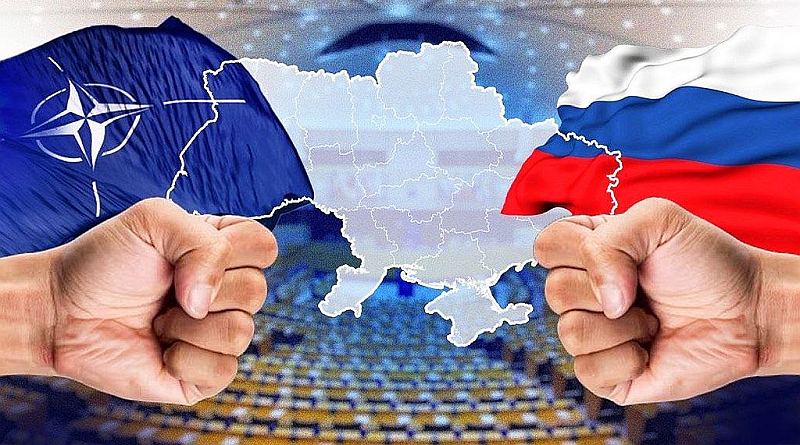
I. Initial Positions
The collapse of the USSR, which was so unwanted in the West, happened anyway because the Soviet system exhausted itself. Post-Soviet Russia declared that communism, aggression, and totalitarianism were over, and that Russia would be peaceful, anti-communist, and democratic. The liberal West readily and naively believed this.
Wrongly so. Because already in 2007 at the Munich Security Conference, Putin unequivocally warned that he would wage war against the West, which allegedly deceived Russia. The “deception” was about NATO, despite promises (which, however, were never confirmed), pledging not to approach Russia.
They, of course, forgot that the Central European countries, after being freed from the socialist camp, all without exception quickly and without any compulsion knocked on the doors of the Alliance. And they didn’t get there automatically or immediately.
But has anyone in Russia ever told the truth?
The evolution of hostility towards NATO reached its peak in December 2021, when Russia, through the Deputy Foreign Minister of the Russian Federation Sergey Ryabkov, demanded that the Alliance “pack its bags and move back to the 1997 borders.” The territory of the former USSR was also supposed to become a zone of unquestioned influence of Moscow.
The falseness of the thesis about the “threat” from the West was obvious, as NATO never intended to attack Russia. This is easily proven by looking at the state of the armed forces of NATO countries even now—after almost four years of full-scale Russian aggression. What can be said about the previous years?! But Russia continues to insist that NATO is an existential threat to it.
On the other hand, Russia’s full-scale aggression against Ukraine forced the liberal-hedonistic West to finally wake up and realize that Russia itself is the biggest threat to democratic civilization.
This conclusion has been reflected, in particular, in a series of resolutions by the European Parliament, the NATO, OSCE, and Council of Europe parliamentary assemblies, in which Russia is defined as a country that promotes and implements a misanthropic theory and practice—Rashism.
The West still calls on Russia to end the war in Ukraine and start negotiating. However, no one understands about what. But what everyone understands well is that there is no trust between the West and Russia, and there won’t be any in the near future. In parentheses, it is noted that within NATO not everyone is confident in the effectiveness of Article 5 of the Washington Treaty.
In the end, we have two antagonistic forces: the democratic world and the Rashist regime in Russia, supported by authoritarian China, with Ukraine becoming the field of confrontation. It is extremely difficult to predict how this confrontation will end, considering the inadequacy of the Kremlin leadership, which constantly blackmails the world with its nuclear weapons, on one hand, and the animalistic fear of the West towards Russia on the other.
II. How to Respond to the Security “Concerns” of the Parties?
The traditional answer: disarmament, verification, confidence-building measures, and so on. As today’s situation shows, such an approach does not work. Because Russia’s imperial expansionist policy remains unchanged. Therefore, there is no point in repeating past mistakes.
So what should be done?
Look at the problem from another angle. Do not disarm, but ARM! Because only weapons and the fear of their use will provide a real guarantee of mutual security. In our European case (since Moscow fears NATO’s eastward expansion in Europe), it should be about the following:
a) Mutually recognize that the line of demarcation between Europe and Russia, based on today’s realities, is the countries of NATO’s eastern flank and Ukraine (within its internationally recognized borders. This is a key element of future agreements).
b) Mutually recognize that this line of demarcation should become a zone of concentration of such quantity and quality of armaments from both sides that would make a physical attack by one side on the other meaningless. The range of the accumulated weapons should extend up to 4,000 kilometers in both directions and include a nuclear component.
The width of such a “defensive wall” is subject to agreement. The same applies to the list and quantity of weaponry, as well as the maximum level of personnel. Strict and unconditional control should be established over not exceeding these parameters.
Thus, from both sides in the demarcation zone (from Norway to Romania), such a number of personnel and armaments will be accumulated and deployed, the potential impact of which will cover the entire European continent and a significant portion of Russia’s territory. This “defensive wall” will become a real security guarantee for both European countries and Russia.
Any country that expresses a desire to join the participants of the Pact from one side or the other will be able to do so with the consensus agreement of the other participants of the western group of countries (i.e., the EU and Ukraine) or Russia and its allies. In such circumstances, both sides will determine additional elements of mutual deterrence.
Weapons, multiplied by the fear of being mutually destroyed, will not allow either side to attack the other, thus alleviating existing security fears. Because neither NATO nor Russia will be able to move forward. Thus, NATO’s advance to the east and Russia’s to the west will be impossible.
This de facto state of affairs needs to be enshrined in a Non-Aggression Pact. Unlike previous ones, it will have real guarantees of being adhered to and, therefore, will be effective.
At the same time, it should clearly state, among other things, that an attack from one side will have an automatic and immediate response from the other. This will prompt NATO to develop a clear mechanism for applying Article 5 of the Washington Treaty or an equivalent for the participating countries of the Pact from the European side.
III. How to Implement?
- It is advisable to start with a political declaration by Ukraine and NATO countries willing to participate in such a project, on one side, and Russia, on the other, on their readiness to conclude a Non-Aggression Pact (if any NATO country does not wish to become a party to the Pact, its provisions will not apply to that country. If any European country that is not a NATO member expresses a desire to join the Pact, the other European participants must consider this proposal within a reasonable timeframe).
- Russia’s allied countries or other countries bordering it may also join the Pact alongside Russia.
- After the political will of the parties to conclude the Non-Aggression Pact is clearly established, they will agree on the quantitative and qualitative parameters of the “defensive wall” and control mechanisms.
- Subsequently, Russia will withdraw its troops from the Ukrainian territories it has occupied. Thus, Ukraine will regain full control over its internationally recognized territory.
- Simultaneously, the parties will prepare the text of the Pact and incorporate provisions regarding the absence of territorial claims against each other and commit not to violate each other’s territorial integrity.
- The parties will carry out the necessary internal procedures, and the Non-Aggression Pact will come into force.
- NATO countries that are part of the Non-Aggression Pact will reduce sanctions pressure on Russia proportionate to its compensation for damages caused to Ukraine.
- The parties agree that the period for negotiations regarding the preparation of the Non-Aggression Pact text will not exceed six months. The same period will be stipulated for conducting internal state procedures.
- The duration of the Pact is 25 years. If no party expresses a desire to withdraw from the Pact within five years, its term will automatically extend for another 10 years.
IV. What Will We Have in the End?
The subject of aggressive intentions between parties will become a thing of the past.
Europe will no longer fear an attack from Russia, relying primarily on its defensive capabilities.
But what about Russia, what is its interest? After all, it will be forced to withdraw from Ukraine and pay reparations?
The main motive will be that by restoring dialogue with Russia and gradually resuming economic cooperation, Europe, and more broadly the West, will give it a chance to survive in one form or another.
It is understood that after the collapse of the Putin regime, Russia in its current borders will no longer exist. Various peoples will separate and form their own statehood. However, what remains will have a chance to exist for some time.
This perspective might seem much more attractive to the current Putin-adjacent “elite” than driving Russia to complete collapse if the war continues.
Moscow will be able, at least ostensibly, to sell this as a “victory” because, supposedly, the sinister NATO will never again threaten Russia. The source of “neo-Nazism” in Europe, Ukraine, will take decades to recover from “our heroic special military operation.” Kremlin propaganda will convince the local populace of this within a month.
What will accelerate the realization of this option’s inevitability in the Kremlin and among those around it?
Ukrainian flying/floating sanctions (good drones and missiles of various types in the necessary quantities) and real economic sanctions from the EU that will halt war financing.
We should, by the way, congratulate the residents of the Moscow marshes on the start of a new era of the nuclear arms race and remind them of what specifically caused the “greatest geopolitical catastrophe” of the 20th century — “Star Wars.” There’s something there to seriously ponder now.
Moscow’s response will be a test of the seriousness of Russia’s statements about the threat to its security from the West. Or it will once again prove that the true goal of the RF is to try to conquer Ukraine and restore its influence in the post-Soviet space and in Central Europe.
Will Russia forgo this beneficial win-win strategy for itself? Otherwise, it faces a rapid repeat of the fate of the USSR, regardless of whether the West wants it or not. History cannot be deceived.
This variant, by the way, will also give hope to those politicians in the West who are mortally (but senselessly) afraid of Russia’s collapse. Because, for a time, under such a scenario, it will partially survive.
It will also help many European politicians better understand the meaning of the concept of “security Eurocentrism,” where it won’t always be necessary to find out which side of the bed the current occupant of the Oval Office got up on this morning.
So, a question also for our European partners: maybe we should finally start thinking and acting in this direction?
Collage: Center for Countering Disinformation
