

In the Polish public discourse of recent years, the assertion that the deterioration of Ukrainian-Polish relations is due to a “difficult historical past” is increasingly heard. It is said that unresolved issues of memory and interpretation of 20th-century events inevitably draw our societies into conflict.
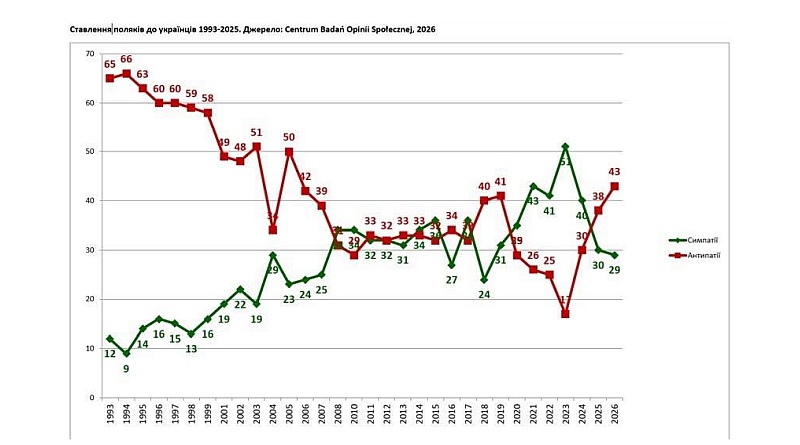
However, sociology paints a different picture. Data from the Public Opinion Research Center (CBOS), which track Polish attitudes toward Ukrainians over a long period—from 1993 to 2025—show a clear dynamic of change. The level of sympathy and antipathy was not constant: it rose and fell in different periods, despite the historical past remaining unchanged. The same historical “baggage” accompanied fundamentally different public moods in different years.
The recent years are particularly telling. After 2022, sociology captures a deterioration in Polish attitudes toward Ukrainians—a rise in negative evaluations and a decrease in sympathies. This occurs not against the backdrop of new historical revelations or a rethinking of the past, but in the absence of any changes in historical knowledge itself.
Since 2022, there have been no new studies that could significantly alter the understanding of the Polish-Ukrainian conflict in the past or provoke a new wave of public emotions. The academic field remains the same—complex, debatable, but not new. Similarly, there has been no increase in the number of people who directly remember the events of Polish-Ukrainian confrontations: over time, they become fewer, not more, and their direct influence on public mood objectively diminishes.
Thus, we have an obvious paradox: in the absence of new historical factors, sociology records a worsening of attitudes. The only convincing explanation for this process lies not in the past itself, but in how and for what purpose this past is used today.
History is increasingly becoming a tool of modern politics: a means of mobilizing emotions, an argument in internal disputes, a convenient explanation for decisions for which responsibility is shirked. Referring to a “bad past” allows blame to be shifted from the present to history, from living political actors to events a century ago.
We cannot change the past. It is what it was—with tragedies, crimes, and painful pages. But we are obliged to treat it responsibly. We are not responsible for the past, but we are responsible for the memory of it—how we shape it, how we talk about it, and how we use it for political purposes.
It is especially concerning that worsening attitudes toward Ukrainians occur against the backdrop of Russia’s full-scale war against Ukraine. A war in which Ukrainians are defending not only their own independence but also the security of Poland and all of Europe. Ukrainian resistance today holds back the same imperial threat that historically has always been the main danger for both Ukraine and Poland.
The fact that under these conditions history is used to exacerbate relations indicates that the most crucial lessons about the nature of the Russian threat, common to our peoples, have still not been learned.
Research Report for the Mieroszewski Center: Poles on Ukraine and Polish-Ukrainian Relations 2025
