
In August 2024, Volodymyr Zelensky stated that Ukraine had achieved true strategic partnership with Japan. At the time, few doubted that Japan was doing everything possible for Ukraine to ensure the Russian aggression ended with a just and lasting peace. Two years have passed since then. Zelensky again commented on the partnership with Japan, but this time he said that the results of the cooperation are not as significant as they could be, and this needs to be corrected.
Indeed, recently, Tokyo has been making moves that raise questions in Ukraine. Japan recently sent an economic mission to Moscow. The Japanese Foreign Minister spoke with his Russian counterpart. In August, a government program allowing Japanese students to study in Russia for the first time in seven years will resume. Japanese experts call this approach “flirting with Russia.” One way or another, today we see certain moves by Tokyo towards Moscow that were not present two years ago.
At the same time, the Japanese government continues to support Ukraine and maintains sanctions against Russia. Thus, there are currently no grounds to speak of a reversal in Japanese-Ukrainian relations.
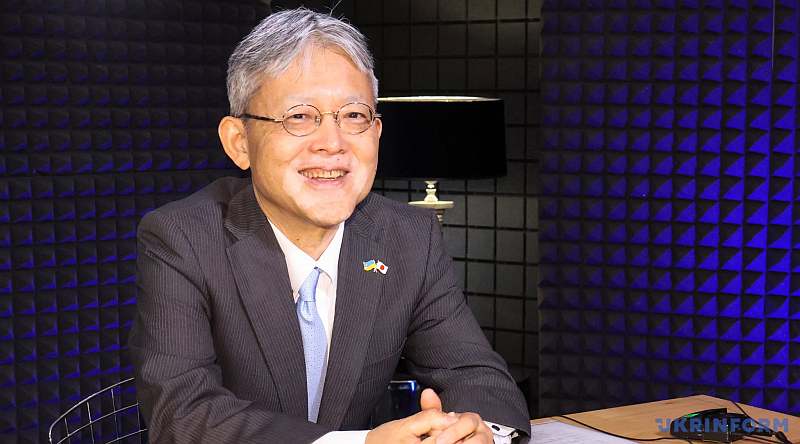
During these two years, the Japanese ambassador in Kyiv was Masashi Nakagome, who recently completed his mission in Ukraine. On the eve of his departure, it was important and interesting to ask how Japan sees the further development of relations with Ukraine amid the war. Ukrinform asked the ambassador to summarize these two years and explain what has changed during this time in Ukrainian-Japanese relations, why Japan maintains dialogue with Russia, whether it plans to provide new energy assistance to Ukraine, why anti-corruption reforms in Ukraine are important for Tokyo, and how realistic it is to receive lethal weapons from Japan. (This interview was recorded before Putin visited the Japanese island Etorofu occupied by Russia in the Kurils).

IN TWO YEARS, OUR RELATIONS HAVE ADVANCED IN MANY AREAS
– I did not expect the decision for your replacement to be made so quickly.
– In the Japanese Ministry of Foreign Affairs, the term of service for an ambassador is about two to three years, rarely longer. This is a normal summer rotation. Given that there is a war in Ukraine, it was probably considered that it is not advisable to leave a diplomat for a long term under such conditions.
– In August 2024, the President of Ukraine, Volodymyr Zelensky, assessed the partnership with Japan as exemplary. However, on August 3 this year, he noted that compared to expectations from the government of Sanae Takaichi, “the results are not that significant yet.” In your opinion, what has changed in Ukrainian-Japanese relations over these two years? Or is it just differences in assessments and different approaches of the parties?
– I do not believe that there are any disagreements or misunderstandings. On the contrary, many people have told me that at the start of the war, they could not imagine that Japan would provide such significant support to Ukraine. So, probably, two years ago there was a sense that Japan was helping more than expected. As our relations have deepened and another two years have passed, perhaps there is an expectation that even more can be done.
In fact, over these two years, our relations have advanced in many areas. Speaking of major events, last year, Japan hosted the Conference on Humanitarian Mine Action in Ukraine (UMAC), and at the Expo in Osaka, a wonderful Ukrainian pavilion was created, through which we were able to send an important message to the whole world.
Moreover, in recent months there has been a real surge in official visits: in June, Deputy Minister of Economy, Trade, and Industry Kenji Yamada and Deputy Minister of Foreign Affairs Ayano Kunimitsu visited Kyiv, followed by Deputy Minister of Justice Hidehiro Mitani. Many more visits and missions are planned for the future.
I believe the most striking example of deepening economic relations is the public-private partnership. When I worked in Tokyo, the Japan-Ukraine Conference on Economic Growth and Reconstruction was held. Many journalists asked me then: “Are there companies willing to do business in a country at war?”
And today, besides the 40 companies that previously worked in Ukraine, another 90 new Japanese enterprises are trying their hand in various business areas with Ukraine.
JAPAN’S POSITION ON CONTINUING SANCTIONS IN COLLABORATION WITH THE G7 HAS NOT CHANGED
– However, recent actions by the Japanese government, which seem to be attempts to improve relations with Russia, cause concern in Ukraine. In particular, officials from the Ministry of Economy, Trade, and Industry, the Ministry of Foreign Affairs of Japan, and representatives of Japanese private business visited Russia; Japanese Foreign Minister Toshimitsu Motegi spoke with Russian Foreign Minister Lavrov in Manila; the Japanese government has repeatedly invited Kremlin special envoy Mikhail Shvidkoy. Such actions by the Japanese government are assessed by some in Ukraine and Japan as “flirting with Russia.” Why does the Japanese government pursue such a policy?
– I am an ambassador to Ukraine, so I am not responsible for relations with Russia and do not know all the details. However, what I constantly repeat to Ukrainians, including government officials, is that Japan’s position has not significantly changed. The policy of supporting Ukraine and continuing sanctions against Russia remains unchanged.
Moreover, there is an issue that Japan needs to resolve with Russia as a neighboring country. It concerns visiting graves in the Northern Territories. After the end of World War II, former residents of the Northern Territories could almost annually visit their ancestors’ graves on the four islands. However, during the coronavirus pandemic and after the start of the full-scale invasion, these visits became completely impossible.
Meanwhile, the former residents are aging, their average age now exceeds 90 years, and many are passing away. In these circumstances, they wish to visit the graves and honor their ancestors’ memory at least one more time, and the Japanese government’s aspiration is to meet them halfway.
– However, when it comes to resuming grave visits, Russia imposes the condition of lifting sanctions. After a meeting with Lavrov, Foreign Minister Motegi stated that Japan would continue its sanctions policy against Russia. But the last time the Japanese government imposed sanctions against Russia was in September 2025. In view of this, I have two questions: will Japan maintain the sanctions imposed against Russia until the end of the war, and is Japan ready to impose new sanctions against the Russian Federation?
– Japan’s position is to continue sanctions in cooperation with the G7, and this position has not changed. Regarding the timing of imposing sanctions, Japan’s course has not changed, and we will continue to act accordingly based on this policy.
– The Japanese Embassy in Kyiv constantly issues statements and condemns Russia after major attacks on Kyiv and other cities. But on July 3, the Chief Cabinet Secretary of Japan, Minoru Kihara, used the term “deep concern” regarding the attacks on Kyiv. In diplomatic language, the terms “concern” and “condemnation” differ, with “concern” being a much milder degree.
What do you, as someone who has witnessed the suffering of residents and the destruction in Kyiv, think about these Russian attacks?
– As you know, the embassy acts according to the policy of the Japanese government, so we do not express differing evaluations. Both the Chief Cabinet Secretary’s statement and our messages are based on a consistent course.
In any case, living in Kyiv, I can see that the number of Russian missile attacks has indeed increased, and we have to go to shelters much more often during air raid alarms. I have personally seen many destroyed residential buildings, as well as energy facilities that are almost completely gone.
I have seen many places with horrific destruction. Bearing this in mind, we must continue to support Ukraine.
It is with these thoughts that I perform my work.
– Recently, a warehouse belonging to the publisher “Ranok” and other companies burned down in Kharkiv, where Japanese children’s books translated into Ukrainian were destroyed.
– The fact that translations of Japanese children’s books were burned in that warehouse was a huge shock for me. We wanted children’s books created through the collaboration of Japanese citizens and Ukrainian enterprises to reach as many people as possible, so this event was a real blow.
Russia attacks not only “Ranok,” but also many other warehouses and logistics centers, which is heart-wrenching. The thought arises: could they be deliberately targeting even book warehouses?
We must not forget that Russia regularly strikes cultural sites and museums.
JAPAN WILL COOPERATE WITH UKRAINE TO HELP PREPARE ADEQUATELY FOR WINTER
– According to research by the Kiel Institute, Japan currently ranks sixth in terms of total aid to Ukraine, with particularly notable support in the energy sector. Can we expect new energy assistance from Japan?
– This winter is expected to be very severe, so Japan is doing everything possible to provide maximum assistance.
Before coming here, I had a meeting with the Minister of Energy, Denys Shmyhal, where we discussed providing energy assistance from Japan for this winter.
Energy equipment requires significant time for delivery. For example, generators or transformers are not something you can buy in a market and receive in a week; their delivery takes from half a year to almost a year.
We have been preparing through JICA and UNDP, and now various equipment is already starting to arrive. Japan seeks to cooperate with Ukraine to help it prepare adequately for winter.
REQUESTS FROM JAPANESE ENTREPRENEURS TO HELP UKRAINE OVERCOME CORRUPTION
– Last month, the National Anti-Corruption Bureau of Ukraine (NABU) and the Specialized Anti-Corruption Prosecutor’s Office (SAP) reported suspicion against former State Secretary Oleksandr Bankov of embezzling aid funds. According to court materials, these funds included donations from Japan (not governmental aid from Japan, but funds transferred by ordinary Japanese citizens to the Embassy of Ukraine in Tokyo). In Japanese society, of course, there is outrage and disappointment.
At the same time, Japan has supported Ukraine’s anti-corruption bodies, including NABU and SAP, for many years, which has contributed to the establishment of a system that allows such crimes to be uncovered and prosecuted through judicial procedures.
What is the significance of supporting anti-corruption and judicial reforms in Ukraine for Japan? Will such support continue in the future?
– Regarding this case of law violation, procedural actions are currently underway. But if confirmed, it will turn out that the funds donated by Japanese citizens to the Ukrainian embassy in Tokyo were misused. This is a betrayal of the goodwill of the Japanese people, and it is unacceptable. We have addressed the Ukrainian side with a firm demand to conduct a full investigation, provide all information, and strictly hold those responsible accountable.
I believe that supporting the fight against corruption in Ukraine is important. As I have already said, Japanese companies are eager to participate in the reconstruction of Ukraine and are making various efforts in this direction, but we hear requests from these same Japanese entrepreneurs to overcome corruption in Ukraine. Supporting the fight against corruption in Ukraine is undoubtedly important for Ukraine itself, but it also promotes the support of Japanese business, so we must work diligently on this.
We are now supporting NABU and SAP, and another area that Japan is actively working on is supporting the reform of the Ukrainian customs system.
– As you mentioned, the rule of law is an important element of Japan’s policy towards Ukraine. At the same time, regarding the creation of the Special Tribunal for the crime of Russia’s aggression, Japan is part of the “Core Group” but has not yet joined the “Enlarged Partial Agreement.” How will Japan participate in the Special Tribunal in the future?
– Japan has been actively involved in discussions on holding Russia accountable for aggression. Regarding the form of our further participation, there are many factors, so, as I understand it, we will consider this issue in cooperation with partners.
– An important topic for Japan is the reconstruction of Ukraine. Give a few examples of the contribution Japan can make to the reconstruction of Ukraine, especially using its unique technologies.
– Now many people in Japan are eager to contribute to the reconstruction of Ukraine using Japanese technologies. The Japanese government aims to fully support this and is making efforts towards this cause.
For example, there is “remote construction” technology. It allows for the control of construction equipment from a safe location thousands of kilometers away. In Japan, this technology was developed for use in areas affected by natural disasters, where it is difficult for people to access. Since there are many very dangerous areas in Ukraine, this technology can be extremely useful during reconstruction.
In terms of agriculture, one of the excellent Japanese technologies is shock freezing. It allows for very quick freezing of fresh vegetables and fruits, making it possible to deliver them worldwide. With such solutions, we could help Ukraine export its highly competitive agricultural products to the global market.
There are also Japanese modular homes. This technology enables the construction of high-quality housing in a short time and at a relatively low cost. In Ukraine, housing is a huge challenge for post-war reconstruction, so in this area, we can also make our contribution.
– This year, the Japanese government lifted the “5 categories” rule, making it possible to export lethal weapons under certain conditions. However, Ukraine does not currently qualify under this system. At the same time, Deputy Head of the Office of the President of Ukraine Ihor Zhovkva stated in February this year that Ukraine and Japan plan to sign an “Agreement on the Transfer of Defense Equipment and Technologies.” Is this true?
– Regarding the “5 categories,” the Japanese government reviewed them this spring, but there are two obstacles in relations with Ukraine. The first is that the “Agreement on the Transfer of Defense Equipment and Technologies” has not been signed. The second is that Ukraine is a country where active combat is currently taking place. Since such countries are not targeted, providing weapons to Ukraine is currently impossible.
Regarding the “Equipment Transfer Agreement” with Ukraine, which Minister Motegi mentioned in parliament, no decisions have been made at this time, and Japan’s position is to continue the dialogue.
I REALLY WANTED TO SEE THE ACHIEVEMENT OF A JUST AND LONG-LASTING PEACE DURING MY TENURE
– Mr. Ambassador, you have long been an associate of former Prime Minister Fumio Kishida. I recall July 17, 2014 – the day when a Malaysia Airlines plane was shot down in Eastern Ukraine. You were in Kyiv at the time with then-Foreign Minister Kishida (I was working at the Embassy of Japan in Kyiv then). Do you remember those events and your emotions? And how do you feel now, when the war at that time continues, although it has changed its form?
– In 2014, I was in Ukraine with then-Foreign Minister Kishida. On the day of our departure, the tragic incident of the Malaysia Airlines plane being shot down occurred, and I remember Foreign Minister Kishida urgently held a press briefing.
I couldn’t have imagined that day that I would one day come to Ukraine as an ambassador. Twelve years have passed since then. In the two years I’ve spent here, I really wanted to see the achievement of a just and long-lasting peace with my own eyes during my tenure. I am incredibly sorry that this hasn’t happened yet.
JAPAN HAS MUCH TO LEARN FROM UKRAINE
– You worked as an ambassador for two years and lived in Ukraine. How has your personal understanding of this country and its people changed during this time?
– I am not a specialist on the region, but after arriving in Ukraine, several things truly impressed me deeply. The first is the strength of Ukrainian innovations.
Now, in this war, Ukraine is resisting Russia’s vast resources with drone technology, and this entrepreneurial spirit and ability to constantly develop new technologies impressed me.
The second is the strength of civil society. In Japan, there is rather a culture of respect for what the authorities say, but in Ukraine, society is not such that everyone says “yes” just because the government said so. Here, everyone has their own opinion, and the government makes decisions considering these opinions, and I very clearly felt this energy.
When talking about other differences between Ukraine and Japan, it’s worth mentioning that initially there were about eight companies involved in UAV production in Ukraine, but now there are hundreds. This is a point of pride for Ukraine, but from a Japanese perspective, the number of enterprises seems somewhat excessive.
For example, considering the war between Russia and Ukraine, at the beginning, the Russians established mass production and began launching 1,000 Shaheds a day, and initially, the Ukrainian side had nothing to counter this.
In such cases, according to Japanese practice, logic suggests reducing the number of companies, concentrating resources on a few, and starting mass production. But Ukrainians say, “No, that’s not the case. This should be handled by the private sector. If the government intervenes and starts selecting companies, it will become a breeding ground for corruption, and nothing will come of it.” By giving freedom to the private sector and stimulating competition, you actually unlock innovative potential. This is the essence of Ukraine. And this Ukrainian vitality is truly impressive.
Prime Minister Sanae Takaichi and other Japanese leaders often talk about the importance of increasing autonomy and resilience. I believe Ukraine has implemented this in practice under very severe wartime conditions. Regarding armament, at first, you asked different countries for tanks, F-16 fighters, medium-range weapons.
However, Ukraine began to ramp up its own production, become autonomous, and now produces more than half of its weaponry independently. It is thanks to this increase in autonomy and resilience that Ukraine has been resisting Russia’s full-scale invasion for four and a half years.
– What do you think Japan should learn from Ukraine?
– Japan should develop a National Security Strategy by the end of the year, and one of the important aspects is the “New Defense Approach.” Also, increasing the ability to conduct prolonged combat operations and preparing for a long-term war. Both of these points are what Ukraine demonstrates in practice.
The strategic environments of Japan and Ukraine are significantly different from each other, so we cannot fully adopt this experience, but how Ukraine fights and defends its independence can serve as an excellent model for Japan.
– Finally, what would you like to say to the peoples of Ukraine and Japan before leaving Ukraine?
– I believe that Japan has much to learn from Ukraine. It’s not just about Japan supporting Ukraine, but by supporting Ukraine, we also learn from it and in the future can move towards mutual assistance relations. I believe such a format will allow forming more long-term and sustainable relationships.
– Do people in Japan really think that there is something to learn from Ukraine?
– I keep repeating this, but such understanding has not yet become universal. I would like to continue conveying this idea further.
Photo: Pavlo Bagmut
