
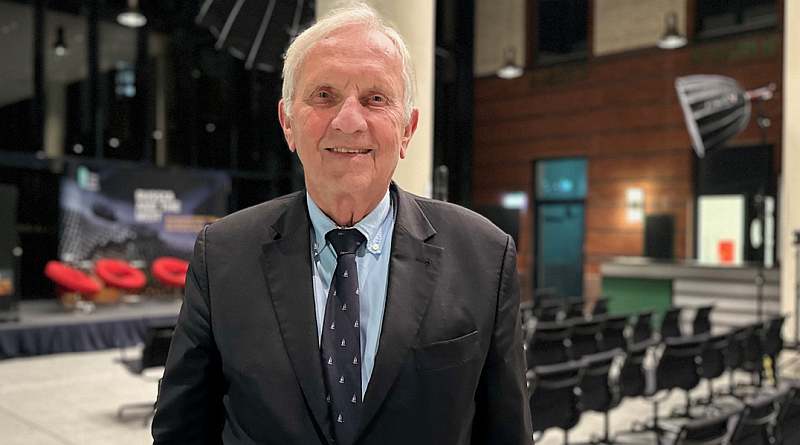
After the use of combat drones at Leipzig airport, Russia’s hybrid war against the West is reaching a new level. This requires Berlin and NATO not only to strengthen the defense of their territory but also to abandon the practice where Moscow effectively holds the “escalation initiative.” Allies must determine possible consequences for Russia, clearly warn about them, and be ready to implement them if necessary. One component of such a response should be significantly more decisive support for Ukraine.
This was stated in an interview with Ukrinform by retired Bundeswehr Brigadier General, lecturer in modern history at the University of Potsdam Klaus Wittmann. According to him, the West has been helping Ukraine for too long “with the handbrake on,” and the support formula “as long as it takes” should have long been supplemented with the words “whatever it needs” and “in a timely manner.”
One of the main problems, Wittmann says, is Russia’s continued ability to strike with ballistic missiles, while the capabilities to intercept them remain limited. Under these conditions, he believes Ukraine should be able to systemically strike the launchers, military airfields, logistics, and defense production deep within Russia.
Among other topics of the conversation are how to draw the line between a hybrid attack and an open armed attack; whether Europe and Germany have woken up; whether it is realistic to cover part of the Ukrainian sky with allied forces; who now has the strategic initiative on the front and what is the impact of Ukrainian “long-range sanctions”; what needs to change on the battlefield and in Russia itself for the war to end.
THE ATTACK IN LEIPZIG – THIS IS A NEW LEVEL OF HYBRID THREAT
– General, in Leipzig, it was only due to a lucky coincidence that a disaster was avoided. A drone equipped with explosives attacked an “Antonov” plane. Another cargo plane also apparently collided with a drone but was able to land safely. How do you assess this incident? What do you think it was?
– Let’s start with the word “incident.” It is the most striking understatement of the day, an understatement in its purest form. Because it was an attack – an attack as part of a hybrid war.
It seems only a badly secured cable prevented this rather powerful drone bomb from exploding near the “Antonov” plane.
Even less is known about the second plane. Where the collision apparently occurred, no debris has yet been found on the ground. However, they could have fallen over quite a large radius. So nothing certain can be said about this yet.
But compared to what we have observed in Germany so far in the form of sabotage, this drone represents a new level of threat.
– Who do you think is behind the attack?
– Proving this is always difficult. Attribution, that is, establishing responsibility for cyberattacks as well as drone attacks, is always challenging.
But experts believe—and in this case, I also count myself among them—that there are three factors indicating that this operation was initiated by Russia. The drone didn’t necessarily have to come here from Russia. It could have been delivered by so-called disposable agents or other people acting here in Russian interests and on Russian orders.
Three factors point to this. First, the target: the Leipzig/Halle airport holds special significance for transporting military aid to Ukraine.
Second, the method: a drone loaded with explosives. Although it hasn’t been definitively established which explosive was used, it is apparently about Semtex. If this is confirmed, it would suggest a state actor. Ordinary people do not have such materials—these are with state structures or people acting on behalf of the state who receive the necessary materials from it.
And the third indicator is the Russian strategy. Putin has repeatedly stated that he will not limit himself to Ukraine but will also keep an eye on the rear. And in this case, Germany is undoubtedly such a rear. After all, his entire narrative is that in Ukraine, Russia is supposedly defending itself from the “aggressive West.”
Two years ago, there was also an incident in Leipzig/Halle with a package that caught fire, and only due to a delay in the DHL plane did it not ignite on board. In this matter, Russian agents or people hired by Russia have already stood trial; investigations are ongoing.
And many other recent incidents can quite possibly be linked to Russia. So this fits into the overall picture. And I will tell you one more thing that fits these cases perfectly: if something looks like a duck, quacks like a duck, and walks like a duck, then it is probably a duck.
SHOULD NOT ALWAYS LEAVE THE INITIATIVE OF ESCALATION TO PUTIN
– Earlier, you mentioned that any attack on NATO territory should have “unpredictable and unbearable consequences” for Putin. What does this mean in the case of diversions that remain below the formal threshold of an open armed attack?
– This is one of the elements of hybrid warfare: it remains below the threshold of real war. That is why our Federal Chancellor Scholz has already said: we are not in a state of war, but we no longer have real peace.
Everything Putin wants to do against NATO states, he will do in such a way that discrepancies arise in the North Atlantic Council regarding whether it is already a military attack according to Article 5 of the North Atlantic Treaty.
That is why I believe we should be quite certain that this is Russia. There is no need for a final court-acceptable proof. But as a result of analysis and possibly additional signs that can still be found, within a few days, we should conclude: this is a case for applying Article 4 of the North Atlantic Treaty—for consultations within NATO and also for consideration in the European Union.
And this should become a reason to finally seriously implement the sanctions that have long been discussed and move to a much tougher line against Putin. Not in the purely military sense, as we as NATO do not want to go to war against Russia.
But it concerns the shadow fleet, frozen assets, much more active public exposure, and condemnation of his criminal war. In my view, this should constantly be a topic of the UN Security Council, especially what has been happening in the past few weeks—this reckless bombing and missile war against the civilian population and their homes.
And Taurus should also be part of this.
So, to sum up: one should not always leave the initiative for escalation to Putin. We need to think about how to demonstrate consequences to him, threaten with them, and, if necessary, actually implement them.
THE WEST HAS BEEN HELPING UKRAINE “WITH THE HANDBRAKE ON” FOR TOO LONG
– You’ve already mentioned Taurus. Could the supply of these cruise missiles be part of such a response and a signal to Moscow that Russian diversions on German territory do not weaken support for Ukraine but rather strengthen it?
– Currently, due to the shortage of Patriot missiles, which are almost the only ones capable of intercepting ballistic missiles, Ukrainian cities have been largely defenseless against Russian ballistic missiles for several weeks now, and this may continue.
I believe – and President Zelensky has also made corresponding statements and is increasingly implementing them – that the Ukrainian strategy needs to change again in the sense that targets deep inside need to be attacked much more intensively: logistics, defense industry, launch installations, and military airfields.
And Taurus would be exactly the tool needed for this. After all, within a radius of several hundred kilometers, there are very many stationary military targets and defense-industrial objects. Furthermore, Taurus, as one of the few similar systems, has great penetrating power.
And I will say somewhat dramatically: every day that we in the West provided Ukraine with military support only “with the handbrake on” cost human lives.
The eternal mantra “we will help Ukraine as long as it takes” should have been supplemented years ago with the words: “with everything it needs” and “timely.” Both elements were lacking.
I have already publicly spoken and written that it would be good if the federal chancellor fulfilled his statements from his time in opposition. Just a day before the election, he said that if he became the federal chancellor, he would supply Taurus. And a few days later – no, after all, no.
Experts like Deputy Kiesewetter, and I myself quite often said: at least an order should have been given to start training Ukrainian personnel to work with Taurus and to inform Putin about it. It could have been said: if this or that continues or if Russia does this or that, we will supply Tauruses.
I consider it almost shameful that we, for example, by the words of Defense Minister Pistorius, say: now Ukraine no longer needs Taurus because it can do it itself.
UKRAINE IS FIGHTING A WAR THAT WE DO NOT HAVE TO FIGHT YET
– Regarding the shortage of Patriot interceptor missiles: what solution exists for the coming months? Do you think there are still reserves among allies that could provide additional missiles to Ukraine?
– A number of European countries, including Spain and Greece, still have reserves of Patriot missiles.
Last year or the year before, Germany tried – and this must be acknowledged – through both Pistorius and the foreign minister, to persuade countries that still have these reserves that Ukraine is now the frontline.
Denmark, for example, transferred its military resources to Ukraine, largely because the prime minister stated: if the front in Ukraine does not hold, we will be next.
Ukraine is the frontline, and it is buying us time. Somewhat pathos-filled, I always say: Ukraine is fighting a war that we – for now! – do not have to fight ourselves.
So, a short-term opportunity would be for these countries to transfer Patriot missiles. We ourselves have already provided a lot of missiles.
There are also new Ukrainian developments and the FREYJA program for countering ballistic missiles, which Ukraine is promoting together with European partners. But all this takes time and is not a solution for today or tomorrow.
American stocks of Patriot missiles are also obviously seriously depleted. Many missiles were used during the war with Iran, and producing new ones takes time.
Therefore, I return to the thought that we must do everything possible to prevent the launches themselves, not just react when the missiles are already flying.
In addition, it is necessary to significantly more actively expose and condemn the aggressor, and substantially increase public pressure on Russia for this criminal method of waging war.
If Trump believes and constantly says he has influence over Putin, then let him finally demonstrate this and say: stop! He already said so, but then immediately took his words back.
Moreover, the American willingness to allow Ukraine to license produce the Patriot is also apparently in question.
NATO IS NOT READY TO CLOSE THE SKY OVER WESTERN UKRAINE
– Another theoretical option would be the protection by allied forces of at least part of the airspace in Western Ukraine. How realistic is this?
– I consider this unrealistic because we will not find consensus in NATO for this.
Such a large-scale operation would effectively mean creating a no-fly zone and, in material terms, would make its participants a party to the war. In my opinion, there will be neither a majority nor a consensus in NATO or the EU for this.
Therefore, although I initially considered this idea correct, I do not see the prospect of its implementation.
But the more Russian missiles or drones fall intentionally or unintentionally in Poland and Romania, or the more Ukrainian drones appear in Latvia, Estonia, and Lithuania after being diverted by Russia, the more we need to think about what we are doing to protect our own airspace, at least at the border and possibly a little beyond it.
Returning to the topic of supply. Nearly two years ago, Russia again attempted to advance across the border near Kharkiv. Then, an always very cautious President Biden allowed the use of HIMARS artillery systems across the border against targets in Russia—in a very limited local area.
A few days later, intercepted radio communications of Russian soldiers complaining that they were no longer receiving supplies—food, fuel, etc.—were intercepted.
And I always thought: if such an effect was achieved in such a small local area, what could it have been if it were allowed on a large scale?
Restrictions on the use of Western weapons against targets in Russian territory greatly assisted Russia in conducting the war.
THE FRONT REMAINS RELATIVELY STATIC, RUSSIA ADVANCES SLIGHTLY AT THE COST OF HORRIFIC LOSSES
– Let’s return to Leipzig: this incident shows that the war unleashed by Russia is not limited to the Ukrainian front. However, its outcome will still be decided in Ukraine. How do you assess the current situation on the battlefield? Who do you think has the strategic initiative?
– I think that now neither side really has the initiative. Ukraine is defending and has been doing so successfully for the most part. However, it seems there is once again slight Russian advancement – and still at the cost of terrible losses.
Everything must be done to prevent the encirclement of the so-called fortress belt. General Syrsky, in my view, has made the right tactical decisions, what we call in German “Verzögerung,” – actions for delaying, leaving certain territory to reorganize forces and save the lives of his soldiers. But this cannot go on indefinitely.
Combat on the front line is relatively static. The strategic initiative still remains with Russia, because Russia is the aggressor. The fact that Ukraine continues to successfully hold back the enemy and defend itself was hardly imaginable four years ago.
The main problem for Ukraine is personnel. Technologically, especially regarding drones, Ukraine continues to impress me greatly, as does the courage of its soldiers. But if it becomes increasingly difficult to replace front-line forces with trained military personnel, it cannot last endlessly.
Russian initiative essentially involves sending soldiers to their deaths again and again, while gaining almost no territory. This is cynicism that is hard to grasp. Here the rule also applies: every loss lies on Putin’s account.
AS SOON AS IT IS KNOWN WHERE THE NORTH KOREAN MISSILES ARE LOCATED, – FOCUSED FIRE THERE
– How do you assess Ukraine’s “long-range sanctions” – strikes on Russian oil refineries, military airfields, and other deep strategic targets?
– It is absolutely necessary to transfer the war to Russian territory and focus as much as possible on militarily significant targets. At the same time, Ukraine must avoid giving grounds for accusations of fighting against the civilian population, as Russia does daily.
So far, I see no grounds for making such accusations against Ukraine.
The warehouses of Wildberries, the so-called Russian Amazon, in my opinion, are a legitimate target as military goods are also sold and advertised there. Oil refineries are, of course, also legitimate targets.
There should be stronger hits on supply lines, as is already happening with tankers on the routes to Crimea. Here I see a clear difference between Russian strikes on Ukrainian gas stations used by civilians.
And I repeat: missile launchers and military airfields need to be targeted as much as possible.
I’ll tell you quite frankly: as soon as it is known where this new North Korean ballistic missile unit will be deployed, – focused fire there!
– Meanwhile, hits affect not only oil refining in Russia but also export infrastructure. Should Ukraine intensify the pressure on Russian export routes and the shadow fleet to also hit the revenues funding this war?
– Ukraine has already largely done this on its own. And certain Western countries are decisive enough to counter the shadow fleet, while others are less so.
You can board these vessels to check insurance documents, environmental standards, and technical condition. This alone can disable a significant portion of the shadow fleet without needing to sink these vessels.
THE FIRST VERDICT FOR A “WAR CRIME” IN THIS WAR SHOULD NOT BE GIVEN TO A UKRAINIAN IN GERMANY
– We talk about energy infrastructure as one of the important resources of the Russian war machine. Here we approach a particularly complex issue – Nord Stream. If the version of the German investigators about Ukrainian involvement is confirmed by the court, and the goal of the operation was indeed to deprive Moscow of revenues to finance the war, could Nord Stream, from a military-strategic point of view, be considered a justified target?
– I am ready to go so far as to say: from a military-strategic and moral point of view, it is a justified target.
I am not a lawyer and certainly do not want to question the independence of justice. But looking back, I was among those who categorically opposed Nord Stream 2.
The decision on Nord Stream 2 was made when Crimea was already long occupied. Despite this, there was continued belief that Russia could be relied upon as a reliable supplier of cheap gas, calling it a purely economic project.
At the same time, the warnings from the Baltic countries, Poland, and, of course, Ukrainians were ignored: from the Russian perspective, it was a geopolitical project.
Here I would like to quote Polish Prime Minister Donald Tusk, who said the problem was the construction of Nord Stream 2, not its destruction.
Of course, the destruction of someone else’s property is a serious matter. But it should also be viewed in a political and psychological dimension and asked whether it is in Germany’s interest that the first verdict for a “war crime” in the war in Ukraine is issued against a Ukrainian – and in Germany?
I don’t know how much room for maneuver the Federal Prosecutor’s Office had or if it was obliged to demand extradition.
But given the scale and horror of Russian war crimes, I do not find it acceptable for German justice to primarily focus on a “Ukrainian war crime.”
– Nord Stream was also a symbol of the policy towards Russia, which is now widely considered a mistake in Germany. Has Germany made strategic conclusions from these mistakes? Has Germany and Europe truly awakened?
– Yes, I believe they have awakened. But the conclusions are not being drawn fast enough. I have adopted the saying, “time has become a matter of fate for us.”
This relates to national and allied defense, as well as equipping, training, defense planning, and building up the armed forces. Germany, on one hand, is a logistical hub for NATO, and on the other, is potentially itself under threat.
I think the political class has largely awakened. But we need a much faster pace.
– North Korea has economic capabilities that are almost impossible to compare with European ones. Yet, it has managed to support Russia with millions of artillery shells, ballistic missiles, and now direct military involvement. What does this say about Europe’s ability to effectively convert its vast economic potential into military power?
– This, of course, is also the difference between a command and a market economy. In a democracy and market economy, you cannot act like Russia or North Korea. But this cannot be an excuse for us being too slow.
Russia accepts huge economic costs to continue this war. Therefore, the very idea of bringing the war to Russian territory was correct: the consequences of this war need to be felt there too, through strikes on military-significant targets.
At the same time, Russia is also facing increasing difficulties in recruiting personnel. With such heavy losses, it can barely replenish its troops with trained soldiers.
A CRUCIAL MOMENT MAY COME WHEN RUSSIAN GENERALS TELL PUTIN: WE CAN NO LONGER CONTINUE
– Do you see a real possibility of changing the strategic dynamics of the war in favor of Ukraine? Or will we witness the war increasingly turning into a prolonged war of attrition?
– The war will only end when Putin truly faces the danger of losing it, when he looks into the abyss of defeat.
For this, the use of long-range weapons on targets at the rear, strikes on militarily significant objects, and everything we’ve talked about are at least as important as holding the front line itself.
Look at Crimea. It is almost isolated.
I recall Zelensky, who one and a half or two years ago addressed the people in Crimea with the words: leave while you still can. At the time, it was taken somewhat as a joke, but part of it has already been accomplished. With long-range weapons, using Deep Strike, much more can be achieved.
I have held my belief for many years and have repeated it: this war will end not when the last square kilometer of Ukrainian territory is physically reclaimed, but when the generals come to Putin and say: we can no longer continue this war. Then the invasion will have to stop, and the occupying forces withdrawn.
People say: Putin will never do this. I don’t know that. But we must do everything to put him in such a situation.
