
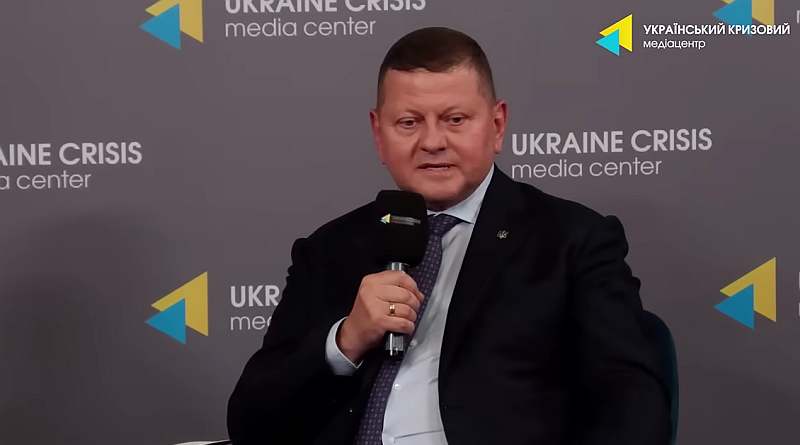
Ukraine’s future lies solely in security. This is possible only if Ukraine is part of alliances that respond to the challenges of the new world order. This opinion was expressed at the Ukrainian Crisis Media Center during the meeting in the format “Geopolitical Dialogues with Valeriy Chaly” by Ukraine’s Ambassador to the United Kingdom, former Commander-in-Chief of the Armed Forces of Ukraine Valeriy Zaluzhny. Texty.org.ua presents the key points of the conversation.
Ukrainians Abroad as a Strategic Asset of the State
Valeriy Zaluzhny emphasizes that the foundation of Ukraine’s support in the world is not political agreements, but people.
- On British Support: The ambassador notes that the stability of the UK’s course is primarily ensured by its people: “The Association of Ukrainians in Great Britain was organized in 1947. All of this has formed such a stable support for the country as one where our, so to speak, compatriots have passports and the right to vote. And they decide whether Britain supports Ukraine or not. They will support as long as the people living there want this support. They have Ukraine in their hearts, they just need to be nurtured: nurtured by cultural events, nurtured by some attitude towards them.”
- About “Ukraine in the Heart”: “Look, who is Britain and who are the Ukrainians in Britain? These are prisoners of World War I, prisoners of World War II, the first immigrants after the collapse of the Soviet Union. What does it mean for people who lost their homeland after World War I, after World War II? It means they have passed on their genes with Ukraine in the heart— with Ukraine in the heart.”
- About the Ukrainian Asset in Britain: “I believe this idea of bringing Ukrainians living in Britain back to Ukraine is somewhat wrong. Because no one can currently count how many ethnic Ukrainians live there… Can you imagine, such a foundation—336,000 now living there—what results it will give in 50 years for Ukraine? In their lifetime, as long as Ukrainians live there, they will never let go of Ukraine and will help them.”
- About the Polish Experience: According to Zaluzhny, people who have ended up abroad are the main guarantor of security: “This seed… it is the greatest guarantee.” He draws parallels with Poland, where the diaspora played a key role in the country’s European integration and economic leap. “This seed led Poland, in my personal opinion, into the EU, this Polish seed in America has brought Poland to, let’s say, an unprecedented economic development.”
NATO in Crisis
Zaluzhny views NATO not as an end in itself, but as part of a geopolitical alliance whose political foundation is currently in crisis due to the changing world order.
- About changes in the Alliance: “This person sitting before you in 2019 completely planned out the entire reform with these hands and this head, including changes in almost 37 legislative acts to transition Ukraine and its strategic management system to NATO principles and standards. I’ve amassed so many enemies that you can’t even imagine. Zaluzhny is the most significant NATO supporter in the Armed Forces of Ukraine. But in 2026, entirely different things happened, and an entirely different situation arose, completely different. What is NATO? Let’s speak geopolitically: NATO is one component of this geopolitical bloc, primarily a political union of states, secondly, an economic and military one, which this bloc covers. The old world order is being destroyed and will continue to be destroyed, and it will no longer exist.”
- About the system’s crisis: The General claims that the political superstructure of the bloc is “cracking” as the old world order is being destroyed: “And this military bloc, if the political system has already collapsed, is cracking at the seams, and the military bloc itself — it raises several questions as a bloc that protected the old world. And that’s not all. There is also a completely understandable scientific and technical progress. This scientific and technical progress does not concern itself with the political process; it develops according to the laws of physics. And these laws of physics have led to the fact that, I can tell you for sure: in 2026, Ukraine used all types of weapons (well, except for ‘Tomahawks,’ nuclear weapons, aircraft carriers, and F-35 planes, which are in NATO’s arsenal) and applied the doctrines of their use. Look: the resource is depleted. Russia found a counteraction to all this. It all started with ‘HIMARS,’ which gave the Armed Forces of Ukraine the opportunity to liberate Kherson… They turned into just a useless thing that is impossible to use within a month. This is only half the trouble. The problem also lies in the fact that military science is evolving in a straightforward way on one hand, and very complex on the other. In military science, there is a concept of the emergence of weapons. Weapons emerged. Next, what emerges after weapons are forms and methods for using these weapons. Ukraine found drones. This entire process — weapons, forms and methods of application, organizational structure — together form a new doctrine of application. This new doctrine of application, honestly speaking, is not yet fully formed in Ukraine because these weapons are in constant development. This doctrine subsequently forms a completely different order of preparation, completely different financing, and, as a consequence, a completely different industrial policy. All of this combined allows for planning the development of defense capabilities for five years, ten, and twenty.”
- About the technological gap: “NATO is still operating under the doctrine of the end of World War II; we are in space. I have a question: if we record that we are joining, or rather, are in the Constitution to join NATO — an absolutely correct idea at the time — and if NATO disbands tomorrow, what will we do with the Constitution of Ukraine? Scientific and technical progress and the ongoing war have thrust the Armed Forces of Ukraine to an entirely different level. And now NATO has no other option but to switch to completely different standards to adopt an entirely new doctrine.”
About the need for a new bloc
- About prospectsJEF: “Should Ukraine join NATO? Most likely, Ukraine needs to join the bloc. Definitely the bloc. Well, the bloc cannot be formed solely around a military bloc. A bloc is always a political section, including economics and military, and it will still be tied to political interests, no matter how you look at it.
I’m talking about the fact that we need a completely new military bloc. Most likely, territorially tied to Europe, completely new.
And I’m talking about the organization JEF [Joint Expeditionary Force]. From a political point of view, it is quite promising. It includes Nordic and Baltic countries, headed by Great Britain. That’s where you can join. This is a bloc within NATO.”
Ukraine as an Equal Partner, Not a Military Company
Zaluzhny warns against a model where Ukraine becomes merely a supplier of military experience or “manpower” for Europe’s security without considering its own national interests.
- About risks: “A huge risk for Ukraine, for its people, for its potential, is to turn into some kind of PMCs. I believe this is a dead-end issue and it must not be allowed.”
- About subjectivity: He insists on partnership: “Building the foundation of European forces at the expense of Ukraine, using Ukrainian experience, yes, but not at Ukraine’s expense… Norway has everything, Britain has space, and the Netherlands has a large factory for producing chip manufacturing machines. So, look: it’s just a strategy that needs to be built and achieved, you understand? We are partners. What prevents Ukraine from joining this group of countries, this top ten?” Zaluzhny emphasizes that Ukraine’s future lies only in guaranteed security, which will become the foundation for the economy.
The War of the Future: Robots and Digital Fields
According to Zaluzhny, future conflicts will fundamentally differ from the doctrines of the 20th century. It will be a war of autonomous systems, where a person can be thousands of kilometers away from the battlefield.
- Robots on the battlefield: “The future war is a vast digital field. In these enormous digital fields, robots operate—let’s call them robots rather than technology. Two variations: one is human-controlled robots, and the second is Smart on the board, meaning intelligence is onboard. Essentially what is shown in the movie ‘Terminator’, especially ‘Terminator 2’. This is the future war.”
- New threat: Technologies becoming more dangerous than nuclear weapons: “This is the new nuclear weapon that has emerged now, even more terrifying—machines that can fight… Scientific and technological progress has no interest in politics at all. Annexation, as such, has lost all meaning with the advancement of scientific and technological progress. In 2023, we planned an excellent operation for isolating Crimea remotely, and the Americans told us that we were not just fools, we were idiots. Look, it works today: you capture territory, but can’t do anything with it.
Putin achieved one strategic goal—he broke through a land corridor between the Donetsk region and Crimea. Today, not even mice run along this land corridor. Scientific and technological progress provides no opportunity, there is no point today in fully capturing the Donetsk region.
Middle Strike is gradually transitioning to Deep Strike, catching up in cost to Middle Strike. It’s all done quite simply: first, you take out the refueling stations, then you wait for the fuel tankers to move, and take them out—it costs pennies. After that, you take out all the trucks that are moving, after the trucks—all the cars. After this, communication between cities ceases.”
How to secure Ukraine
- On closing 5 security domains: “To be prepared for this (future—Ed.) war, five domains must be filled:
You need to have capabilities on and under the water.
You need to have capabilities on land.
You need to have capabilities in the air.
You need to have capabilities in space.
You need to have digital capabilities—both creation and protection of these digital fields.” - Let’s look at these five domains, where Ukraine stands:
On water, it can, but with the help of partners.
On land, it can, let’s say, with minimal help from partners.
In the sky, it can do nothing, let’s be honest.
In space, it can do nothing.
In digital fields: well, for example, to mass-produce some stations, materials are needed. We don’t have the rare earth materials for producing these electronic devices. Here is the future security alliance—we are looking for those who have capabilities. For now, for example, to combat hypersonic targets, they are expensive, but they exist in the United States, in Britain, and so on. Moving further into space: okay, either take out a huge loan, perhaps around hundreds of billions, and fully build our space program to get remote earth sensing, navigation, secure satellite communication, and see 24/7 how flies are moving in Russia… Or find someone in this future security alliance who provides this. The same applies to rare earth materials.” - On clear security guarantees: “For Ukraine, I can tell you for sure: if we exchange Ukraine’s security for anything… for warmth in homes
- Valeriy Zaluzhny emphasizes, “Whether for the economy’s development or other political preferences—period, take your children, grandchildren, and move them. Ukraine’s future is only in safety. Only in safety! To make this choice, for the future life—let’s dismiss everything else. Any charlatan who will talk about the economy… Charlatans! Ukraine will be concerned with safety only for the next 50 years. But safety not for the sake of safety, but safety that truly ensures economic development.”
- On the new world order: “Regarding the geopolitical situation: I believe that today, at least since 2024 for sure, for Ukraine, when the page was turned, a war of attrition began. It will not bring victory; it will bring defeat to both Ukraine and Russia.
For the world, it’s the beginning of an open struggle for changing the global rules, essentially for redrawing the world order. This is what Putin wrote about in 2007. I think about 20 years after 2007, around 2027, this struggle will intensify.
That’s why they are doing nothing yet—because a Global Decision is needed in this situation. A new Global Decision, a new Potsdam, a new Yalta with entirely new rules are needed. Political systems cannot withstand any load that they carried under the rules built after 1945. And there are many such problems. These problems need to be reviewed and, roughly speaking, a new world order with somewhat new rules of the game needs to be created.”
Photo: video screenshot
