

Ankara’s initiatives in the Black Sea region have turned into a complex geopolitical game, where Recep Tayyip Erdoğan’s ambition to act as an indispensable arbiter combines with his pragmatic desire to maximize benefits from growing instability.
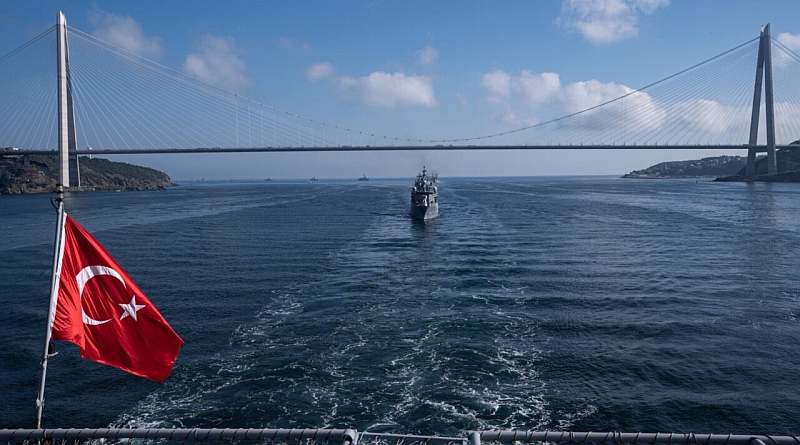
The security of trade routes is proclaimed by the Turkish administration as a top priority, though it masks an aspiration to strengthen national influence and single-handedly control the passage of grain and energy flows through the Bosporus and Dardanelles straits.
The application of the Montreux Convention allowed Turkey to close the straits to military ships of warring states, enabling it to block the strengthening of the Russian Black Sea fleet. At the same time, the Turkish side avoids sharp actions against Moscow’s aggressive steps, as Erdoğan aims to maintain special economic relations with the Kremlin, balancing between NATO obligations and commercial interests.
The full-scale war unleashed by Russia against Ukraine brings Turkey significant threats and economic damage. Drifting naval mines, regular attacks on port infrastructure, and assaults on civilian bulk carriers are disrupting familiar logistics chains, increasing freight and insurance costs in the region.
Turkish ships are regularly in high-risk areas, and recent incidents of damage to commercial transport have led the authorities in Ankara to restrict movement through the straits. The Kremlin’s aggressive policy has turned the once-stable Black Sea into a dangerous military arena, directly undermining Turkey’s food and energy security.
Turkey’s ability to lift the Russian military blockade of the “Greater Odessa” ports remains limited by political considerations regarding Moscow.
Although Ankara has a powerful navy and participates in mine-countering initiatives, Turkish leadership is not ready to enter a direct military conflict with the Kremlin to ensure free navigation.
Erdoğan’s diplomatic efforts to restore grain corridors are occasionally stymied because the Russian side uses hunger as blackmail and resumes attacks on Ukrainian ports.
The factual breakthrough of Odessa’s maritime isolation became possible due to Ukrainian forces’ strikes on Russian ships, while Turkey preferred to limit itself to cautious diplomacy and observation.
Ankara’s Black Sea initiatives lead to prolonged uncertainty because attempts to sit on two chairs do not allow for the formation of a reliable collective security system. As long as the Kremlin continues to use the region for escalation and attacks on civilian shipping, Turkish pragmatism merely masks the inability to guarantee complete order in the area.
