
Paul Adams, BBC / BBC News Ukraine
This morning, the Black Sea seems calm.
A Ukrainian Navy boat goes on patrol in an area that in recent weeks has become one of the most dangerous in the country. Here, a Russian missile or drone can appear almost without warning.
The military gazes silently at the horizon. The boat is equipped with machine guns, protective nets, and anti-drone systems. If attacked, there is a chance to fight back.
But the military cannot protect civilian vessels heading to or leaving Ukrainian ports.
They increasingly become targets of Russian strikes.
According to Ukrainian sailors, a real war is happening in the Black Sea. Russia and Ukraine are attacking each other’s ships, with hundreds of vessels already affected.
This is most obvious not during battle but when you look around.
Once this part of the sea was filled with commercial ships waiting their turn to enter port. Today the horizon is almost empty. Instead of dozens of freighters, there are just a few tugboats.
This silence best shows how much the life of Ukrainian ports has changed.
The military allows us to visit one of the largest Ukrainian ports on the Black Sea.
We do not disclose its name and location for security reasons.
Filming the area is also prohibited to prevent providing Russia with additional information about the state of port infrastructure after attacks.
Our guide is Dmytro, as we’ll call him for safety reasons.
In 20 years of working here, he says, he has never seen the port so empty.
Ukrainian ports are formally open. There are no bans for commercial vessels. But fewer are willing to enter.
“They are afraid that what happened in Odesa Bay this morning will happen to them,” Dmytro says.
According to him, since July, Russia has effectively started targeting civilian commercial vessels.
– Why now?
– It’s better to ask them, but the goal is obvious: to block Ukrainian ports and hit the country’s economy.
We walk along the docks.
Under the towering port cranes, it’s unusually quiet. Infrastructure designed for 24-hour operation has almost come to a standstill. Only a few people are working.
Two seriously damaged freighters stand by the dock. The bridge and crew living quarters are almost destroyed by strikes.
Throughout our time, we see only one cargo ship slowly entering the port.
“It breaks my heart,” says one of the enterprise’s managers, who asks not to be named. “Previously, even in open waters, ships waited their turn to dock.”
He recalls the grain deal brokered by Turkey and the UN in 2022. At that time, Russia agreed to unblock Ukrainian agricultural exports, and ships received a safe corridor.
“Russia pulled out of the grain deal in mid-2023, but it only started regularly shelling ports now.”
“They are aiming not at the ships, but at people”
According to co-owner and CEO of TIS port, Andriy Stavnytser, the current strikes have long surpassed the fight for port infrastructure.
“As far as I understand, the Russians are targeting not the ships themselves. They are aiming at people. At the crew.”
In his view, Moscow’s current campaign is most likely a response to successful Ukrainian operations against Russian shipping.
In recent months, Ukraine has repeatedly attacked tankers with Russian oil, as well as ships carrying cargo to occupied Crimea.
Using maritime drones in the “MoLoCHKa” operation (“Moscow will fall through Crimea”), about 200 Russian ships have been hit, nearly paralyzing movement in the Sea of Azov.
– I think this is a response.
– Revenge?
– Absolutely.
In Kyiv, however, they emphasize that the actions of the two sides cannot be compared. Ukraine attacks Russia’s military logistics, while Moscow strikes civilian vessels carrying Ukrainian grain to other countries.
For Ukraine, this is especially painful right now, during the harvest season.
“This is the most sensitive period,” says Volodymyr Slavinskyi, the trading director of one of Ukraine’s largest grain trading companies, “Nibulon.” “Farmers must quickly harvest the crop to avoid losing it. Then the grain needs to be sold, and the proceeds invested in the next production cycle.”
If Russia continues to disrupt the work of Ukrainian ports, the consequences will be felt far beyond Ukraine’s borders.
Before the full-scale invasion, Ukraine supplied about 6% of the world’s wheat exports and almost 10% of corn exports. It was one of the world’s largest producers of grains and oilseeds.
Since the start of the large-scale war, by various estimates, the country’s exports have decreased by at least a third.
Despite this, the Black Sea remains the main route through which Ukrainian grain reaches other countries. Last year, over 73 million tons of cargo were exported through the ports of Odesa, almost 38 million tons of which were grain.
Now there are fewer and fewer ships in the sea corridor.
“I would say that we have already lost the ability to supply approximately 500 to 700 thousand tons of Ukrainian grain and oilseeds to world markets,” says Slavinskyi.
“Look at my hands”
The consequences of these attacks are visible not only in the port.
In the office of the Union of Maritime Transport Workers of Ukraine, we are greeted by Svitlana Halchenko, a shift manager at the Odesa Sea Port.
She limps slightly. After a Russian missile strike a year ago, fragments of a ballistic missile still remain in her leg and back.
During the conversation, Svitlana tries to speak calmly.
But when she recalls the work of recent months, her hands start to tremble.
“Very hard. Many worries. Many ‘shaheds.’ Many hits. People live in constant tension.”
She smiles, but her eyes fill with tears.
“What can I say? Look at my hands.”
Then she recalls the day her partner died.
“My crane operator, my partner, died just five meters from me… The driver remained in the cab. He died too.”
Despite severe injuries, Svitlana returned to work. She says she couldn’t leave her colleagues.

According to the Ukrainian Sea Ports Authority, in July alone, Russia attacked civilian vessels 57 times. Of these, 22 strikes happened at sea.
Another 67 strikes targeted port infrastructure.
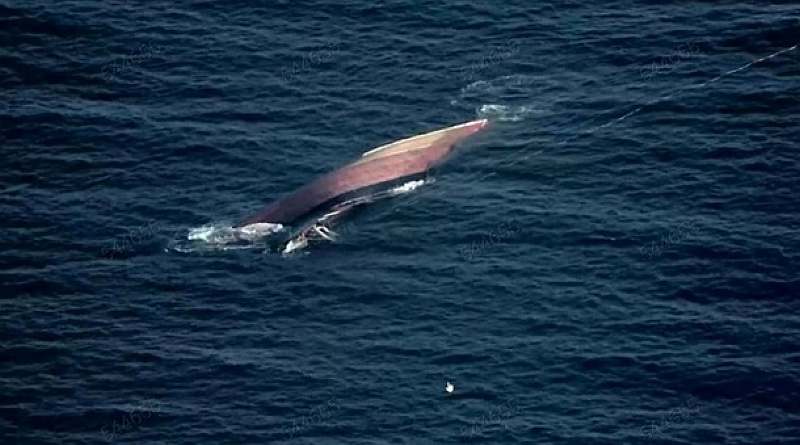
On July 19, three Russian missiles hit the bulk carrier Golden Leo, which was transporting Ukrainian corn. Ten crew members died, among them citizens of India and Syria, and a Ukrainian pilot. The vessel sank off the coast of Odesa.
According to Lloyd’s List, a leading international maritime publication, the Black Sea is likely today the most dangerous area for the merchant fleet.
And July was the deadliest month for civilian sailors since the start of the full-scale war.
The head of the Marine Transport Workers Union of Ukraine, Oleh Grygoryuk, says even veterans admit: working in the port is scarier than fighting.
“A missile from Crimea reaches us in less than a minute. To descend from the port crane to the shelter takes three and a half minutes. There’s almost no chance.”
We don’t manage to finish our conversation.
A siren sounds over the port again.
Together with the workers, we descend into the shelter.
Inside, almost no one speaks. People silently look at their phones, waiting for messages.
– Is it a drone?
– Yes.
A few minutes later, the all-clear is announced.
“Now you’ve seen for yourself what it’s like to work in the port during the war,” says Dmytro when we come outside. “For us, it’s just an ordinary day.”
Later it becomes known that two Russian recon drones fell nearby.
“If we start crying, nothing will change”
But outside the port, Odesa seems to live a completely different life.
The holiday season is in full swing. Beaches are filled with vacationers who have arrived from various parts of Ukraine. Street musicians play on the Potemkin Stairs, and people on the coast increasingly ignore air raid alerts and distant explosions.
On Monday, a video spread across social media showing holidaymakers pulling a Russian drone out of the sea. A crowd gathers around. Everyone understands how dangerous this is.
At the end of June, 26-year-old Daria Kravchenko died on a beach after debris from a downed Russian drone fell there.
A similar tragedy occurred this week on the Russian Black Sea coast. An intercepted Ukrainian drone, according to Russian authorities, crashed onto a crowded beach. Seven people were killed, including three children.
It is unknown what target Ukraine was trying to hit.
The war for ports and sea routes increasingly takes the lives of people who have no connection to it—sailors, port workers, and those who are simply unlucky enough to be nearby.
After a recent drone strike near Odesa, we met 83-year-old Andriy Dudyka. He stood by a damaged house, surveying the ruined garden.
Andriy himself was unharmed and spoke surprisingly calmly about the drone that interrupted his usual post-lunch nap just a few hours earlier.
Despite everything, he has not lost his sense of humor.
“If we start crying, it won’t change anything.”
Does he consider himself a random victim of Russian attacks on ports?
“Of course. And I will never forget that.”
Kristina Volk and Anastasia Levchenko also contributed to this material.
On the cover: The Russian-damaged cargo ship GOLDEN LEO sank on July 26, 2026. Photo: AMPU
