

Today I was asked a question that quite surprised me, namely, are Russia’s “Iskander” ballistic missiles running out, and where will they find replacements?
The question seemed quite strange, as, firstly, “Iskander” ballistic missiles do not exist; there is the operational-tactical missile system “Iskander-M/K,” and the missile itself is the 9M723. But someone might accuse me of being pedantic and dull. And they would be right.
Secondly, something that is being produced cannot run out. And it is being produced quite actively, I would say. Currently, 9M723 missiles are being produced at a rate of 3 units of finished product per day. In 2021, 9M723 were produced at a rate of 1 missile per week, today it’s 3 missiles per day.
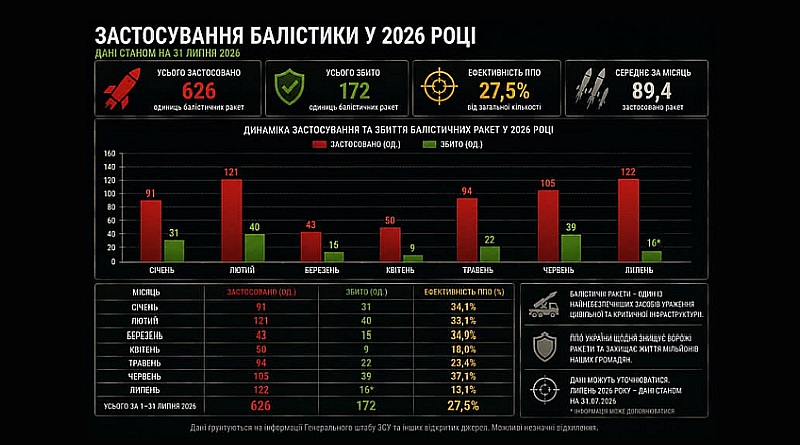
The use by the adversary of missiles such as 48N6DM, 3M22, P-800, and North Korean KN-23, in addition to 9M723, indicates the scaling of terror within the existing production capacities of all modifications. However, in 7 months of 2026, I have not seen monthly strikes exceed monthly production, which I have repeatedly stated and written about — the ROW is extremely rationally planning the current terror against Ukrainian cities.
Let me put it this way. Even the accumulated stockpile of missiles from 2025 has not particularly dwindled, so I have no idea where these assumptions that the ROW is running out come from.
Instead of dreaming about warm baths, hoping the enemy’s missiles will run out, it’s advisable to be prepared that a warm bath with such an approach may not be available.
It is essential to assess the enemy’s capabilities adequately, as well as the methods to counter these threats.
In the image: Statistics of the use and interception of ballistic missiles by months for the period from January to July 31, 2026
