
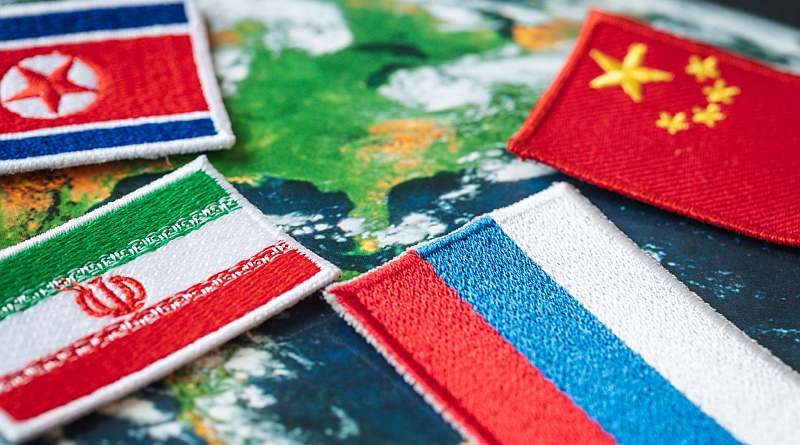
WASHINGTON – The deepening strategic partnership between China, Russia, Iran, and North Korea has become one of the major security challenges for the United States and its allies.
In the recently published book «Axis of Aggressors», retired U.S. Navy Rear Admiral Mark Montgomery and his co-authors Bradley Bowman and Elaine Dezenski documented over 600 instances of cooperation among the four authoritarian states. They argue that this interaction covers military, technological, economic, and cyber domains.
Montgomery heads the Center on Cyber and Technology Innovation and is a senior fellow at the U.S. Foundation for Defense of Democracies. He believes that the West still underestimates both the extent of this convergence and the risks it creates.
Radio Liberty spoke with him about the war against Ukraine, confrontation with Iran, the risk of simultaneous conflicts in different regions, and the changes the American military needs to make.
«Ukraine is fighting against all four»
– Has Washington finally started to perceive China, Russia, Iran, and North Korea as a single authoritarian axis, or does it still underestimate the level of coordination among them?
– We largely underestimate the level of their coordination. As a result, our response to their joint actions often proves insufficient. In the United States, this is particularly evident in the case of Ukraine.
Ukraine is effectively fighting against Russia, Iran, North Korea, and China.
Iran is providing Russia with «Shahed» drones – not only thousands of ready-made devices but also technology for their production within the country. Now Russia itself mass produces drones based on the Iranian design.
North Korea deployed 12,000 military personnel, which is usually the focus of attention. But it also supplied Russia with five to six million artillery and mortar shells. This is more than all NATO countries have produced in several recent decades.
China, for its part, supports the Russian war machine by supplying microelectronics for ballistic, hypersonic, and cruise missiles, which are currently being used to strike Kyiv.
Therefore, Ukraine has to fight against all four countries.
The United States, even under Joe Biden’s administration, has been very slow to supply Ukraine with the necessary weapons systems of the required range. The U.S. also has not deployed its military in Ukraine to train Ukrainian forces.
U.S. President Donald Trump did even less, reducing security assistance by 99 percent compared to the Biden administration. Therefore, we have not done enough in Ukraine.
At the same time, a similar problem can be seen in Europe when the United States confronts Iran.
Iran is an authoritarian regime that has existed for 47 years and has supported terrorist activities for almost its entire duration. It has killed over a thousand American military personnel in Iraq and Afghanistan, around 500 NATO country servicemen, and hundreds of Europeans as a result of terrorist attacks.
Iran supports its allies and controlled groups, including Yemeni Houthis, Hezbollah, as well as armed formations in Iraq and Syria. It also killed over 30,000 of its own citizens in a single weekend.
Yet Europe continues to view this conflict, claiming that Iran and the United States are two equivalent sides of a confrontation. This is absurd.
Iran has support from Russia. It is backed by China. In the past, it also received support from North Korea. But we still cannot get Europe’s support in confronting Iran.
Thus, we see two different conflicts where the West clearly does not recognize the scale of the interaction between these countries and does not respond to it collectively.
Are the U.S. ready for multiple simultaneous wars?
– You have repeatedly warned about the risk of coordinated crises that could force U.S. forces to operate in multiple theaters of war simultaneously. How close is the Pentagon to being unable to support two or three wars at once?
– There are two main problems here.
The first is the structure of the armed forces: the number of ships, aviation squadrons, tanks, and battalions.
The second is ammunition reserves.
The situation with force structure is somewhat better. We are relatively close to being capable of conducting several conflicts simultaneously, but we do not yet have that ability. We need larger investments and higher defense spending.
We often criticize European countries for not taking an adequate share of defense spending. However, American defense expenditures have also decreased—from about 4–5 percent of Gross Domestic Product at the end of the Cold War to about 3 percent, and at the end of the Biden administration, even lower than this level.
A much more serious problem is ammunition. Our reserves have been insufficient after 25 years of underfunding. Now they are under additional strain due to support for Ukraine and operations related to Iran.
When comparing force structure and ammunition reserves, the shortage of ammunition will be a more serious threat in the event of multiple simultaneous conflicts.
“Russia Shares Experience with China, Iran, and North Korea”
– Your research indicates that Chinese microelectronics are used in both Iranian missile production and Russian weapons programs. U.S. officials often cite sanctions as the main response. Can they be effective if Beijing remains a technological and economic pillar for this entire axis?
– One of the main problems with microelectronics is that many components have dual-use purposes.
A certain product may be exported to China for entirely legitimate civilian use and then repurposed or redirected for military needs and transferred to Russia. This makes enforcing sanctions very difficult.
Furthermore, export restrictions on Russian and Iranian oil have often been implemented inadequately, and in many cases, simply ignored.
New legislation is now being discussed, including Lindsey Graham’s bill, which aims to increase pressure on Russia. But in reality, the government already has many necessary powers. We just don’t apply them properly or allow for too broad exceptions.
Sanctions remain important. They limit access to technologies, which is particularly significant for Iran, and also reduce the financial resources that Russia and Iran can use to wage war.
Talks with Iran
– While Washington considers the possibility of diplomatic negotiations with Tehran, you caution against hasty agreements. What is the greatest strategic risk if a potential agreement does not dismantle Iran’s broader military infrastructure and its allied group network?
– It’s hard to pinpoint just one priority here.
Obviously, Iran should not acquire nuclear weapons or ballistic missiles capable of delivering them.
The good news is that due to the joint bombing campaign over the past year and a half, Iran’s nuclear program has been pushed back by about five to ten years.
The facilities have been significantly damaged, engineers have been lost, and missile production has suffered serious losses. Iran can partly compensate for this through imports from Russia or China, but now it is much more challenging.
Another major issue remains the Strait of Hormuz. Iran’s geographical position gives it significant leverage over shipping through this route.
Oman has a similar geographical advantage but adheres to international law. Iran does not. Therefore, the Strait of Hormuz will continue to be an important strategic issue.
Negotiating with Iranian authorities is difficult since the Islamic Revolutionary Guard Corps can inflict enormous suffering on Iranian citizens without bearing corresponding costs themselves.
In my opinion, even before negotiations begin, a much more aggressive campaign should have been conducted to create costs for companies controlled by the Islamic Revolutionary Guard Corps.
They control large segments of construction, shipbuilding, and telecommunications. These enterprises should be treated as businesses belonging to a terrorist organization.
Ukraine as a Testing Ground for New Warfare
– You recently visited the Ukrainian frontline. Has this war effectively become a battle laboratory where the authoritarian axis tests and refines methods of future warfare?
– Yes, for both sides.
For the United States, the West in general, and Russia, Ukraine is a laboratory. The difference is that the U.S. does not fully utilize this opportunity.
The United States has only a minimal military presence in Ukraine, mostly related to embassy work. We do not have enough specialists who could directly study the battlefield experience.
Meanwhile, Russia is actively sharing the lessons learned with China, North Korea, and Iran.
North Korea is learning directly from the war. Initially, it sent 12,000 troops, and now there are reports of possibly up to 30,000 North Korean military personnel participating on Russia’s side.
They are gaining firsthand experience of this new form of warfare in which both sides constantly change tactics and adapt to new technologies.
The United States and its European allies should be much more active in adopting Ukraine’s experience. We are learning, but not nearly as quickly as we could.
What Russia offers in return for support
– Russia and Iran exchange data for target identification and combat experience. How quickly does this feedback improve the ability of U.S. adversaries to counter American weaponry and military doctrine?
– There are two different dynamics at play here.
The first is that Russia learns very quickly directly on the battlefield. It promptly adapts and subsequently shares this experience with other countries.
This primarily enhances Russia’s own capabilities, but over time it also strengthens its partners.
The second dynamic is what Russia provides to these countries in exchange for their support.
Iran receives information that helps identify the location of American forces in the Middle East.
North Korea is receiving space assistance that directly supports the development of intercontinental ballistic missiles capable of reaching the United States in the future.
North Korea has already transferred missile technologies to Iran and may do so again.
China likely receives the greatest advantages. According to reports, Russia is providing it with submarine noise reduction technologies, helping to overcome one of the U.S.’s main military advantages over China.
Russia is also reportedly transferring technologies and conducting training for large-scale airborne operations using helicopters, which may be required in a possible invasion across the Taiwan Strait.
This involves a significant transfer of military capabilities that Moscow was previously unwilling to share. It’s part of the price Russia pays for support in the war against Ukraine.
Main reform for the U.S. Army
– Looking beyond current conflicts, what one structural reform should the U.S. Army implement in the next decade to deter an increasingly coordinated authoritarian axis?
– The biggest structural changes need to occur in the defense procurement system. Specifically, we must be ready to take on more risk to work significantly faster.
For decades, the United States could afford a very slow and consistent process because no state was able to seriously challenge us.
We spent 15 years designing and building a ship. Developing and commissioning a new aircraft took ten years. These timelines need to be radically reduced.
When it comes to drones, counter-drone systems, or munitions, procurement should take months, not years.
Even the development of large platforms like ships and aircraft should be measured in years, not decades.
Ultimately, success will depend on reforming defense procurement and the ability to create a fast and flexible system necessary to compete with our adversaries.
