
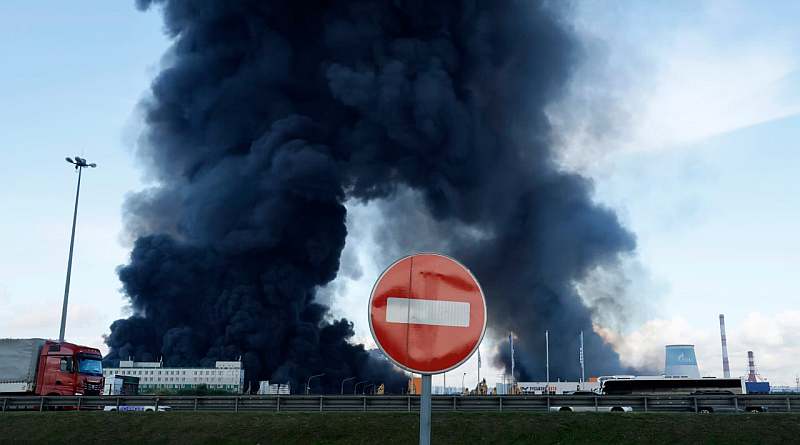
Ukrainian strike UAVs have become frequent visitors at the warehouses of the Russian company Wildberries, the Russian counterpart of Amazon. It has a network throughout the Russian Federation and serves as a hub for a vast number of retailers and consumers.
The visits began on July 17–18, and today 12 out of 25 warehouses have been affected: in Elektrostal, Moscow region, Saint Petersburg (two locations — Shushary and Utkina Zavod), Krasnodar, Nevinnomyssk, Stavropol Krai, Penza, Sarapul in Udmurtia, Simferopol, Ryazan, Volgograd, Novosimeikino in Samara region, and Khryastovo in Vladimir region. Fires have covered a total of 1,508,900 m².
Why are the Defense Forces attacking these warehouses?
It is clear that planes-tanks-guns-munitions do not move along this logistical path. However, semi-military goods and dual-use items do so quite actively. Among the supply channels for small drones and components for them is Wildberries.
The role and position of Wildberries (grandiosely and fully — the RWB/Wildberries & Russ group) at the beginning of 2026 is described by the indicators: total annual turnover — over 6.1 trillion rubles (+49% compared to 4.1 trillion in 2024), net profit — 175 billion rubles (+68% compared to 104 billion in 2024), investments — over 310 billion rubles in logistics, IT, and new directions. Own logistical complexes totaling 5.2 million m² (there are estimates that even up to 5.6 million); processing millions of orders per day; hundreds of warehouses and pick-up points; over a million sellers and tens of millions of active buyers.
This is the largest marketplace in the Russian Federation, holding up to 52% of the e-commerce market. Together with Ozon (and the Defense Forces have only checked the air defense and fire safety at one of its warehouses — in Zelenodolsk, Tatarstan), it dominates and controls up to 77% of the market. The turnover of the RWB group is equivalent to several percent of Russia’s GDP. E-commerce in general and marketplaces in particular are an important part of the consumer economy, employment, and tax revenues. Wildberries also develops fintech, advertising, and logistics.
When Defense Forces analysts concluded that consumer sentiments could have a significant impact on the situation in enemy rear areas, the carbon birds were sent on their way. They also needed to ask about the strikes on “Nova Poshta” and Ukrposhta. In the first phase of the “bird migration,” up to 10% of logistic areas were affected (440–550 thousand m²). Then they increased the rate and reached 860 thousand m² (15% of total areas). If counting affected warehouses (i.e., partially damaged), not those that burned down, it involves 1 million m². The company’s biggest losses: Elektrostal — 250 thousand m², Ryazan — 170 thousand m², Kotovsk, Krasnodar, Nevinnomyssk, Shushary — 100 thousand m² or more.

Losses in goods are estimated at 150–235 billion rubles in Elektrostal and Kotovsk alone, with total losses for sellers and the company reaching $2 billion.
What the Defense Forces achieved with these strikes:
- significantly and painfully hit the consumer economy, small/medium sellers (hundreds of thousands of “businessmen” depend on the platform’s operation, they lost stock: only the warehouse in Shuvalovo absorbed the property of 1,500 entrepreneurs);
- hit logistics and employment (the company is a large employer);
- undermined trust in e-commerce and supply chains.
This does not collapse Russia’s economy, of course, but it causes noticeable disruptions in regional logistics, increases inflationary pressure on certain product groups, creates new problems for the “Moscow Commodity Exchange” haven, further strains the budget and insurance (entrepreneurs from regions where e-commerce is almost the only way to earn will come to employment centers; unfortunately, also to military enlistment offices, as they have nothing to lose besides debts).
Rebuilding the warehouses will cost tens of billions of rubles, but that’s a personal expense for the owner of Wildberries, Tatyana Kim. Repeated strikes will complicate operations even more. Along with attacks on oil refining and energy facilities, this will pressure the rear infrastructure. The company seeks to move part of the warehouses to Kazakhstan. They don’t want to touch what seems to be a neutral country, but the Iranian ship had to — they sent it to the bottom of the Caspian… So it’s better not to provoke. And they shouldn’t propose nonsense like processing Russian oil at Kazakh refineries. Better safe than sorry.

Through Wildberries, FPV drones, hexacopters, components (flight controllers, engines, drop mechanisms, fiber optic coils, etc.), armor plates, helmets, tactical gear, radios, thermal imagers, and scopes were moving to the aggressor’s army. There is an entire category “Everything for the SVO” with thousands of military/dual-use items (22.4% of the total volume of goods processed by Wildberries).
Thus, the conclusion: Wildberries was and remains part of the “people’s military-industrial complex,” volunteer/crowdfunding supplies, parallel imports, primarily of Chinese components. Most of the products on the platform have been and still are civilian, but military/dual-use items and logistics made WB hubs a relevant target for Ukraine.
Drone strikes by the Defense Forces destroyed stocks of such goods, complicated quick supplies to the front, and increased costs/risks for suppliers. What the Ukrainian drones didn’t finish off, the Russian firefighters soaked, for which they can be slightly thanked. What drowned won’t burn.
The direct effect on official military procurement is certainly limited, but for gray and volunteer supplies of FPV and components, it is very noticeable and already felt: it is reported that the use of FPV in the troops is strictly limited due to logistics problems. How unexpected!
There is another hidden effect — the struggle of influential players in Russian business for an air defense umbrella for their assets will intensify. There is not enough air defense for everyone, but one’s wallet is dearer than some foreign oil refinery, even if it burns! And they almost blew up the head of the Air Defense Committee, Colonel General Alexander Chaika. Unfortunately, they didn’t finish him. Maybe next time. But the leading commander of the Russian air defense got tense and is not too inclined to think about someone else’s warehouses.
The widespread fuel shortage at the beginning of the summer, created by the Defense Forces, showed the enemy’s inability to cover not only everything but even key objects, from which we conclude that nothing will come of it here either: Russia’s inability to take serious measures to strengthen air defense is a fact that requires no proof. Open rears and chronic inability to protect its airspace are a huge vulnerability that Ukraine must maximize.
In favor of this thesis is the removal from office of the coordinator of deep strikes, the commander of missile troops and artillery Major General Andriy Malinovsky, and the preparation of a decree by the President of Ukraine on the creation of a new command that will coordinate and optimize long-range strikes. General Drapaty is taking the right step.
Cover photo: Occupier’s media
