

Information on current Russian losses due to sanctions as of 03.08.2026.
1. Ukraine attacked a university where drones were developed and one of the largest Wildberries logistics centers.
– On the night of August 3, Ukrainian drones attacked the Belgorod State Technological University named after Shukhov, where an automated drone control system based on the Russian microprocessor “Milandr” was developed and tested.
– After several hits on the university grounds, a large-scale fire broke out, completely destroying one of the buildings.
– One of the largest Wildberries logistics centers in the Vladimir region was also hit. The logistics complex, covering an area of 171.9 thousand m², is an important hub for Russia’s largest marketplace network and handles the distribution of goods for the Moscow region, the central, and northwestern parts of the European territory of Russia.
2. Russia’s banking sector faced the largest liquidity shortage since March 2022.
– In July, Russians withdrew 595.5 billion rubles in cash from banks and ATMs — 39% more than the previous month. This is the second-largest monthly figure of 2026, after April, when 679 billion rubles were withdrawn by the population. Overall, the amount of cash in the hands of the population exceeded 2 trillion rubles since the beginning of the year.
– The massive outflow of funds from banks led to the sharpest liquidity shortage in Russia’s banking sector since March 2022. Banks increasingly lack free funds for daily operations and lending.
– According to forecasts, the demand for cash may rise to 650–700 billion rubles per month by autumn, further exacerbating the liquidity deficit. To attract funds back into the banking system, financial institutions will likely have to raise deposit rates or seek financing from the central bank.
3. Russia’s federal budget deficit reached almost 8.7 trillion rubles by the end of July, nearly double the planned figure for the entire year of 2026.
– Over seven months, budget revenues amounted to 19.2 trillion rubles, while expenditures reached 27.9 trillion rubles. Initially, the government planned for an annual deficit of 3.8 trillion rubles, later increasing it to 4.7 trillion rubles, but the actual deficit has already significantly exceeded this level.
– The main reason for the worsening budget situation remains record military spending, the financing of the military-industrial complex, and payments to servicemen.
– Meanwhile, revenues from raw material exports are declining, and the tax base is weakening due to the economic slowdown. To cover the deficit, the authorities will have to more actively engage in domestic borrowing, spend reserves, or resort to additional monetary emission, which will intensify inflationary pressure and increase the burden on public finances.
4. The Russian oil industry is increasingly facing structural problems: readily accessible reserves are depleting, production costs are rising, and dependence on imported technologies remains critically high.
– Over the last 25 years, oil extraction conditions in Russia have significantly worsened. While new fields provided high extraction volumes in the early 2000s, companies now increasingly have to work at old and depleted fields, where each new well yields significantly less oil than before.
– Today, about 50% of all operating oil wells in Russia are low-yielding — producing less than 30 cubic meters of oil per day.
– Additionally, due to a shortage of modern equipment for operating such wells, approximately 45,000 of them are entirely idle.
– The situation is complicated by technological dependence on the West. In the segments of exploration, drilling, and oil transportation, the share of imported technologies and equipment still reaches 70%, which increasingly affects the ability to maintain production under sanctions.
– The Russian oil industry is gradually losing competitiveness: extracting oil is becoming increasingly difficult and expensive, and the opportunities to compensate for this with modern technologies are diminishing.
5. Despite the growth in PMI, Russian industry faces weak exports, personnel losses, and record business pessimism.
– The business activity index (PMI) in Russia’s manufacturing sector increased to 50.7 points in July from 50.3 in June, according to S&P Global. This growth was primarily driven by domestic demand. Meanwhile, the survey identified several negative trends.
– Export orders are shrinking at the fastest pace since October 2022 due to weak demand in key foreign markets.
– Companies continue to reduce staff — employment is decreasing as manufacturers do not replace departing workers.
– The volume of unfulfilled orders has been declining for the 18th consecutive month, indicating underutilization of manufacturing capacities.
– Inflationary pressure is also intensifying. The cost increase of raw materials has reached its highest point since January 2026 due to fuel shortages, transportation issues, and supply cost increases. Producer prices for finished products are rising at the fastest rate in the past six months.
– An additional source of pressure is supply chain issues: delivery times for raw materials have increased the most since February 2025.
– Despite the slight improvement in the PMI index, business sentiment has worsened to its lowest level since May 2020. Companies attribute this to customer uncertainty, increased competition, and worsening business conditions.
6. Ukrainian attacks have caused a shortage of vessels for exporting Russian coal through the Black Sea.
– Due to regular Ukrainian strikes on Russian maritime infrastructure and shipping, Russia has faced a shortage of vessels for exporting coal through the Black Sea.
– According to the Price Index Center, as of July 26, the number of available bulk carriers decreased to 97 vessels — 21% less than a month ago and 28% less than a year ago.
– Following increased risks in the Black Sea, insurance companies have begun refusing to insure vessels entering the Azov-Black Sea basin. As a result, large bulk carriers are redirecting to other routes, and some small-tonnage vessels have been withdrawn from operation until the situation stabilizes.
– The fleet shortage has already affected exports: throughout the last week, Russian companies have not concluded any new coal supply contracts through the Black Sea. At the same time, the reduction in available tonnage has led to an increase in maritime transportation costs.
– The cost of delivering coal by Panamax ships from the port of Vostochny has increased by 5-10% over the week, depending on the route. Worsening logistics and rising transportation costs further complicate the export of Russian coal, which is already under pressure from sanctions, weak demand, and reduced profitability.
7. Large businesses in Russia are massively cutting costs.
– In July 2026, a record 86% of the largest companies reported cutting costs to “increase business efficiency.” This is 21 percentage points more than the previous survey in April and the highest figure during the entire period of the full-scale war.
– The main problem for 40% of companies was non-payment from counterparties. According to Rosstat, the volume of overdue settlements in the economy reached 9 trillion rubles. Another 33% of businesses reported a drop in demand, and 27% reported a lack of working capital.
– The deterioration of the financial situation forces large companies to cut staff, postpone investment projects, and halt production facilities. This year, VTB and Russian Railways have already announced massive layoffs, Rosatom postponed the construction of new nuclear power plants, and the largest metallurgical companies reported suspending part of their production.
– According to an estimate by the Kremlin-associated CMACP, civilian sectors of the economy outside the military-industrial complex are shrinking by 4.6%, and business profits are falling for the second consecutive year.
– The main factor cited by company leaders is the uncertainty of the economic situation: fears of further war escalation, new mobilization, and increased state control over the economy are holding back investments and deepening the crisis phenomena.
8. The EU landed on a Russian “shadow fleet” tanker in the Mediterranean Sea for the first time.
– As part of the EU maritime mission EUNAVFOR MED Irini, Italian military landed from a helicopter on the tanker Toa Payoh, which is part of Russia’s “shadow fleet” and is under EU sanctions.
– The tanker, flying the flag of Cameroon, was intercepted in the Mediterranean Sea west of the Italian island of Pantelleria during its voyage from Benin to Istanbul.
– According to the Italian Ministry of Defense, the ship’s captain initially refused to comply with the inspectors’ demands, after which a group of Italian soldiers boarded from a helicopter. The inspection of the ship, which lasted about two hours, was supported by a Greek military ship and a Polish maritime patrol aircraft. During the operation, they checked the national affiliation of the vessel, the legitimacy of the flag usage, and the ship’s documentation.
– Following the inspection, the Italian authorities are reviewing the seized documents. The operation became one of the EU’s toughest steps to monitor the activities of the “shadow fleet” used by Russia to circumvent oil sanctions.
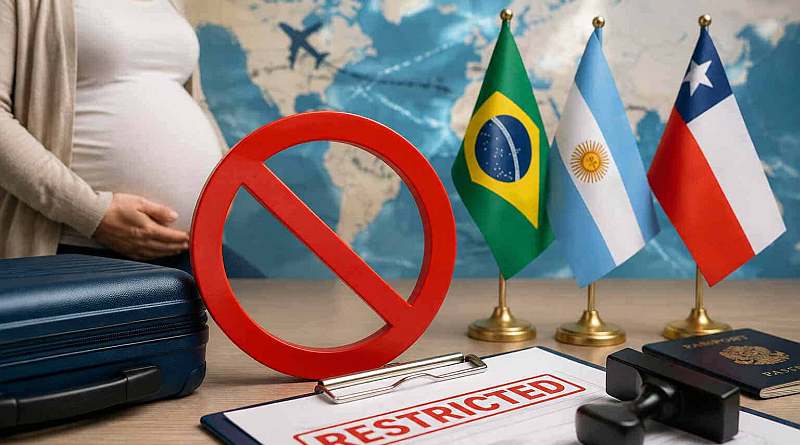
9. Brazil has begun restricting “birth tourism” from Russia.
– Brazil has become the third Latin American country after Argentina and Chile to begin countering “birth tourism” from Russia. The country’s border service has started denying entry to pregnant Russian citizens if there is suspicion that the trip’s purpose is to give birth in order to obtain Brazilian citizenship.
– According to a representative of one of the agencies organizing births abroad, in just two days, Brazilian authorities refused entry to over 10 families, and four families were indefinitely banned from entering.
– The popularity of Brazil among Russians was explained by the fact that after the birth of a child—a Brazilian citizen—the parents could obtain permanent residency through the family reunification program, and subsequently apply for citizenship much faster.
– After stricter immigration rules in Argentina, Brazil became one of the main destinations for Russian “birth tourism.” Now, this opportunity for Russian citizens is significantly narrowing.
