
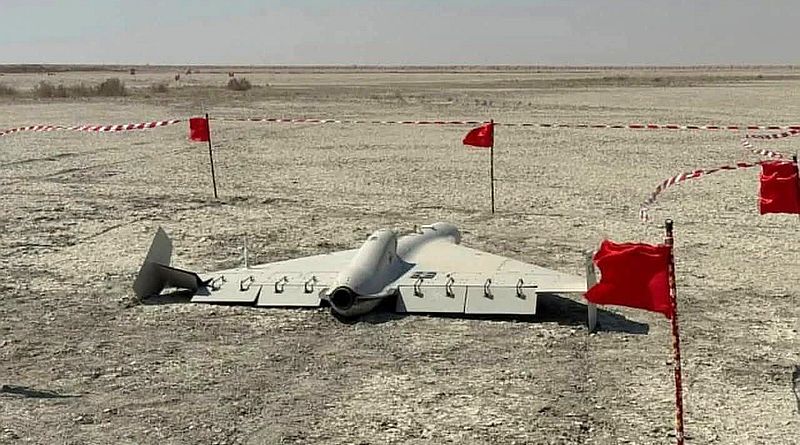
One of the priority tasks of Ukraine’s air defense is to learn how to destroy the Russian jet “Shaheds,” stated presidential advisor Serhiy Beskrestnov (Flesh) following a meeting with the head of state. Jet “Shaheds” appeared in the enemy’s arsenal relatively recently and are effectively a mass substitute for cruise missiles. Texty.org.ua examines what this weapon is and why it is being discussed at the highest levels.
The loitering munition with Iranian roots, Shahed-238, known in Russian nomenclature as “Geran-3,” is equipped with a compact turbojet engine, unlike its propeller-driven predecessor, Shahed-136. Similar engines, only larger, are found in familiar passenger planes that we normally traveled on during peacetime.
The key difference is that the speed of this device is two to three times higher than the older model. Consequently, the response time for air defense systems (ADS) is significantly reduced.
Although Iran introduced Shahed-238 at the end of 2023, its combat applications were sporadic. The situation changed in the second half of 2025 when Russia managed to produce the “Geran-3.” This year, jet “Shaheds” have become a common element of combined air attacks on Ukrainian cities.
The drone is approximately 3.5 m in length, with a wingspan of 3 m, and a maximum takeoff weight of 380 kg. The combat payload is estimated to be 50 kg.
The jet “Shahed” can be used in several variants. The basic version with an inertial navigation system combined with satellite GPS/GLONASS is used for strikes on stationary targets. Modifications with infrared or optical homing heads are for attacking moving objects. With a radar homing head, it is used for destroying radar stations and air defense systems.
Among the obvious drawbacks, the turbojet engine consumes a lot of fuel, resulting in a shorter flight range. Producing such a UAV is more expensive than the propeller version: $50–100,000, depending on the configuration.

Incidentally, Ukrainians have already learned to recognize jet “Shaheds” — the flight is accompanied by a loud whistling sound that can be heard from afar.
What they shoot down with
The turbojet engine provides the drone with a radical increase in speed and flight altitude.
“The Chinese engine accelerates the new ‘Shahed’ to 380–400 kilometers per hour. Under ideal conditions, the maximum speed can reach 450 or even 600 kilometers per hour,” notes one of the military experts.
Let us remind you that the old propeller ‘Shahed’ flies at significantly lower speeds: 160–170 km/h, with a maximum under certain conditions of 200–210 km/h. It all depends on altitude gain and maneuvering: the more maneuvers, the lower the speed, and vice versa.
The old ‘Shaheds’ are effectively shot down from helicopters like the Mi-8 and Mi-24 or even from sports light aircraft (according to expert estimates, 40% of all interceptions). Additionally, they fly at an altitude of up to 2000 m, making them an ideal target for mobile fire groups and portable anti-aircraft systems (MANPADS).
Another 20–30% of the old ‘Shaheds’ are destroyed by interceptor drones. Artillery systems like Gepard and Skynex collectively shoot down 15–20% of the drones, while mobile fire groups account for 8–10% of interceptions.
The rest of the strike drones are destroyed by anti-aircraft missile systems and fighter aviation.


Difficulty of Shooting Down
The jet version of the drone completely disrupts the previous scheme.
“Since the average altitude of such a drone before entering the target area is about four kilometers, it protects it from most MANPADS from the ground. Small arms, systems like Gepard, Skynex, and other artillery installations almost do not reach the target at a height of four thousand meters or hit with extremely low efficiency. Hitting the drone at such heights is rather coincidental,” explains the officer.
As a result, in the expanded network of mobile fire groups, response time has been reduced threefold. The purely acoustic effect has also changed. Due to high speed, the sound of the jet engine is simply delayed: when observation posts hear it, the drone has already passed the zone of possible visual targeting.
Economic Imbalance and Technical Limitations
The transition of the “Shahed” to the high altitude and high-speed segment automatically classifies it as a target that requires classical anti-aircraft means for destruction: fighter aircraft with air-to-air missiles or heavy medium- and long-range surface-to-air missile systems (such as NASAMS, IRIS-T, or S-300).
This creates a huge financial and material disproportion between the cost of the offensive means and the interception means.
“The means of destruction remain only combat aircraft and SAM systems, the missiles for which cost from 150 to 200 thousand dollars each. Meanwhile, the price of a jet ‘Shahed’ is let’s say up to 80 thousand. The philosophy of confrontation is gradually shifting to classic air warfare, only this time with drones,” says the officer.
Due to the high speed of the target, the primary burden of intercepting jet drones falls on automated air defense systems.
According to experts, the distribution of interceptions is as follows:
- surface-to-air missile systems (IRIS-T, NASAMS, Patriot, etc.) — 35–45%;
- artillery complexes Gepard, Skynex, and other 35-mm systems — 25–35%;
- fighter aircraft — 10–15%;
- interceptor drones — 5–15%;
- army aviation — 5–10%;
- mobile fire groups — up to 5%.

Official statistics on the distribution of interceptions of jet Shahed-238 by type of destruction means have not been disclosed.
Due to high fuel consumption, the maximum operational range of the Shahed-238 falls to 150–200 km, and that’s only with a tailwind.
To send the drone further, 300–400 and up to 1000 km, the Russians are forced to significantly reduce the payload — to 20–25 kg. Such combinations have been recorded recently over Kyiv.
To compensate for the reduction in explosive weight, the occupiers have started equipping jet drones with thermobaric (fuel-air explosive) charges. These have a high ability to ignite objects, create a powerful blast wave, and shatter glass within a large radius around the explosion epicenter. This makes them a dangerous weapon in the frontline zone and near the rear but limits their use for strategic strikes deep within the country.
Conclusions
Russian military technologies are adapting to the conditions of confrontation. By elevating “Shaheeds” to 4 km and forcing air defense forces to expend scarce anti-aircraft missiles, the enemy is pragmatically depleting Ukrainian stockpiles ahead of future massive attacks.
While the defense complex seeks asymmetric responses—from high-speed interceptor drones to new electronic warfare systems (such as the “Pokrova” system)—the main rule for the civilian population remains the strict observance of safety measures. Hopes that a high-speed reactive target can be taken down with a machine gun over a neighboring building are no longer realistic.
On the cover: Iranian drone Shahed-238, found in Iraq in 2025. Source: Sergey Flesh’s Telegram channel
