
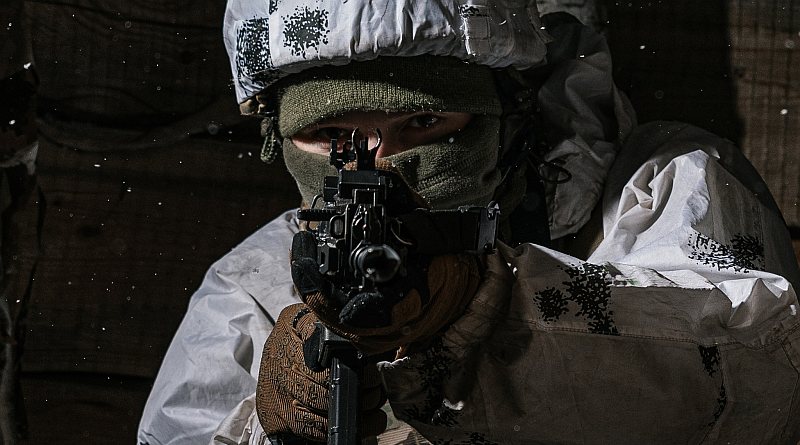
Oleksandr Kovalenko / Obozrevatel
In January 2026, Russian occupying forces slowed down their territorial gains in Ukraine, but the intensity of combat did not change significantly. This maintained the average loss metrics for Russian occupation forces in several categories, but also reduced the effectiveness of their activities. However, the first month of the new year showed several very interesting figures.
Read more about this in the joint project by OBOZ.UA and the group “Information Resistance”.
First of all, I should note that at the turn of December 2025 and January 2026, weather conditions deteriorated sharply across almost the entire line of engagement. Amid the Russian forces reaching large cities and settlements and engaging in exhausting urban battles, conducting offensive operations in field conditions with low temperatures and heavy snowfall is quite a challenging task for an infantry-oriented army.
These and many other factors affected both the losses of the aggressor country’s army in January 2026 and the pace of its advance and territorial gains in Ukraine.
Personnel Losses
In January 2026, the losses of the Russian occupation forces were not record-breaking compared to 2025 and were even lower than December of the previous year. However, they look quite interesting in proportion to the territories captured in the month. But let’s go through everything in order.
Thus, Russian forces’ losses in January amounted to 31,710 personnel. At the same time, deaths were less than 20,000, which is also worse than the absolute record set in December 2025 – over 22,000 people.
In January 2026, Russian occupiers captured 231 km² of Ukrainian territory, which is almost half the figure for November and December 2025, but slightly less than in September and October.
The proportion of occupation forces’ losses to captured territories was 137 bodies per 1 km², which is quite a good indicator of enemy losses for their consistent attrition.
Such proportions can be caused by both the complex urban combat conditions in which Russian forces are bogged down in major directions and the challenging weather conditions. Nonetheless, this situational moment can play a very important, positive role in shaping the future strategy of the Ukrainian Defense Forces regarding the attrition of Russian forces during the spring-summer combat operations.
Tank Losses
In January, Russian occupiers lost 137 tanks. This is the highest figure since May 2025. Such an increase is explained by the fact that under difficult weather conditions and the need to show certain results of offensive actions, the Russian command was forced to engage this mechanized component more often.
This was predictable, and I have repeatedly noted in my reviews that during the winter period, Russian occupiers would begin using MBT components more frequently than in the last six months of active hostilities in 2025.
However, such a level of MBT activity will not last long, and the use of this component will be exhausted after February-March, again favoring light transportation vehicles (LTV) and infantry.
Let me remind you that in 2025, the Russian occupation forces lost 1,814 tanks, with losses sharply decreasing from February due to extreme MBT conservation on the battlefield and very rare use starting in May.
AFV Losses
In January, the loss of armored fighting vehicles in the Russian occupation forces was 131. And, strangely enough, this is less than the MBT losses. Although ordinarily, the AFV units should have a minimum ratio of 3 to 1 compared to tanks. In other words, for a conditional company of tanks – a battalion of AFVs.
We are now witnessing a phenomenon where Russian troops are using AFVs in the combat zone in the same quantity as the main battle tanks or even less. And there is a very unpleasant explanation for the adherents of the so-called “SMO.”
The AFV losses in Russian troops during the full-scale invasion of Ukraine were so great that production from scratch or restoration from Soviet legacy storage centers, as well as repair after damage in the combat zone, do not compensate for losses and the average need for this type of equipment.
The same case where there are fewer Russian AFVs on the battlefield than tanks – despite even the new production of AFVs being higher than MBTs. A paradox? No, the realities of a degrading Russian military-industrial complex.
Artillery Losses
January 2026 was quite notable for artillery losses in the Russian occupation forces – 1,099 units.
While not a record, under current conditions it’s a clear indicator that in case of worsening weather and reduced drone activity in the nearby zone, artillery is deployed – to support offensive actions.
Let me remind you that the artillery losses in 2025 amounted to 14,017 units.
MLRS Losses
The loss of multiple launch rocket systems in the Russian occupation forces in January amounted to 45 units.
This is the highest MLRS loss figure for Russian occupiers since November 2023, also driven by the enemy command’s attempt to accelerate offensive processes in several directions – while needing to demonstrate results on the diplomatic arena. However, they lack any impressive outcomes.
Air Defense Losses
During January, Russian occupation forces lost 24 air defense systems.
The defense forces of Ukraine continue systematic work to destroy Russian air defense systems, and January 2026 became the most active and successful month in this category since May 2025.
Transport Losses
In January, Russian occupation forces set an absolute “silver” record for losses of motor vehicles – 4,021 units! More were lost only in April 2025 – 4,104 units.
This is a consequence of the prolonged attempts by the command of the Russian Armed Forces to speed up the offensive process in several directions for impressive statistics and reports for negotiation processes. However, all this occurs amidst challenging weather conditions and the impossibility of conducting offensive actions solely on foot. At the same time, the list of losses in vehicular transport includes all LTZ used by the Russian Armed Forces, even those that do not belong to the “vehicle” class.
Let me remind you that in 2025, the Russian Armed Forces lost over 42,225 units of vehicular transport!
Losses of Special Equipment
In January, Russian forces lost 20 units of special equipment, which has long been an unchanged average statistic of losses in this category.
Conclusions
The first month of 2026 turned out to be challenging for the Russian occupation forces due to weather conditions, making it even harder to break through the defense of the Ukrainian Armed Forces. The weather also did not always allow for air support, forcing artillery and MLRS to move closer to the line of confrontation, which again placed them on the list of higher-than-average losses.
However, the measures taken did not accelerate the rate of territorial capture in Ukraine. The Russian Armed Forces were unable to capture the cities and settlements they encountered, despite the intensity of hostilities not decreasing. The losses of personnel and light vehicles clearly demonstrate how active the combat engagements are now.
It is evident that this trend will persist until the end of winter, but with the onset of warmer weather, the Russian Armed Forces will face another natural obstacle—muddy terrain. This will temporarily complicate logistics and troop mobility, with all the ensuing consequences for both the effectiveness of the offensives and the indicators of losses.
Photo: 92nd Separate Mechanized Brigade named after Ivan Sirko
