
Pavlo Aksyonov, Dmytro Vlasov, BBC, Farnborough, United Kingdom / BBC News Ukraine
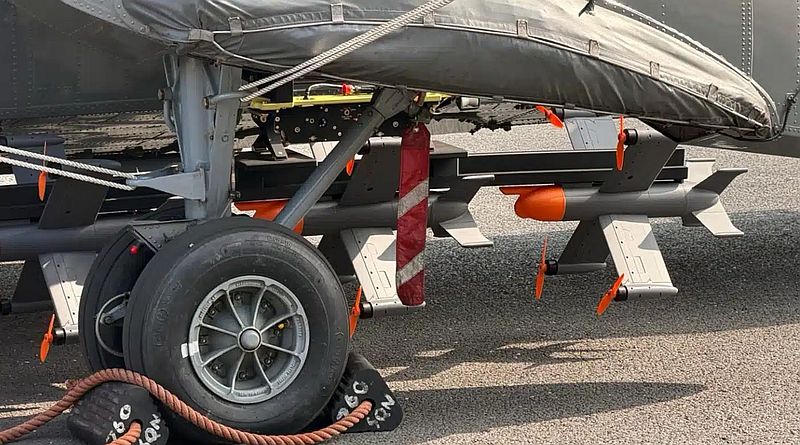
Around the entrance to the Farnborough Airshow stands an old Sea King naval helicopter with models of small interceptor drones, similar to those used in Ukraine to shoot down Russian long-range drones. This striking combination vividly illustrates the challenging situation faced by European countries: the threat of drone strikes caught them off guard, and solutions need to be found quite literally “on the fly.”
The British airshow, which until recently was primarily a peaceful platform for civil aviation, is rapidly militarizing. This is evident in both the stands and the open exhibits, where the number of civilian airliners has significantly decreased.
Another difference: this year, one of the most prominent national participants in the airshow is Ukraine. Its exhibition occupies half of an entire pavilion.
However, Ukraine’s influence is much broader: nearly half of the companies from other countries involved in aviation weaponry, unmanned systems, and other military themes are connected to it.
These changes are related to several geopolitical processes at once. First, the war in Ukraine is increasingly shifting toward long-range drone strikes. Both Kyiv and Moscow are improving their strike capabilities and means to counter such attacks.
Secondly, in Europe, many countries—primarily the Baltic states and Poland—fear that Russia may start a war against them, where long-range drones will be one of the key tools.
Europeans are also seeking ways to protect against such threats. The helicopter at the Farnborough Airshow is more a symbol of this process, as it does not reflect the full range of advanced air defense systems presented at the exhibition.
Finally, the third factor is President Donald Trump. One of the principles of his foreign policy is to encourage Europe to take greater responsibility for the security of its own continent.
It’s not to say that this path was without obstacles for him, but he still managed to push European countries to spend more on defense, investing in their own developments.
The main participant in all these processes is Ukraine. It is actively developing its own weapons and closely cooperating with European countries, helping to create systems that are immediately tested in combat conditions.
Thus, Ukraine, which still significantly depends on European financial and technological assistance, is simultaneously becoming an important source of military technology. In Europe, such support is often referred to as an investment in security.
Ukrainian Exhibition
Ukraine presented both long-range strike drone systems and interceptor drones at the Farnborough Airshow.
“Ukroboronprom” brought three drones to the United Kingdom: the jet-powered “Peklo” and “Palianytsia,” which can be considered cruise missiles, and the propeller-driven drone “Liutyi.”
These drones have long been used by Ukraine for strikes on Russian territory. “Liutyi” is a regular participant in such attacks.
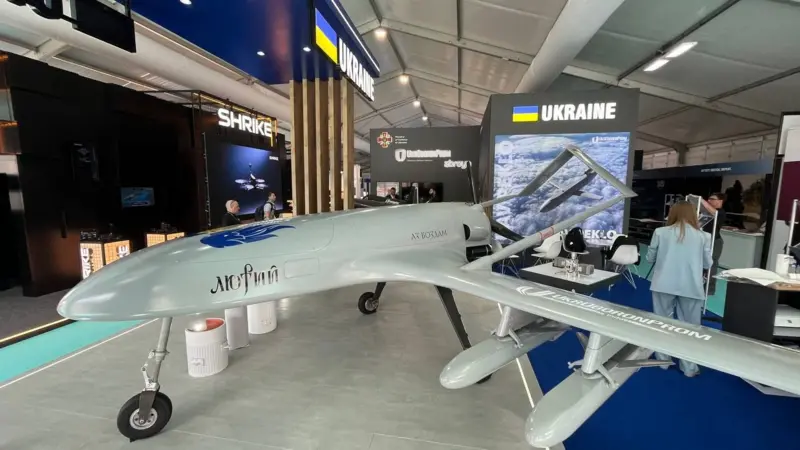
Its flight range allows it, possibly with special equipment, to cover over 2500 kilometers – approximately the distance these drones traveled at the beginning of July during the attack on the Omsk refinery.
At the Farnborough Airshow, the Ukrainian side presented a new version of “Lyutyi,” equipped with four “Katran” aviation missiles. They can strike ground targets, although the power of such munitions is insufficient to cause significant damage.
A company representative stated that these missiles can be used as decoys.
“These missiles can be used as decoys – launching four reactive targets. On radars, it’s not clear what exactly is flying, so the enemy tries to shoot them down with their rockets. Meanwhile, a window of opportunity is created for other drones to penetrate the target and deliver fire damage,” said a representative of “Ukroboronprom,” who wished to remain anonymous.
He also noted that such decoys are effective in terms of the cost-to-price ratio of the interceptor missile, which in this case is significantly more expensive.

At the neighboring stand, the company SkyFall presented a new interceptor drone of the P1-SUN series – JetKiller. This is a new development, specifically created to intercept jet-powered long-range drones, which the Russian side increasingly uses during strikes. They fly at higher speeds, reducing the chances of mobile fire groups to intercept them.
“We understand that just as we constantly implement new technologies, new concepts, and new drone modifications, so do the Russians. We constantly adapt just as they adapt,” a representative from SkyFall told the BBC.
“We are currently observing a certain trend. The overall number of strikes is decreasing, while the number of Shahed reactive drones is increasing. Regular Shaheds operate on gasoline engines. They are used as an analogue of long-range artillery near the front line. Meanwhile, reactive drones are primarily launched for deep strikes into the country. This is why we decided to create the P1-SUN JetKiller to effectively counter such reactive means of attack,” he explains.
According to him, SkyFall is working on developing systems with artificial intelligence, as well as technologies that will enable interceptor drones to act as part of a “swarm” – a group of UAVs united into a single network capable of joint actions.
Affordability as a Weapon
The Sea King helicopter on an open platform is equipped with drone models similar to early P1-SUN models. They are designed to intercept regular Shaheds.
This solution could well be effective. At the same time, the Sea King itself likely serves more as an example of solving this problem.
Turning an amphibious helicopter, which can successfully conduct rescue operations at sea, into a drone hunter is not necessarily required.
Intercepting drones with aviation is not a new idea. Helicopters and light aircraft shoot down UAVs both in Russia and Ukraine. As a SkyFall representative mentioned, the company has also used aviation platforms to launch its drones, which allows increasing their range.
Meanwhile, in such a combination, it is extremely important for the carrier to remain inexpensive. Not only the old Sea King can be suitable for this, but many other helicopters or airplanes as well.
Such affordability helps bridge the gap between the cost of the UAV and the means of intercepting it – a gap that itself harms the defending side, irrespective of the damage on the ground.
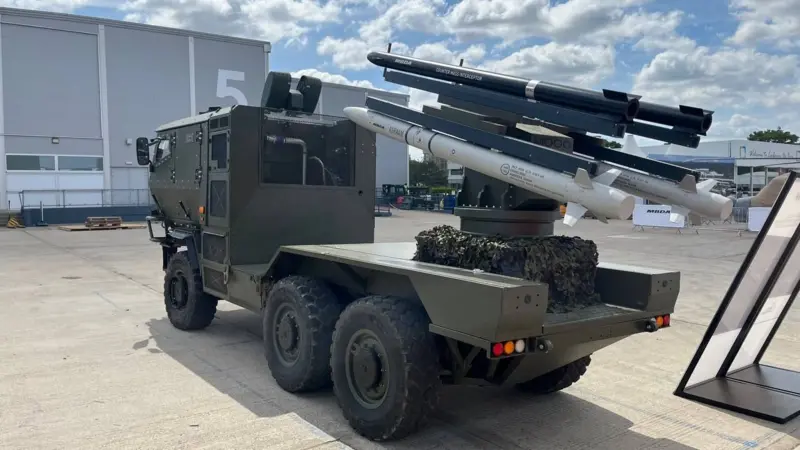
This issue may have many solutions. For example, the international consortium MBDA brought a new anti-aircraft missile to Farnborough, whose main declared advantages are simplicity and low cost. The exact price has not yet been disclosed, but the approach itself is unusual for a company known for its high-tech and far from cheap developments.
The missile is called the Counter Mass Interceptor. It will be equipped with a thermal imaging homing head.
In an interview with Reuters, MBDA representatives reported that they are already developing a production scheme for the missile with a view to maximum mass production on the corporation’s existing production lines or its partners. The first version of the interceptor is expected to appear as early as 2028.
The development speed, mass production, and low cost are some of the key components of this project.
Another system, presented for the first time in Farnborough, is also primarily distinguished by its price.
The American corporation Lockheed Martin has showcased a new missile for the Patriot system – PAC-3 Adapted Capability Effector (ACE).
However, the PAC-3 missiles are designed for intercepting ballistic missiles, not drones. These are kinetic munitions that hit the target with direct impact.
The company stated that the cost of the new missile will be less than half the price of the PAC-3 Missile Segment Enhancement (MSE) interceptors, which are currently produced and, according to Reuters, cost about 4 million dollars per unit.
Ballistic Threat
Counteracting ballistic missiles is no less important a task.
These missiles have demonstrated their effectiveness in Ukraine, where Russia has been increasing their numbers in each strike in recent weeks, as well as during the US and Israel’s war against Iran.
This refers to missiles of various classes – from tactical-operational to medium-range missiles, such as the Russian “Oreshnik.”
Ballistic missiles are quite difficult to intercept, as in the final phase of their flight they rapidly descend towards the target, accelerating to very high speeds.
Currently, a small number of systems in the West are capable of intercepting such targets, the most famous of which is the American Patriot. However, the missiles for it are too expensive, produced in insufficient quantities, and the involvement of the US – the main manufacturer of these systems – in the war against Iran limits the supply capabilities to other countries, including Ukraine.
In response to this challenge, the “Antiballistic Coalition” has been created in Europe – an alliance of several major defense companies for the development of a new ballistic missile interceptor.
The coalition includes leading arms manufacturers, such as Thales, Diehl, Saab, Leonardo, MBDA, Safran, as well as the Dutch company Destinus (founded by Russian entrepreneur Mikhail Kokorich and Ukrainian politician, former Minister of Finance, and Secretary of the National Security and Defense Council Oleksandr Danylyuk).
Destinus initially worked on the development of only hypersonic vehicles, but now participates in creating an interceptor which, as Oleksandr Danylyuk told the BBC, should be no less effective than the PAC-3.
“It must be said that a class of interceptor like this does not currently exist in Europe. Therefore, the main thing is to create it quickly to fulfill its tasks and, of course, reduce its cost. And we will reduce the price. But the most important thing is the timeline. Because the threat from Russia is real, and everyone feels it,” says Danylyuk.
“We understand that you can’t do this in a year (…). But the experience of the company allows us to move forward. We will do this as quickly as possible,” he adds.
Impact of War
The direct involvement of Ukraine or the apparent impact of war experience is evident in many projects.
As an employee of a Ukrainian defense company, who wished to remain anonymous, told the BBC, Ukrainian developers are quite flexible in implementing innovations during the war. They quickly adapt to new challenges and make changes to the design of their systems in the shortest possible time.
At the same time, the Russians manage to quickly establish mass production: as soon as they obtain a sample of new Ukrainian weaponry, they immediately attempt to start its large-scale production.
In Europe and the USA, they evidently understand this characteristic of Russia, so during discussions with representatives of various companies, the launch of mass production is often cited as one of the most important goals of development programs.
The full-scale war that Russia initiated in 2022 accelerates the development of military technologies, and this is particularly evident at defense exhibitions.
In the spotlight: Solutions should be simple, inexpensive, and ready for serial production. An example of such an approach is the installation of interceptor drones on the old Westland WS-61 Sea King helicopter. Photo: Naval News
