
Ilya Abishev, Military Analyst BBC / BBC News Ukraine
The Ukrainian army has launched a hunt for Russian tankers and cargo ships in the waters of the Sea of Azov and the Black Sea and is intensifying strikes on ground targets deep within Russian territory. Following attacks on refineries and oil depots, massive raids on logistics centers have begun.
The Russian army is also intensifying strikes on Ukraine’s rear areas, which it has been doing for the fifth year of the war—attacking civilian ships near Odesa, hitting large cities with missiles and drones, bombing, and shelling frontline settlements.
As a result of mutual shelling, civilians are increasingly being killed, and the military conflict between Russia and Ukraine increasingly resembles the Iran-Iraq war of 1980–1988, specifically the phase known as the “war of cities and tankers.”
Four years after the invasion of Iran by Saddam Hussein’s army, a positional stalemate developed at the front, and the warring parties moved to massive rocket attacks and bombings of each other’s rear infrastructure, hoping to exhaust the opponent’s forces and compel surrender.
During the war, at least 20,000 civilians fell victim to strikes on capitals, large and port cities, civilian ships, including foreign ones, oil terminals, and other industrial facilities. The material losses on both sides were enormous, but neither Iraq nor Iran succeeded in breaking the opponent.
How appropriate is the parallel between the current stage of Russia’s military confrontation with Ukraine and the events of 40 years ago? What might the so-called war of cities and tanker war lead to under modern conditions? Is it possible to emerge victorious?
What is known about the losses
According to the UN monitoring mission, in June alone, at least 293 civilians were killed by Russian strikes on Ukraine, and 1990 were injured. The vast majority of civilian casualties occurred in areas controlled by Kyiv, mostly in Dnipro, Zaporizhzhia, Kherson, and in the capital itself.
According to the same estimates, in the first six months of 2026, the number of killed and injured among Ukraine’s civilian population (1396 and 7978 respectively) was 37% higher than in the same period of 2025 (1122 killed, 5734 injured), and 114% higher than in the same period of 2024 (940 killed, 3442 injured).

There is no exact information on civilian Russians killed by Ukrainian strikes during the same period, as Russia does not publish overall loss statistics.
Approximate figures were provided at a UN Security Council meeting on July 9 by Rosemary DiCarlo, head of the Department of Political Affairs: she reported, citing Russian authorities, about 250 killed and 1,596 injured civilians in Russia in the first half of the year, but noted that the UN has not yet been able to verify these numbers.
It is even more challenging to assess the material losses of the sides – officially, and except on rare occasions, neither Russia nor Ukraine provide information on military-industrial and other strategic objects that have been attacked, or they provide limited information that does not allow judging the scale of the damage.
However, it is impossible to hide the facts of explosions and fires, most of which occur on the territory or in close proximity to large populated areas.
Attacks on Cities
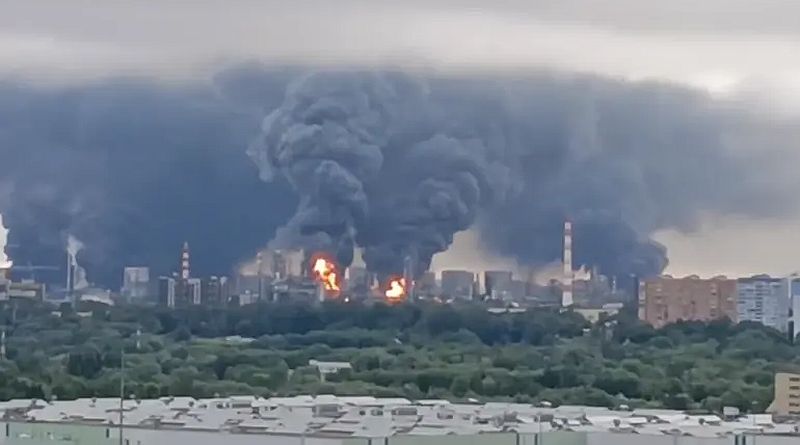
According to open sources, from January to July, the Armed Forces of Ukraine struck all 11 major oil refining enterprises in the European part of Russia, as well as two refineries in Tyumen and Omsk. The Ukrainian army also attacked several dozen fuel storage facilities, factories, seaports, oil terminals, and other important facilities.
Due to damage to primary oil processing facilities, Russian refineries have stopped operations completely or partially. In Russia, there is a recorded decrease in the production and export of oil products, the loading of individual refineries, and a fuel shortage.
Despite serious disruptions, oil refining in Russia is not completely paralyzed, oil exports continue, some damaged facilities are gradually restored, and the authorities have so far managed to redistribute raw materials and fuel flows between regions. However, it is difficult to judge the prospects of the Russian oil industry now, as the attacks continue.
In July, new targets appeared in the sights of Ukrainian drones – warehouse complexes of large logistics centers. On the night of July 18, the Wildberries marketplace was attacked in Elektrostal near Moscow and Kotovsk in the Tambov region, resulting in the warehouse in the Moscow region being almost completely burned down.

The next day, a list of the 25 largest hubs in the European part of Russia appeared on one of the Armed Forces of Ukraine’s sites as an announcement of future strikes. And the strikes indeed continued.
On July 20, after a drone attack, a fire broke out in the “Southern Gate” industrial park in Domodedovo, and there were reports of an attempted raid on a Wildberries sorting warehouse in the Podolsk district of Moscow region.
On the night of July 22, Ukrainian drones struck Wildberries logistics centers in Krasnodar and Nevinnomyssk, Stavropol territory. The operation of both centers was suspended, the company reported.
Russia is also intensifying attacks on Ukrainian rear infrastructure. Primarily affected by the strikes of Russian drones and guided bombs are settlements in the frontline and near-rear areas, but cities in the deep rear are also being hit.
Gas stations, railway stations and locomotives, vehicles, farms, shopping centers, and administrative buildings are being set on fire, and hits on medical facilities and residential buildings are frequently recorded.
For several years now, Russia has been targeting the terminals of the Ukrainian logistics operator Nova Poshta. On the night of July 19, a Russian ballistic missile almost completely destroyed the main distribution center of the company Amtel, with an area of 100,000 square meters near Kyiv, which provided cargo delivery across the country.

The Russian authorities and state media typically explain strikes on terminals and logistics centers by claiming that these facilities are allegedly used not only for civilian transport but for military purposes as well.
For instance, in June 2026, the Russian Ministry of Defense stated that the attacked logistics centers of “Nova Poshta” in the Novo Korotych area near Kharkiv and in the Sumy region stored weaponry, including drones and their components.
Russian z-blogger Fighterbomber criticizes such explanations, believing that in such cases, it is better to “****** [strike] silently.”
“We are digging ourselves a hole and jumping into it with both feet. Because the reception, storage, and distribution of dual-use goods are handled by the same Wildberries, for example, a strike on which we officially call a targeted terrorist act,” he writes.
“Tanker War”
A few days before the start of the strikes on Russian logistics centers, the warring parties launched a massive campaign against shipping in the Black Sea and Sea of Azov.
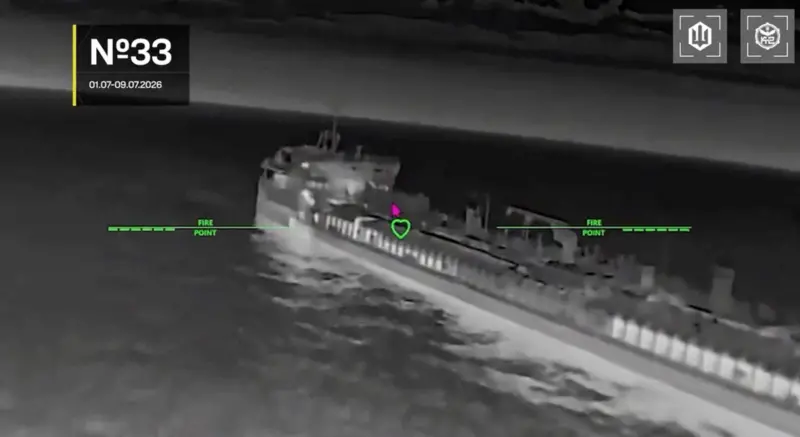
According to the Ukrainian Unmanned Systems Forces, between July 6 and 17, drones hit at least 159 vessels linked to Russian logistics, 117 of them in the Sea of Azov and 42 in the Black Sea.
Among the claimed targets, most were oil tankers, as well as gas carriers, dry cargo ships, tugs, and a ferry. There is no independent confirmation that all of them were disabled for an extended period, but at least a few of them were heavily burning or suffered serious visible damage.
Last Friday, the Russian authorities restricted shipping in the Sea of Azov, through which a quarter of Russia’s grain exports pass, and this week they banned vessels from entering the port of Azov in the Taganrog Bay and the port of Kavkaz in the Kerch Strait.
“Now the enemy has shifted attacks to the Black Sea due to a significant reduction in traffic in the Azov Sea,” writes the Russian Telegram channel “Military Informant.” “According to SAR images, the number of ships there has decreased by 78%, and the largest concentrations near ports and the Kerch Strait have practically disappeared.”
In turn, the Russian Ministry of Defense stated on July 16 that Russian forces struck a naval vessel and a high-speed boat of the Ukrainian Armed Forces heading to the ports of the Odesa region, which Ukraine did not confirm.
On July 19, Ukrainian authorities reported a strike on Odesa’s port infrastructure, damaging a civilian ship under the flag of Antigua and Barbuda.
The next day, the Ukrainian side stated that Russian forces struck a bulk carrier, Golden Leo, under the flag of Guinea-Bissau, which was transporting grain near the coast of Odesa, with three cruise missiles. At least 10 crew members were reported dead. Reuters, DW, and several other international media confirmed the incident.
Historical Parallels
Parallels with the Iran-Iraq war are evident in the timing of the transition to this stage of hostilities, the intensity of the strikes, and the choice of targets. However, there are important differences too.
The war of cities and tankers between Iran and Iraq began almost simultaneously—formally initiated by Hussein when it became clear that the situation on the front was not in his favor, but the Iranian side quickly responded.
In the case of the Russian-Ukrainian military conflict, the transition to a “war of cities” was only discussed when Ukrainian retaliatory strikes became particularly pronounced, although Russia essentially has been conducting it for the fifth year.
“Even in 2022, Russia dismantled Ukraine’s entire oil refining and main oil depots. Then dismantled gas processing. Started hitting production,” reminds Ukrainian military observer Oleksiy Kopytko, pointing out that Ukraine at that moment lacked adequate means of defense and long-range attack capabilities.
“Russia totally attacked defense industry enterprises. Chemical factories. Just engineering plants. Just metallurgy enterprises, etc. Having prioritized deindustrialization, the Russians shifted the focus to ports, elevators. Then attacks on logistics centers, warehouses followed,” writes the Ukrainian expert.
There is another difference. The weapons used 40 years ago by Iran and Iraq were not highly accurate; many people died from indiscriminate strikes and missile deviations from the target.
Modern missiles and drones used by Russia and Ukraine are much more accurate, and although they can still miss or crash into a residential building not accounted for in the flight program, most often they hit precisely where they were programmed to.
This means that, on one hand, civilian casualties can be minimized if civil defense work is organized properly, primarily through alert systems and evacuation mechanisms.
However, on the other hand, it will be very difficult to protect large bases and production sites from targeted attacks. Especially for Russia, with its centralized production and storage concentration.

In a protracted war, offensive means begin to notably outweigh defensive means—strike weapons are generally simpler and cheaper to produce.
According to Ukrainian military sources, since the beginning of the full-scale invasion of Ukraine, the Russian military-industrial complex has tripled the production of Iskander ballistic missiles, and the Ukrainian Armed Forces simply do not have enough expensive anti-missiles capable of intercepting them.
On the other hand, Russia faces similar problems—its air defenses cannot reliably destroy hundreds of cheap Ukrainian drones that attack objects across the vast Russian territory daily.
At the same time, the Russian army is also massively launching drones at Ukraine, and the Ukrainian Armed Forces have increasingly begun to use cruise missiles and may soon use their own ballistic missiles.
Given this trend, the prospect of the continuation of the “war of cities” looks bleak for both sides. However, while Ukrainians have been living in such conditions for the fifth year, Russians are just beginning to get used to them.
In the cover image: Moscow, June 2026. Photo: ASTRA
