
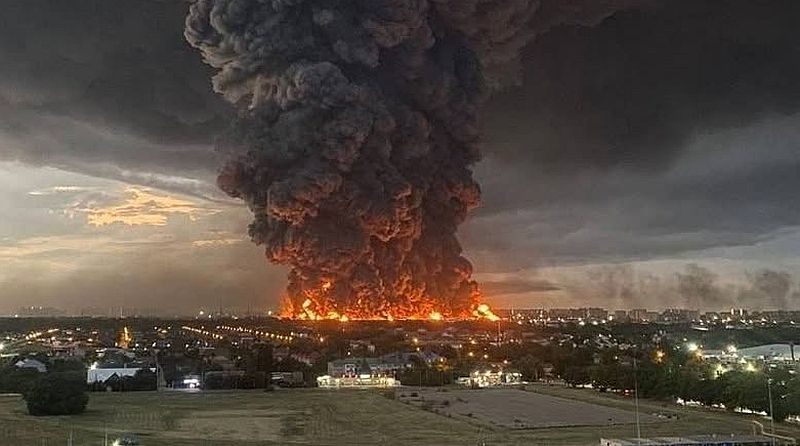

They had a salary of $1000+ in the prosperous 2013, they had their own Olympics. They were truly building “killers” of Amazon and Alibaba, successfully dominating the markets of Kazakhstan and Belarus. But the old lady wanted to become the mistress of the sea and play geopolitical games.
And now the peak of their economic dreams is not opening their own order pickup point, but a one-time payment of 2 million rubles for signing a contract and a guaranteed one-way ticket.
Modern e-commerce is a colossal super-concentration of manual labor. A single mega-hub of 100,000 square meters on average employs 5 to 10 thousand staff working in multiple shifts. In Elektrostal near Moscow alone, about 10,000 people worked on the warehouse before the arrivals. In Krasnodar and Nevinnomyssk (a total of almost 200,000 sq. m) another 15–18 thousand people worked. All of them are now on the street.
But this is just the tip of the iceberg. Every hypothetical “Z-entrepreneur” or custom doll seller is an individual entrepreneur on which people in the regions depend: seamstresses at local factories, packers, product card managers, shuttle drivers. When the core collapses (the warehouse burns), the chain reaction throughout Russia collapses thousands of small businesses. This knocks out at least 150–200 thousand jobs locally from the economy.
Even if the war stops right tomorrow: a year will be spent repairing the burned refineries, a couple of years patching up damaged gas carriers and bulk carriers, the remnants of the Black Sea Fleet will be restored for decades. Businesses in which people invested all their savings have burned down with the warehouses, leaving a whole generation on the sidelines of life.
An old man, who smells of age and sickness, grunted on TV — and the result is hundreds of thousands of destroyed families, an avalanche of overdue loans, and a complete collapse of horizontal connections in the economy.
The results of their last great war — they still cannot accurately count the millions of dead. The results of the one before — the collapse of the empire.
A stupid, absolutely unteachable herd. Not being interested in politics is very painful and expensive, username. Avoid it at all costs.

Since everyone has already watched enough videos with the Kuban-Stavropol volcanoes, a bit of statistics and retrospection.
Keyword: hyper-concentration.
1. I’ve already mentioned that Russia not only committed an act of aggression but also, without the slightest justification, destroyed civilian logistics and trade facilities in Ukraine since 2022. The Russians originally indicated that there were no restrictions in this case. The calculation was clear: Ukraine had no means for symmetric attacks.
For more than 4.5 years, Russians claimed to launch “precision weapon” strikes against military and other facilities “used by the Armed Forces of Ukraine.” There’s no point in commenting on this lie; it has been said a thousand times.
Today, the Russian Ministry of Defense officially (!) announced that it carried out a deliberate attack on the “Nova Poshta” logistics center in Odesa, allegedly used for “storing military cargo.”
Even if we forget everything that happened before, today the Russian Ministry of Defense OFFICIALLY turned all logistics centers and warehouses in Russia, even the smallest ones, into storage for “military cargo.” Automatically. Because everything is mirrored.
2. What does this mean in practice? For example:
The population of Moscow and the Moscow region totals approximately 22 million people.
The area of Moscow and the Moscow region is about 47 thousand sq km. For comparison: this is one and a half times larger than the Kharkiv region or 1.8 times larger than the Kyiv region.
Not long ago, Ukrainian officials and academics shared this assessment: around 25 million people (range 22-29 million) are in territories controlled by Ukrainian authorities. Let’s even say 29 million.
In total: the population of the Russian capital agglomeration with its region is comparable to the entire (!) population of Ukraine in territories controlled by Ukrainian authorities, yet these Russians are concentrated in an area 10 times (!!!) smaller.
Consequences?
To provide Moscow and the region with goods and services, a hyper-concentration of the corresponding capacities is necessary: production, logistics, energy, etc. And a lot of warehouses are needed.
According to industry Russian statistics, about 50% of all large warehouse space in Russia is concentrated in Moscow and the Moscow region. Another 10% is in St. Petersburg and the Leningrad region. The rest is structured around major cities: Kazan, Yekaterinburg,… Krasnodar.
This makes sense: cyclopean warehouses require comparatively lower maintenance costs. Such warehouses are operated by monopolies or similar structures: X5 Group, Magnit, Ozon, Wildberries… There are few – about a dozen. Most of these warehouses are located between the MKAD and the Small Moscow Ring (approximately in a 20-30 km strip). The Small Ring itself is about 40-55 km from the Kremlin. Logistics is structured on both sides of this ring.
For interest, just wander around Google Maps. You’ll find dozens of huge rectangular logistics centers.
On one hand, all of this is located within an incredibly saturated air defense area. On the other hand, it’s still impossible to protect such facilities.
3. Consequently, with a certain concentration of logistics in Ukraine (since the principle of operating large complexes is the same), the parameters are still incomparable with those of Moscow.
Ours is more dispersed by an order of magnitude. It’s much harder to protect, but also much harder to inflict critical damage. Supply chains for the needs of the population are less vulnerable.
By the way, the population of the Krasnodar region is 5.9 million people. Local collapses in Krasnodar itself have been showing for several years that the infrastructure is not keeping up with the growth in the number of consumers. This is all vulnerable even without war.
Two days ago (July 19/20, as I wrote) the SBS partially dismantled the Russian air defense area on the Azov coast of Kuban (Yeysk – Primorsko-Akhtarsk). As a result, today friendly drones visited not only the Southern Coast of Crimea, not only traditionally chased Russian ships, but also paid a visit to Krasnodar, Armavir (Krasnodar region), and Nevinnomyssk (Stavropol region). This looks like mass penetration into a breach.
Do you understand the perspective?
Yes, Russia can destroy more stores and warehouses in Ukraine. Especially with ballistics. We cannot defend ourselves.
But Ukraine can very well create a ring of fires around Moscow. And also precisely – up to the Urals, meaning reaching about 70-75% of Russia’s logistics infrastructure.
This logic is also valid for energy.
4. Tomorrow, Russian Foreign Minister Sergey Lavrov is set to meet with U.S. Secretary of State Marco Rubio in Manila. The Kremlin has every reason to ask Washington to somehow calm Ukraine down. Because the trend is frighteningly clear. But they will have to offer something.
About 200 Russian ships in the Azov and Black Seas have been inspected over the month.
In a week, in three approaches (2 successful, one not very), about 20-25% of the Wildberries marketplace’s capacity has been wiped out. Repeat visits to Tambov, the Moscow region, as well as Voronezh and Rostov-on-Don could affect just as much. This is only what’s within frontal reach (there’s also Nizhny Novgorod, Samara, etc.).
Twenty-seven days have passed out of the 40-day period of forcing Russia to reasonableness. If tomorrow Lavrov again starts the song about the “goals of the Special Military Operation,” it means the Kremlin has decided to sacrifice all the logistics around Moscow, and closer to winter – energy as well.
Dear Russians must realize what they are being prepared for.
