
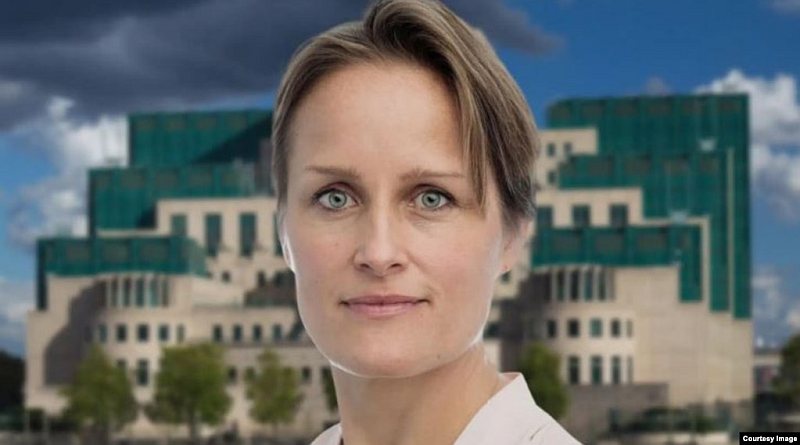
Blaise Metreveli updates the legendary MI6, preparing for an era of conflicts in Europe.
For a supposedly secret organization, the British Foreign Intelligence Service spends a lot of time polishing its public image. Key messages emphasize the relevance, efficiency, and modern management style of the Secret Intelligence Service (SIS), known as MI6. Forget about James Bond movies with flashy stunts and questionable sexual antics, or the more realistic world of starched suits from John le Carré’s novels about George Smiley, where espionage was a shadowy offshoot of British establishment activities that were never publicly discussed. Today, the SIS positions itself as a mirror of modern Britain: diverse, inclusive, and classless. If you want to join, don’t wait for a tap on the shoulder from an Oxford or Cambridge professor; just visit the website. Former head of the service (known as ‘C’), Sir Richard Moore, even introduced the hashtag #ForgetJamesBond in his post on X about a career at MI6 that’s suitable for family people.
The question arises whether the appointment of Blaise Metreveli, the first woman to head the SIS, is part of this image campaign. Metreveli was featured (under the pseudonym ‘Ada’) in a laudatory article in the Financial Times in 2022, dedicated to promising women who at the time held three of the four highest deputy positions in the service. Moore repeatedly hinted that he wanted his successor to be a woman — life imitating art, as since 1995, Judy Dench played the role of boss 007 in eight Bond films.
However, it would be a mistake to think that Metreveli’s promotion is primarily related to her gender. First, she has an outstanding operational career, having risen to head the Q division, which deals with science and technology. The code name Q, borrowed from the Bond films, is now a generally accepted term for denoting inventors of clever gadgets for the British intelligence service. Remember agent 007’s Aston Martin in the film ‘Goldfinger’ — equipped with built-in machine guns, an oil sprayer, and an ejector seat? Unlike the cinematic car, the real equivalents are marvels of miniaturization and disguise. Some wonder whether her habit of wearing brooches (the only style quirk Metreveli has) is a nod to the longstanding history of using jewelry as spy equipment.
There are hardly any other biographical details about her. Married, has a family, the granddaughter of post-war immigrants from Eastern Europe. In childhood, lived in Hong Kong when her father, a prominent doctor, worked there. Metreveli attended one of the most prestigious Westminster schools in the UK, and then at Cambridge University, where she was a champion rower. She still rows with a very close-knit group of friends. Apart from serving in MI6, she has worked nowhere else, except for the related organization MI5.
Now Metreveli promises changes in MI6, reminiscent of a turbulent past era. In her first public speech, the woman only briefly mentioned terrorism, which had been the main priority for more than two decades, and China, which the authorities consider the greatest national security threat. Metreveli also practically neglected the United States, which once was Britain’s most important intelligence ally. Today, this country is considered unreliable, unpredictable, and, on some fronts, openly hostile in London.
Instead, Metreveli focused on Russia’s campaign to export chaos, mentioning arson, sabotage, cyberattacks on critical infrastructure, drones flying over airports and military bases, “aggressive” underwater activities, and influence operations that cause and exploit “divisions in society.” In this space “between peace and war,” she stated, MI6 will no longer be confined to merely understanding its enemies but will actively counteract: “We will refine our strengths and influence with courage, appealing to, if you like, our historical SOE instincts,” she continued, referring to the British wartime special operations service of the Second World War.
With the exception of mentioning Victory Day in the First World War, there was hardly a more telling historical analogy. Winston Churchill established SOE in 1940 when Britain was almost single-handedly fighting against Nazi Germany and tasked it to “set Europe ablaze.” The mission involved organizing sabotage and supporting resistance movements throughout Nazi-occupied Europe.
This mission has become very unfashionable in MI6 in recent years, as the service focused its budget (secret, but in the billions) on gathering the best possible high-level intelligence. After taking over in 2020, Moore closed the “Strategic Advantage” directorate, which was built at great cost and directed intelligence efforts towards hostile actions of Russia, China, and Iran, as some informed sources told me. Insiders criticized the system under which MI6 was to be a universal instrument of power for every secret mission. Instead, the service focused on providing British authorities with secret information that could have practical applications. The prospects promised to be great: if the opposing side’s position is known before negotiations, the likelihood of a quick and favorable outcome increases.
But some intelligence service clients have questioned the value of this approach. “It’s lacking,” a minister who previously praised SIS results told me. In 2024, former SIS deputy chief Nigel Inkster publicly criticized his service for lowering professionalism in dealing with China: “MI6 truly lacks language skills and overall historical and cultural awareness” regarding China. In personal conversations with me, other intelligence insiders raised similar concerns. Where is the deep knowledge of the adversary that allows understanding the meaning of a stolen secret? And what about the long-term value of penetrating the decision-making processes of the opposing side? There are also fears that pervasive surveillance makes old-style espionage virtually impossible. China meticulously collects biometric data to identify anomalies and behavior patterns indicating espionage; Russia has made immense efforts to hack the SIS recruitment site, which could have devastating consequences.
Others question MI6’s focus on a perfect public image. Moore, who also worked as a diplomat, was comfortable with journalists and gave public speeches. His predecessors also expressed their opinions on current issues, usually in line with the government’s position. The declassification of politically useful intelligence has also intensified, particularly to highlight Russian aggression in Ukraine. The success of this tactic has significantly reduced the distrust caused by the unceremonious politicization of SIS intelligence by then-Prime Minister Tony Blair prior to the Iraq war.
If Metreveli achieves his goal, MI6 will return to what American spy jargon calls “covert action”—secretly planned operations producing results, using open and secret means, combined with military, virtual, psychological, and other tactics.
When Russia uses these tactics, Western countries call them “active measures” or “gray zone” attacks.
The West often reacts to these attacks weakly and belatedly. The only exception is Ukraine, which, although often a victim of such operations, has conducted extraordinarily successful counter-operations throughout Russia, using naïve Russian truck drivers to launch drones at military airfields and delivering painful cyberattacks. It’s no secret that SIS closely cooperates with Ukrainian services, training and instructing them, as well as providing high-tech and intelligence needed for the successful execution of such operations.
But SIS is capable of more. It’s not just about some people thinking that the emphasis on public image makes the service risk-averse. Excessive focus on high-level intelligence requires resources that could be directed at less secretive targets with more practical goals. Corruption in Russia means most databases can simply be bought: there’s no need to steal. Instead of finding out what Vladimir Putin had for breakfast, could one just put him in an awkward position by exposing private emails of Kremlin associates? Or leave some clues that cause a furor.
Covert activities may involve leaking personal financial data of Putin’s cronies or disrupting daily life in Russia through tricks, antics, and pranks. One option is posting fake ads on online platforms to undermine morale, reminiscent of the dark arts used by Britain against Nazi Germany. Such ads might, for instance, spread the notion that young Russian women easily find work in Chinese massage parlors, a former intelligence officer suggests. This would play on deeply rooted Russian racism and subtly fuel the growing dissatisfaction among Russians with their country’s dependence on Xi Jinping’s regime. Another option could be sowing panic among depositors in a struggling provincial Russian town. Such operations do not require access to serious intelligence, just imagination and ingenuity.
And also — courage. The main question regarding the more adventurous style hinted at by Metreveli concerns not the potential of MI6; ambitious agents eagerly await action. The real issue is political leadership. Who will be accountable if the operation fails? Or what if it is very successful and provokes a fierce reaction from Russia?
So far, political bosses support Metreveli. She easily weathered the storm during her appointment when the tabloid Daily Mail wrote that her Ukrainian grandfather, Konstantin Dobrovolsky, was a top Nazi spy and possibly a war criminal. (Her grandmother remarried; her son took the surname of the new stepfather — Metreveli).
Moreover, the new head of SIS has extensive powers. The service is known to not be under stringent supervision. The parliamentary cross-party intelligence and security committee is ineffective and understaffed, a pale shadow of its powerful counterpart in the U.S. Senate. Nominally accountable to the British Foreign Secretary, intelligence chiefs usually cite secrecy when awkward questions arise. Only the Prime Minister and the country’s top civil servant, the Cabinet Secretary, have the full right to inquire into the service’s activities, which might take “perhaps an hour a month,” as a former minister told me. SIS successes are a secret, but so, largely, are its failures.
A brilliant image combined with mystery works wonders. Amidst the depleted army, ineffective “soft power,” and unstable British economy, SIS is one of the few institutions that have retained a world-class reputation. Consistent leadership also helps. Over five years in office, Moore dealt with six foreign ministers. Amid chaos, Moore led quasi-diplomatic missions interacting with Saudis, Americans, and other allies. Although the SIS head has the official status of a minister, he has never before had such an independent role in setting the agenda. Moore’s influence highlighted how powerful British institutions took on responsibility amid the disarray in the country’s political system.
SOE, referred to by Metreveli, at least in popular memory, is the opposite of Britain’s current woes, embodying wartime resistance and, ultimately, triumph. In the vast green glass building of the Vauxhall Cross service on the south bank of the Thames, Metreveli and her over 3,500 employees are not only the guardians of Britain’s secret intelligence agency. They can also play a key role in preserving the country’s self-respect.
Edward Lucas – Senior Fellow at the Center for European Policy Analysis (CEPA). Previously, he was a senior editor at The Economist. Lucas has covered Central and Eastern Europe since 1986. A long-time foreign correspondent in Berlin, Vienna, Moscow, and the Baltic States, he is an internationally recognized expert on espionage, subversion, the use and abuse of history, energy security, and information warfare.
Collage: Radio Liberty
Copyright © 2021 RFE/RL, Inc. Reprinted with permission from Radio Free Europe/Radio Liberty
