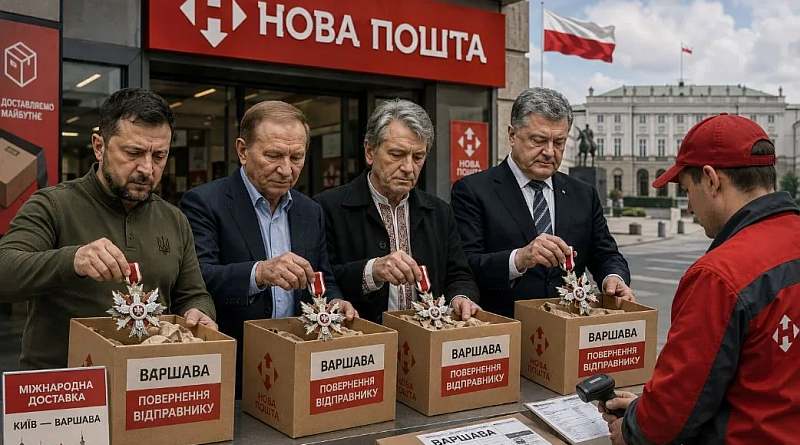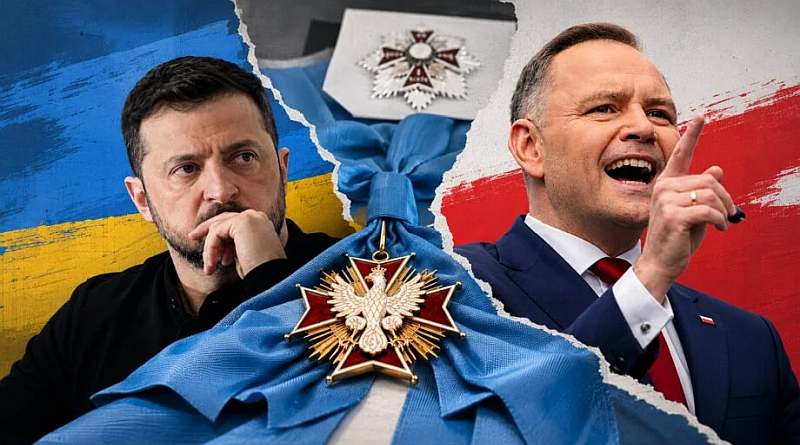

The surreal situation begins with threats from President of Poland Karol Nawrocki to strip President Volodymyr Zelensky of the Order of the White Eagle. After all, this is not an individual award for a specific person. In the person of Zelensky, President of Poland Andrzej Duda awarded all Ukrainians who fought against the Russian invasion and also turned their country into a shield for Poland.
Yes, it is an honor for the President of Ukraine – such an award. But it is even more an honor for Poland that the president of a country fighting a common enemy agreed to accept it. And, pardon me, this order is not a question of Zelensky’s prestige; it is a question of the prestige of the Order of the White Eagle. By awarding the Ukrainian president, the President of Poland awarded every Ukrainian soldier who will never return home or who continues to fight for the future of Ukraine and Poland, every Ukrainian woman who raises children under bombardment, every child who studies lessons in an underground school.
Isn’t this enough for you, my dear Polish friends? Don’t you want to be part of this? I’m sure you do, as Poland’s help to Ukrainians and Ukraine has been unprecedented. And here – an order!
The decision of President of Poland Karol Nawrocki to strip President of Ukraine Volodymyr Zelensky of the Order of the White Eagle is irresponsible, mistaken, and shows an attitude not towards the president but towards Ukraine. Unfortunately, it will have great negative consequences. The order was presented as a symbol of attitude towards the people of Ukraine, their heroic resistance, and essentially as a shield from the same onslaught on neighboring Poland. It was given by Andrzej Duda, the then President of Poland.
Sooner or later, this order will be returned to Volodymyr Zelensky, and everyone will remember this episode as “Karol Nawrocki shooting himself in the foot,” but it will definitely play its role in pandering to a third party, our Moscow enemies, meaning more Ukrainians and Poles will perish, whose lives could have been saved.
At the same time, sharp actions from Ukrainians like returning previously received Polish orders, I consider too emotional and only fueling the scandal and adding fuel to the fire of the rapidly igniting Ukrainian-Polish relations crisis.
You can return and mainly – NOT ACCEPT ORDERS from Karol Nawrocki, but what about the awards presented on behalf of the people of Poland by his predecessors?!
Don’t do this! It will quickly lead to the next similar “exchanges.” Once you start taking and giving back orders, it will quickly shift to monuments… and then borders will be closed before you know it. We’ve seen such scenarios from the Polish side before…
Every nation has the right to its heroes. Meanwhile, we are neighbors with a complicated history, but now and in the future, the peoples of Ukraine and Poland are in the same boat. We have common enemies, common partners, and, I believe, a common great future.
Politicians come and go. They can’t break the good neighborliness of the peoples!
In Moscow, they’ll open a bottle of champagne today. The Polish president insulted not the Ukrainian president but the people. And since the Order of the White Eagle taken from Zelensky is still with Benito Mussolini and Catherine the Second, they will open a second one for that.
History repeats itself. Ghosts of the past kill the future. And we all have to live in an era of idiotic decisions. There have been too many of them in recent years.
Depriving President Zelensky of the Order of the White Eagle shows President Nawrocki’s attitude towards the entire Ukrainian nation and the Armed Forces of Ukraine, regardless of what President Nawrocki tells us.
The real goal is to disrupt President Zelensky’s visit to the URC conference in Gdansk, where European leaders will be present. I hope this does not happen. All attempts by those whose anti-Ukrainian rhetoric benefits the aggressor will fail.
We will continue, together with the Ukrainian and Polish people, and responsible Ukrainian and Polish politicians, to build a common European future and work toward Victory.
It’s a pity that President Nawrocki has never been to Ukraine and seemingly does not plan to. But I hope for the responsibility of the Ukrainian and Polish elites and societies.
* * *
Now, about some of our mistakes.
After Pavlo Koval succeeded in negotiating with the Ukrainian authorities to conduct exhumations, in which I played an extremely active role, one of the main trump cards was knocked out of the Kremlin’s hands. Relations between Ukraine and Poland began to gradually improve because Moscow had used the absence of exhumations for years to exacerbate tensions between our nations.
When this tool ceased to work, a new reason for conflict was sought. However, even before such a reason was found, we ourselves made several steps that did not greatly improve bilateral relations.
On one hand, holding the Polish-Ukrainian congress of historians was undoubtedly a useful initiative. But at the same time, from the very beginning, I suggested focusing not on the past, but on the future. Holding forums on development, European integration, and Ukraine’s reconstruction with the participation of Polish companies. Because the historical theme will continue to be used by anti-Ukrainian forces in Poland. By participating in events dedicated to this topic, we are effectively legalizing their agenda, but at the same time not changing their views.
The next mistake was the Ukrainian side’s approach to conducting exhumations. First of all, we should have conducted them where many Ukrainians are truly buried on Polish territory, and where we know for sure about the presence of graves. One such place is the Jaworzno concentration camp. Instead, the Ukrainian side began to conduct exhumations in places where no victims were found, thus only providing additional arguments for Polish propaganda.
When a reason for a new escalation finally appeared, Russia, through the hands of Polish right-wing forces, used it to stir dissatisfaction in Ukrainian society.
What to do now? First and foremost — remain calm.
I fully understand Foreign Minister Andriy Sybiga, who refused his Polish order. Perhaps it is even better that it was him who did it, and not the President of Ukraine, which would inevitably have led to an even greater escalation of the situation.
At the same time, I do not believe that a mass “order-crash” is needed now. After all, it was not Karol Nawrocki who awarded these honors to Ukrainian politicians, officials, and other well-known individuals. These awards were given on behalf of the Polish state and the Polish people. Just as we do not want the Ukrainian people to be offended because of the decision to strip Volodymyr Zelensky of his order, we must also treat the Polish people with the same respect.
I have repeatedly written that this is far from the first escalation in Ukrainian-Polish relations. We have experienced similar crises before and we will overcome this one too. But we must endure it in such a way as not to give Russia a reason to rejoice and divide us by using historical disputes in its own interests.
“We forgive and ask for forgiveness.” This formula by John Paul II is relevant even now.
An unwise, unfriendly, provocative decision to strip the President of Ukraine of the Order of the White Eagle. Because it’s not about names. Since the beginning of the invasion, many countries and institutions have honored Ukraine, the Ukrainian people, and the heroic Armed Forces of Ukraine with their highest awards, recognizing their sacrifice and courage, and how they are shielding Poland from the Russian invasion today.
I think many Poles are ashamed today. Ukraine is bleeding. If Ukraine falls, Poland will be next. We can survive without the order, but we will not abandon our history, language, culture, heroes, and traditions, neither under pressure from the Russian enemy nor under the blackmail of unwise politicians from other countries. Everything will pass, including this. President of Poland Navrotsky did a disservice not only to his people but also to European leaders by demonstrating a lack of empathy, wisdom, and European spirit.
The most scandalous thing is that this disgraceful act was done on the eve of the Ukraine Recovery Conference, which opens next week in Gdańsk. A city where the legendary “Solidarity” was born, where the Warsaw Pact was dismantled.
Today, the words of Pope John Paul II, “We forgive and ask for forgiveness!” are more relevant than ever. He was a great and wise Pole. I believe that one day his testament will become a guide for statesmen, and the time of politicians and populists will pass.
Many letters for those who care about essence, not hype.
In politics, emotion is not the best advisor. Decisions made solely on emotional impulse or aimed at the emotions of the recipient can be bad. And, as a rule, they are.
There are plenty of examples in world practice. Where emotion dominates, there is the highest risk of being manipulated, because in the heat of feelings you might overlook significant moments.
The order demarche is an emotional story. Let’s try to calmly sort it out.
1. Who is dictating the rules of this game now?
The beneficiary of the Polish hysteria around the Ukrainian attitude towards Ukrainian memory is Karol Navrotsky. The President of Poland, who was previously the head of the local Institute of National Remembrance.
Importantly, Navrotsky is a populist and political opportunist. Evidence of this is his quote. As the head of the Polish IPN, he stated, “Who should be considered heroes and how to honor them is exclusively the business of Ukrainians, and Poland has no right and will not indicate otherwise.” In the presidential seat, Navrotsky says the exact opposite. This is typical for populist politicians—they say what the audience wants to hear here and now, without worrying about future consequences (“consequences” is an important point; we will return to it).
Thus, Navrotsky has imposed his game—making a series of claims towards Ukraine and addressing them to Zelensky as the embodiment of Ukraine on his presidential level. At this stage (pushing claims), Navrotsky is in a favorable attacking position. Official Kyiv must think about how to respond, choosing between “defense,” “direct counterattack,” “ignoring the attack,” or “actions to exhaust the opponent.” The choice of tactics should depend on the goal Kyiv wants to achieve.
To choose the right response, it is important to determine—what is Kyiv’s goal? This question cannot be answered correctly without defining—who is the target of Navrotsky’s maneuvers, to whom he wants to reach out, why, and what would the desired result look like for him?
2. Who is the target?
According to public sociology, the rhetoric of right-wing populists appeals to that part of the society that doesn’t burden itself with thoughts about the causes of situations/problems and is eager for simple solutions. These are typical “ordinary people.” They can be of different ages, financial and social statuses (although it would be interesting for specialists to conduct a detailed MRI of Navrotsky’s target audience), but what unites them is that they love simple answers to complex questions. Simple answers are not about reason; it’s about emotion. And emotions are easiest to manipulate.
3. Why is Navrotsky’s target to instill hatred towards Ukrainians in the minds of ordinary people?
Usually, an image of a threat, external or internal, is needed when there is an understanding that engaging one’s target audience in solving real challenges is very difficult. Because it requires thinking. Ordinary people do not want to think. There is only a year left before the elections to the national assemblies (Sejm and Senate) of Poland—too little time to solve any fundamental problems. Therefore, Navrotsky and his entourage will sell the threat from Ukrainians to the ordinary people.
4. What would the desired outcome look like for Navrotsky and right-wing populists?
A right-wing populist coalition in the next parliament and a completely controlled government. In such a configuration, Navrotsky and Co. aim to extract maximum benefits from the processes unfolding around Ukraine. Specifically, EU assistance, building EU defense industries, and the negotiation process regarding Ukraine’s accession to the EU.
Thus, Navrotsky’s target audience and the goal of his statements are within Poland, and attacks on Ukrainians are a tool to stroke the ego of the average primitive Polish national-patriot from the electoral group of “ordinary people.”
What reactions from official Kyiv and Ukrainians in general would Navrotsky like to see that would help (!) Navrotsky get closer to his goal?
He would be happy if official Kyiv responded to his populist maneuvers with similar moves, and Ukrainians on social networks were overwhelmed with hatred towards all Poles.
Emotional words and actions from Kyiv, real inadequate stories of Ukrainians’ behavior in Poland, anything that political strategists can sell to the electorate with the comment “see how dangerous/unneighborly/ungrateful/unworthy Ukrainians are to be in our Euro-HOA” – all this will benefit Nawrocki and his politicians. All this will bring them closer to their goal of increasing the number of primitive voters and winning elections.
Considering the aforementioned details of the game that the Polish right-populist camp, represented by the current president Karol Nawrocki, wants to impose on us, we ask ourselves – what is Ukraine’s goal in this battle of messages?
Is (or should) our goal be to convince Nawrocki specifically that he is wrong about the UPA? Do we want, with our words/actions, to “persuade” the national-populists to engage in a reasonable and argued discussion? Does anyone believe that people who produce anti-Ukrainian nonsense can suddenly hear SOMETHING from Kyiv and the next day apologize, saying “sorry, we were wrong”? I suspect the answer to these questions is “no.” Not because we shouldn’t want it from our side – it’s just futile wishing, and such a thing won’t happen.
So what should our goal be? The answer to this question should influence the choice of “what we say in public (both as officials and opinion leaders), what we do, how we achieve our goal.”
Isn’t our goal to “find communication with the sensible part of the Polish socio-political environment”? Not to cultivate contempt or mock Nawrocki, but to appeal to those who hear us? Isn’t our goal to provide the sensible part of Polish society with arguments “why Ukrainians are not a threat, but a benefit and strength for Poles”? Isn’t our goal to find allies in Poland who, seeing our ADEQUATE actions, will use them in their internal discussions? Isn’t our goal to find and propose algorithms on how to bypass topics/questions used by populists in the political field? Not to refuse calm discussion of these issues, but to take them out of the forefront of political clashes?
In my opinion, of course, but it seems such a goal is more useful than exchanging maneuvers with Nawrocki. Such a goal represents taking initiative – not sheer “defense,” not direct “counterattack,” but disorienting the opponent and seizing strategic initiative.
How can this be done?
In the sphere of public rhetoric (politicians, speakers on TV channels, bloggers, and publicists in social networks), it’s worth separating “Poles” and “the Polish government.” Because they are different things. Just like “Ukrainians” and “Zelensky” are DIFFERENT THINGS. Moreover, “Nawrocki and right-populists” and “the Polish government” are also different things and different addressees of efforts – the reactions of Tusk and Sikorski are quite eloquent here. And if there is a desire (and there should be) to find an ally among Poles in the fight against the local populist-chauvinistic frenzy, – do not generalize.
In the sphere of public actions of officials, it is important to remember that governments are transient, and Poland as a neighbor remains important to us, and our vital interest is to make this neighborhood as mutually respectful and comfortable as possible. This means that in reactions, it’s worth clearly distinguishing “this is a response to an individual” (Nawrocki, who is only president today, and in a few years, no longer) and “this is a message to the neighboring nation” (with whom we have much more beneficial in common than negative).
Does the demonstrative return of the Polish order by Ukrainian presidents and civil servants correspond to what is written above? Did this action gain us allies within Poland in the moderate camp?
When answering this question, consider that none of the returned awards bear Nawrocki’s signature. In other words, the Ukrainian démarche did not personally affect him. All the orders were signed by other leaders of Poland, with whom relations were much more constructive and beneficial for both nations. Moreover, when answering the question, did you consider the fact that a state award is gratitude from the state, not from a situational current leader?
It is possible and necessary to respond to the bold actions of a specific politician, but at the same time respect institutional matters—awards are one such thing. Even if we have grounds to note that the lineup of order recipients is far from ideal. The truth is, if we demand not to be told whom to name streets or military units after, do we have grounds to advise whom to award or to whom another state should revoke an award?
Did Kuchma, Yushchenko, and Poroshenko have the option of “not refusing” their orders after the démarche of Zelensky, Budanov, and Sibiha? No, they did not. They had to (!) do what they did. It seems Leonid Kuchma emphasized, “I had no choice.”
Was there a choice not to make a démarche (but to react better, more strategically) for Zelensky? Yes. But in a situation where Nawrocki dictates his aggressive game, official Kyiv did not come up with anything better than to resort to mirror actions. That is, to make the same wrong actions as Nawrocki. By taking the order from Zelensky, Nawrocki was playing populism with the internal audience. Zelensky’s response is also an appeal to the internal audience.
The only thing is that Ukraine’s response did not seize the initiative on the field, did not provide lasting “ball possession in play,” and did not lay the groundwork for operational or strategic actions to increase the circle of friends among the sensible part of Polish society. Ultimately, it remained just a reflection, without growth. This is a weak response.
Were there better options for the Ukrainian reaction? Oh, yes—many. Only the Presidential Office should have clearly understood what goal we actually want to achieve with the reaction to Nawrocki’s provocation. Perhaps, before responding, it would have been worth inviting all the presidents to discuss different reaction options with them? This would have been a strong step—all would have come. But strong steps require not emotions, but a cold mind and a clear understanding—what our goal is in relations with Poland. Not just for today, but in principle.
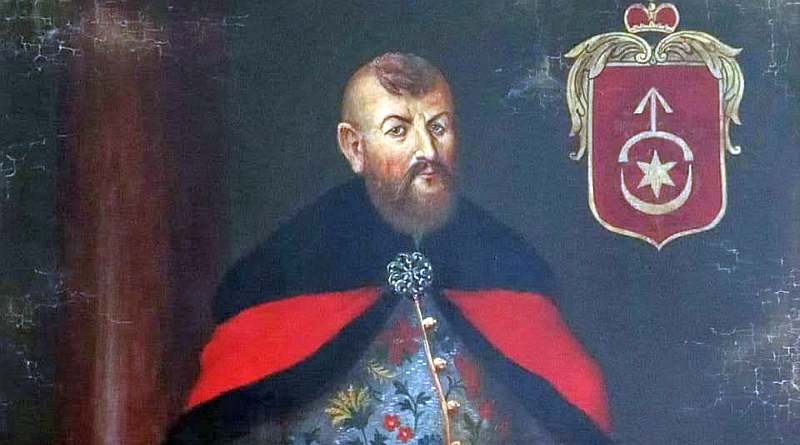
P.S. In the photograph, perhaps this is how the Ukrainian prince Vasyl-Kostiantyn Ostrozkyi looked, the uncrowned King of Rus, and for half a century the voivode of Kyiv (this is more than all of modern Ukrainian statehood!), one of the most influential figures of the Polish-Lithuanian Commonwealth (which was the result of the efforts of not only Poles but also Ukrainians and Lithuanians). Prince Vasyl-Kostiantyn will be 500 years old in 2026. This is about the scope for strategic responses in the interests of Ukraine and Poland, not just a banal reflection on a populist politician, even if in a presidential chair.
The cover from the manhole flew off not only in Moscow but also in Warsaw.
Let’s take at least a piece of our history. The Andrusiv Armistice of 1667, as a result of which Ukraine was divided along the Dnipro River. The left bank went to the Muscovites, the right bank remained under the Poles. Kyiv was supposed to be handed over to Moscow for two years, but they clung to it with a death grip. Because there is the cradle of Kyivan Rus, a source of pure energy, under which the Muscovites desired to adapt their scant history.
Somehow it stuck in memory: “There is no truth in the world. There are only points of view.” This phrase always seemed unfair to me. Points of view do indeed have a right to exist, but not at the expense of truth. Donbas is in fact occupied by Russians – that’s the truth. Their claims that it “always was Russian” are a cynical, disgraceful, distorted “point of view”. Everyone has the point of view they are capable of based on their level of development.
Thus, divided Ukraine had no statehood, although it had all the signs of a nation: culture, language, its own writers, poets, artists, indubitable evidence of its origin, which are still in Kyiv. Later on – the Cyril and Methodius Society, the formation of political trends. And we did not have statehood not because we were incapable as a nation, but because we were forcibly torn apart.
That’s how I see it.
Poles’ historical memory – is that Ukrainians work for them. Then and now.
Muscovites’ historical memory – is that everything of ours is theirs.
We can fuel our inferiority with our own memory – when we ran one way to wash toilets in Moscow suburbs, and another way – to pick strawberries for the Poles, and think that’s who we are. But that will only be one “point of view”. The truth is that both consciously disregarded the right of a separate existing people, with all the signs of a nation, to decide their own fate without their arrogant permission.
The position of the Russians today is not to let us exist at all. The position of the Poles today is not to allow us as a player in the EU competition. Imagine the absurdity of the situation: we don’t want to lose to a new competitor, so let’s not allow them into the competition. Because they might win. With their Bandera, with their units named after the UPA, with their unwillingness to bow down again and ask permission to make a decision that should not concern anyone around, since there are long-established internationally recognized borders.
Imagine Ukraine as a person whose resources have been used by outsiders for too long. This person may be exhausted. Wounded. Bloody. With internal illnesses. But they persist despite the events. They somehow forge their own path. They may not look very attractive due to poor health, old clothes, calloused working hands, exhausted minds, and time spent on others. They may even doubt themselves at times – but they are ALIVE.
If they are not needed by us, if we disregard them the same way others do, if we do not defend their right to life and place in the world, they are essentially needed by no one anymore.
Nova Poshta:
— Next.
Zelensky:
— I need to send a package to Poland.
— What are we sending?
— The Order of the White Eagle.
— Reason for return?
— UPA.
From the queue:
— Oh, look. Finally, under this government, something is being returned.
Zelensky:
— Petro Oleksiyovych, you’re even here?
— I have a subscription to criticism. 24/7. No days off.
— What’s now?
— Nothing. Just if the return process has started, maybe you’ll also return subjectivity to the Verkhovna Rada?
— We’re currently returning the order.
— Well, I’m clarifying. Just in case today is a day of returns.
— What are you doing here?
— The same.
— They didn’t revoke it from you.
— Exactly. Disorder. You gave the UPA name — they took it away. I recognized the UPA — they skipped me. Where’s the justice?
Employee:
— Is it a family shipment?
Both:
— NO.
— We’re arguing.
— Constantly.
— Professionally.
— Volodya, where are you and where is professionalism. Just the address is the same. And the order is the same.
Yushchenko enters.
— I see you’ve started without me.
— Viktor Andriyovych, you too?
— Why not? There’s a scandal in the country about Ukrainian history, and I’m supposed to be home extracting honey?
— Do you also have an order?
— Of course.
Employee:
— Are you at least friends with each other?
All:
– No.
Yushchenko:
– They argue after me.
Poroshenko:
– We argue after you.
Zelensky:
– And after me, the next ones will argue.
Kuchma enters.
– Is this the eagles’ line?
All:
– Leonid Danilovich?!
– What did you think? You’d figure it out without me? I had this distinction when some of you weren’t even in plans yet. Let alone in politics.
Poland:
– Gentlemen, wait. We’re only with Zelensky…
Poroshenko:
– Why did you skip me?
– We didn’t…
– I’m asking: I recognized UPA – where’s my scandal?
Yushchenko:
– I’m interested too.
Kuchma:
– The list was clearly made without experience.
Poland:
– But you all criticize each other.
Zelensky:
– Yes.
Poroshenko:
– Daily.
Yushchenko:
– For decades.
Kuchma:
– It’s almost a state tradition.
Poland:
– So why are you all together?
All:
– We’re not together.
– We’re just simultaneous.
– Don’t confuse it.
– We have an internal fight.
– Not international.
Poland:
– So maybe you’ll reconsider?
Four presidents simultaneously:
– after the Russian ship.
Employee:
– Is it a family dispatch after all?
All:
– NO.
– Four different ones.
– And separate checks.
– Because we still have to argue afterwards.
Employee:
– Should I insure it?
– On the orders?
– No. On Ukrainian politics.
– Girl, Nova Poshta doesn’t insure such amounts.