
Denys Tymoshenko / Donbas.Realii / Radio Liberty
In June, the situation in Kostyantynivka sharply escalated – military experts and military personnel began to speak about it. The situation is most vividly illustrated by a map from the DeepState project, which shows that from mid-May, within a month, the Russian army approached the city closely (“red zone”), and its soldiers began to be regularly recorded in nearly all areas of the city (“gray zone”). “I would like to be mistaken, but it seems that during June-July Ukraine will lose Kostyantynivka…,” – noted on June 8th, Konstiantyn Mashovets, an observer from the group “Information Resistance.”
This is happening against the backdrop of the Russian army’s halt or even retreat in most areas of the Russian-Ukrainian front – according to assessments by the Commander-in-Chief of the Ukrainian Armed Forces Oleksandr Syrsky, as well as the American Institute for the Study of War (ISW), the aggressor lost significantly more territory in May than it occupied.
What is happening in the city, how the Russian army is “squeezing” the Ukrainian defense there, and what consequences the possible capture of Kostyantynivka will have for the fate of the rest of free Donbas – all this in the material from Donbas Realii (a Radio Liberty project).
What is happening in Kostyantynivka?
“The… zone of infiltration into the city is increasing, which may result in the inevitable absorption of the settlement by the enemy,” – wrote DeepState analysts on June 2, commenting on the latest advances of the Russian army south of Kostyantynivka.
“The situation in Kostyantynivka is approaching the format of heavy urban battles”, – noted on June 10, a soldier with the call sign “Muchenoy”, indicating that Russian soldiers are starting to fortify in the “Central” neighborhood, near the Kryvy Torets River, which divides the city in half.
“Evacuation, supply, and the introduction of our infantry into Kostyantynivka are very complicated,” – stated in a comment to hromadske the battalion commander of the drone systems of the 28th Separate Mechanized Brigade named after the Knights of the Winter Campaign Serhiy Yaryi.
“The battles for the Konstantynivka defense district of the Armed Forces of Ukraine have entered the final phase, as the enemy has apparently managed to break through (simultaneously in several sections) to the western (central) part of the city. This, in turn, sharply destabilized the resilience of the entire defense system of the Armed Forces of Ukraine in this area,” wrote on June 10, Kostyantyn Mashovets.
The Ukrainian General Staff has not yet commented on the situation in the city, providing only the number of Russian assaults per day in daily reports. The Konstantynivka direction is among the top three hottest spots.

“Urban battles for Konstantynivka have begun,” says in a comment to Donbas Realities the head of the military department of the “Return Alive” fund, Vladyslav Urubkov. “For two years, the Russian army has been breaking through from several directions to now encircle Konstantynivka from three sides.”
“The enemy conducts infiltration missions in various parts of the city – northern, western, southwestern, eastern outskirts, industrial zone, and along the Kryvyi Torets River, using favorable conditions for concealment,” says Donbas Realities expert of the Center for Defense Strategies, Victor Kevliuk. “Up to 60% of the city is affected by infiltrators, but the enemy cannot establish a foothold.”
The most critical and hottest situation is in Illinivka – a tiny village on the southwestern outskirts of Konstantynivka, experts say.
On the DeepState map, it is marked in gray, meaning “infiltration zone,” but in fact, it has become a “gateway” for Russian soldiers infiltrating the city.
In DeepState, they say that the movement of Russian soldiers from this village south of Konstantynivka takes place simultaneously with the movement of other Russian army units from the east of Konstantynivka (from Novodmytrivka). If they meet north of the city, it could cut off the Defense Forces’ access to other areas.

“Illinivka almost immediately merges with the city,” says military observer Bohdan Myroshnikov in a comment to Donbas Realities. “After the village merges into Kostyantynivka, there is immediately a high-rise development, which is very convenient for accumulating forces and resources. This is probably the hottest area on the entire front because even near Rodynske, on such narrow sections, the enemy does not suffer such great losses.”
“It’s impossible for us even to discuss that we can completely clear any city blocks right now under the current combat conditions,” states Vladyslav Urubkov.
Why is the Russian army able to advance?
Urban battles for Kostyantynivka started amidst the Russian army effectively halting on other front sections. They manage slight advances only to the east of Sloviansk and Kramatorsk, where the Defense Forces are trying to stabilize the situation after the fall of Siversk.
DeepState reported the failure of the Russian offensive in May – only 14 sq km of Ukrainian territory was occupied, and this with an increase in the number of assaults by almost 40% compared to April.
The American Institute for the Study of War also noted a significant slowdown in Russian army advances: from December last year to May, it managed to capture just over 40 sq km (compared to nearly 516 sq km occupied in the same period last year).
According to experts interviewed by Donbas Realities, the crisis in Kostyantynivka is connected with two reasons:
- Russia, after two years of fighting, reached the city this summer simultaneously from three sides;
- Concentrated forces and resources here.
“It’s not a ‘lightning’ breakthrough, but a creeping, costly enemy pressure. The enemy is focusing efforts on the Kostyantynivka direction as part of broader pressure on the Sloviansk-Kramatorsk agglomeration after successes near Toretsk and Chasiv Yar,” explains Victor Kevliuk, an expert from the Center for Defense Strategies.
“Summer weather favors infantry actions. Other front sections are relatively more stable or less dynamic, so resources have been transferred here, as capturing the Donetsk region is one of the tasks of the so-called ‘SVO,'” he adds.
The sharp escalation in Kostyantynivka for the Defense Forces is also explained by the specific tactics of its assault by Russia. It can be simply characterized as: drone operators plus assault troops – neither of which are spared by Russian commanders.

“As soon as assault groups are introduced and when there are enough of them to consolidate, they immediately bring in ‘Rubicons’, ‘Sudoplatov battalions’, and other enemy army units that attack our military with drones,” says Bohdan Myroshnikov.
In other words, he explains, Russian UAV operators are practically on the front line of the battlefield.
“And this allows them to reduce the flight time compared to the flight time of our drones. The difference is about one to two minutes, but in the scale of Kostiantynivka, with such an intensity of hostilities, it’s critical,” notes the military observer.
“To ‘fly in’ with vehicles or armor, you have to have a lot of confidence and truly reckon that the vehicle will most likely remain there,” says Vladyslav Urubkov, head of the military department of the ‘Come Back Alive’ fund. “The infantry has to start almost on foot from Druzhkivka or from Oleksiyevo-Druzhkivka to reach some positions.”
In conditions where supply and rotation in the Defense Forces units in the city are complicated, they are constantly pressured by Russian assault units, analysts explain.
“Today, only Russia has an almost unlimited number of cheap manpower,” says Viktor Kevliuk. “The enemy’s aviation, drones, artillery can physically ‘erase’ Ukrainian positions. Infiltration instead of massive assaults allows for resource savings. Ukrainian units suffer from a lack of personnel in certain areas.”
“They can lose up to 50 people a day in an area [near Illinivka] that’s very narrow and shallow. It doesn’t stop them at all. This is their advantage, that they can afford it,” says Bohdan Myroshnikov.
The dominance of the Russian army in the air also plays a role – it destroys buildings with KABs where Ukrainian fighters hold the defense, as well as their fortifications. Against the backdrop of logistics problems, this forces the Defense Forces to reduce their presence in Kostyantynivka.
In particular, by early May, most Ukrainian reconnaissance drone operators had already left the city, reported the OSINT analyst writing under the nickname Playfra. This has significantly complicated the process of identifying targets in dense urban areas and striking them, the analyst notes.
Can Russia Capture the City by Summer?
The Russian Army is attempting to capture Kostiantynivka using the same strategy as in Pokrovsk, believes the analyst of the “Information Resistance” group, Kostiantyn Mashovets. According to him, this tactic works for cities with dense development and industrial zones: it involves encircling the city from the flanks, breaking into the urban area with separate assault groups and units – preferably simultaneously in several locations, after which a mass infiltration of Russian infantry begins.
From the moment the first Russian assault troops began to be fixed within Pokrovsk (September 2025) to its complete occupation (May 2026), 9 months passed. Kostiantynivka is twice the size of Pokrovsk by area, so according to this calculation, the Russian army may need up to a year and a half to capture it. However, the experts we interviewed are more pessimistic.
“In Pokrovsk, there were several logistical routes that the enemy immediately tried to cut off, and now technical means allow doing this,” reflects Vladyslav Urubkov. “With Kostiantynivka it is more complicated, there are literally a couple of these routes unless we count dirt roads and so on. And unfortunately, they have been under fire for a very long time.”
According to Kostiantyn Mashovets, the movement of Russian groups towards each other from different sides into the city center (which could encircle the Defense Forces’ group) can only be stopped by the river.
As of June 10, the distance between the forward assault groups of the Russian army, which are trying to meet, according to him, is less than 2 km.

“Work is underway to clear them, but again, these are nine-story buildings, these are large basements, there are a lot of private houses. There is no possibility to send a group to clear these basements right now,” explains the specifics of the city’s defense, Vladyslav Urubkov. “The only possibility is drones, plus some small group checking a small area. But for a battalion to go in to ‘clear’ a basement – that is not feasible right now.”
According to Urubkov, the situation could be corrected by Ukraine seizing the initiative in the air over Kostiantynivka – specifically by increasing the number of aircraft, aviation missiles, and analogs of Russian KABs, which would simply destroy occupied high-rise buildings. But according to the expert, this is still very far away.
“Kostiantynivka is holding. The prediction of the city’s loss in June is just one of the possible scenarios, the most pessimistic. The reality as of June 2026 is prolonged street fighting without a quick fall of the city,” Viktor Kevliuk believes.
If Kostyantynivka Falls – What Awaits Donbas?
“The next height after Kostyantynivka is Kramatorsk. You won’t be engaging in battles uphill. So, for the enemy, this will be very convenient. That’s why we cannot give up this city,” said a city defender codenamed “Wolf” in September 2025.
Kostyantynivka is the first city from the south in the so-called “fortress belt” of the Slovyansk-Kramatorsk agglomeration: a part of the Donetsk region that remains under Ukrainian government control. The possible occupation of this city could lead to a sharp deterioration in the defense conditions for this chain of cities connected by the N-20 highway.
“Right after capturing Kostyantynivka, the enemy will move on to Druzhkivka and Dobropillia with a further vector of movement probably all the way to Barvinkove,” believes Bohdan Myroshnikov. “This will also directly worsen [for the Defense Forces] the approaches to the Slovyansk-Kramatorsk agglomeration. It will also worsen the situation in the Chasiv Yar area. Kostyantynivka controls many different front areas, both neighboring and not. It binds the enemy, forcing them to fight at Illinivka instead of storming Druzhkivka, Dobropillia, or Mykolaivka.”
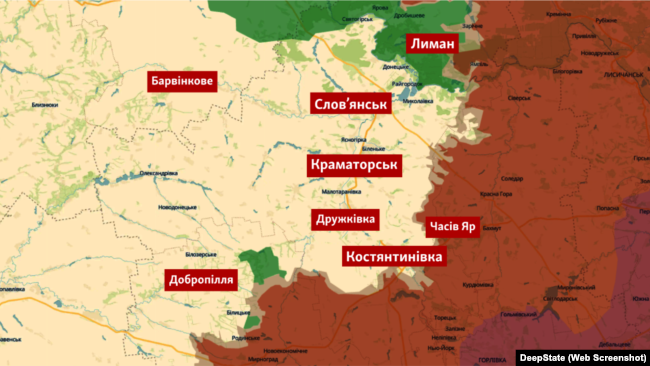
“Kostyantynivka is an important height and logistical hub. Its capture will give the enemy a launching pad to advance to Druzhkivka and further to Kramatorsk, which geographically is the next dominant height. Battles from south to north become more advantageous for the aggressor, as this opens the path to the entire agglomeration,” says Viktor Kevlyuk.

There is also some troubling similarity in the significance of Avdiivka and Kostyantynivka for the defense of Donbas. Avdiivka was a Ukrainian defense stronghold for years, after whose occupation the eastern front literally “fell apart.”
At that time, the military and analysts cited the uncoordinated actions of Ukrainian units and the lack of a fortified defense line behind the city as reasons. The Russian army occupied many Ukrainian cities within months, created the “Ocheretynsky salient” and reached Pokrovsk, which they later managed to capture.
However, according to experts interviewed by Donbas Realii, there is no risk of an “Avdiivka-2” in the event of Kostyantynivka’s occupation. Vladyslav Urubkov notes that the pincer tactic, i.e., flanking around fortified defense nodes, which Russia practiced then, may not work this time. Especially due to the scaled-up use of drones by the Defense Forces.
“When we have cut routes that vehicles can’t traverse, thanks to drones, we can supply our frontline units with almost everything they need. Of course, there are many nuances, but airborne logistics is an innovation; there was no such level back when we were defending other populated areas,” he says.
Experts also advise against comparing the village of Ocheretyne, which became a launching pad for Russia’s advance on Pokrovsk, with Druzhkivka—a city covering nearly 50 square kilometers with numerous industrial facilities suitable for defense.
Druzhkivka is set to become the next “barrier” that the Russian army must overcome in its advance from the south towards Kramatorsk.
“The Sloviansk-Kramatorsk agglomeration is a network of fortified cities, a so-called ‘belt of fortresses,’ with higher defensive density and stable logistics. There won’t be a rapid collapse like in smaller settlements. Druzhkivka is the next major hub, it’s fortified, and the Defense Forces’ resources are dispersed,” says Viktor Kevliuk.
At the same time, the importance of heights should not be underestimated at the current stage of the Russo-Ukrainian war. In early March, the speaker of the 7th Rapid Response Corps of the Air Assault Forces, Volodymyr Poliovyi, spoke about the advantage Russian drone pilots gained by occupying high-rise buildings in the north of Pokrovsk and Myrnohrad.
“In response, we cannot adequately strike the enemy in the volume he employs the most common weapon of this war, the so-called FPV drones,” he noted.
OSINT analyst Playfra already suggests that after capturing Kostyantynivka, the Russian army will push towards Druzhkivka via the railway, which runs along tactical heights. Its occupation, in his opinion, would allow Russian FPV drone pilots to “cover” the advance of their assault forces from the sky.
Even in the event of Kostyantynivka’s occupation, the Russian army will still face a substantial task in preparing to capture the entire Sloviansk-Kramatorsk agglomeration, analysts believe.
The first thing they will need to do is “cut” the Ukrainian tactical salient in the Chasiv Yar area and also cover about 10 kilometers north to Druzhkivka, says Kostyantyn Mashovets.
Further attempts by the aggressor to simultaneously advance towards the Sloviansk-Kramatorsk agglomeration from the north—from the Lyman area, from the east—from Sloviansk, and from the west—from Dobropillia, can be expected. None of these cities are occupied.
“Ideally [for the Russian army], capture Kostyantynivka–Druzhkivka from the south, capture Lyman, approach Raihorodok from the north, already stand at the approaches to Slovyansk from the east, and approach Kramatorsk from Chasiv Yar. And then begin some assault from several sides,” describes the probable plan of the Russian General Staff, Vladyslav Urubkov. “This is their perfect option for cutting off this defense area of the Donetsk region.”
“If they conceive such assaults, and if they find the strength for such assaults — then, I think, in these months we will reach the mark of 50,000 Russians eliminated [per month],” he predicts.
“The potential loss of Kostyantynivka is a serious blow but not fatal for the defense of Donbas in the short term. The aggressor will pay a huge price in human losses and equipment,” concludes Viktor Kevlyuk.
Copyright © 2021 RFE/RL, Inc. Reprinted with permission from Radio Free Europe / Radio Liberty
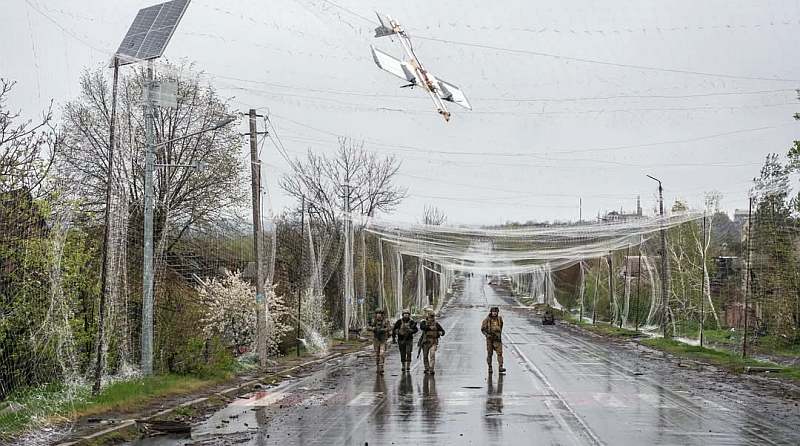
Cover image: Fighters of the 24th OMBr named after King Danylo on the streets near Druzhkivka north of Kostyantynivka, April 2026. Photo: Serhiy Korovayny
