
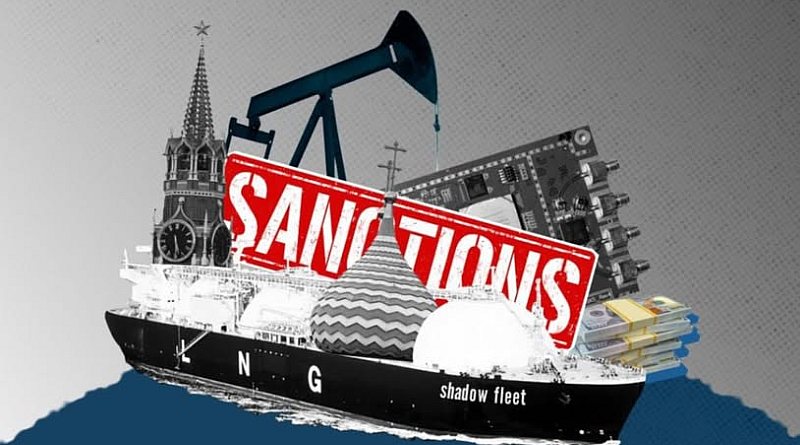

Information on current Russian losses due to sanctions as of 01/30/2026.
1. One of Russia’s largest state banks predicts the complete depletion of the NWF within the year.
– The liquid assets of the Russian National Wealth Fund could fully disappear in approximately 1–1.3 years if current oil prices persist. This forecast was published by experts from Gazprombank’s Economic Forecasting Center.
– At the beginning of 2026, the NWF had 4.1 trillion rubles of liquid assets (currency and gold on CB accounts). The fund starts to be actively spent when oil prices drop below $59 per barrel.
– According to Gazprombank estimates: with oil around $40, the NWF will be depleted in just over a year; at $30–35 — the fund could be zeroed by the end of the current year; at $50, the reserves will last approximately 2.5 years.
– In December, Russian Urals oil averaged $39, by the end of January — $36–38. Additional pressure is created by NWF expenditures on “other goals”: the 2026–2028 budget includes an additional 1 trillion rubles in infrastructure investments from the fund.
– Before the full-scale war, the NWF had $113 billion in liquid assets (6.5% of GDP). By the beginning of 2026, about $52 billion remained — 2.5 times less, only 1.9% of GDP.
2. Russia needs oil at nearly $100 per barrel to balance the budget.
– For a deficit-free budget, Russia requires an oil price of $93 per barrel by the end of 2025. Over the year, the balancing price rose by $4, compared to 2023 — by $7, and relative to the pre-war 2021 — by $21.
– Thus, budget dependence on oil has returned to early 2010s levels, when Russia needed oil at $100 and above to balance the budget. In the late 2010s, federal finances were still balanced at about $49 per barrel.
– There is a sharp increase in the budget’s sensitivity to oil prices. For comparison: in the early 2000s, Russia needed $18–25 per barrel for tax revenues to cover all state expenditures.
– Current calculations confirm the degradation of Russia’s budget sustainability: even with historically high oil prices, the Kremlin is no longer able to fund expenditures without a deficit.
3. A deviation of the average Urals price from the budget benchmark by just $10 costs Russia’s budget 1.5–1.8 trillion rubles in revenue.
– With low oil prices and a strong ruble, the budget deficit by the end of the year could grow to 3 trillion rubles — about 7.5% of the projected 2026 revenues.
– Sanctions are forcing Russia to increase price discounts to maintain exports. The gap between Urals and benchmark grades has effectively doubled following new restrictions — this is the cost of maintaining market share.
– Physical volumes are also falling: in late January, sea exports were estimated at about 410,000 tons per day, 11% less than a year ago.
– The supply structure is changing: in December, exports to China increased by 23%, while shipments to India decreased by almost a third.
4. Losses of Russian business abroad since the start of the full-scale war.
– The sale of Lukoil’s foreign assets is one of the biggest developments recently: the Russian oil giant agreed to sell a significant portion of its international portfolio to the American investment fund Carlyle Group.
– This is effectively an exit from global assets, including refineries, fields, and gas station networks in Europe, Africa, and Asia — the deal still requires approval from American regulators and is a direct result of sanction pressure.
– Gazprom lost control over European assets — the German subsidiary Gazprom Germania came under external management and was then nationalized; Poland also took control of its part of the Yamal-Europe pipeline.
– Rosneft — assets in Germany came under external management, including stakes in several refineries.
– Novatek lost Polish LNG assets, which were transferred to a new owner after temporary management.
– Sberbank and VTB have practically lost their presence in Europe: Swiss, Austrian, Croatian, Slovenian, and Czech subsidiaries were sold, liquidated, or taken under external management. British branches were also closed or transferred to external management.
– Alfa-Bank — its subsidiary Amsterdam Trade Bank was declared bankrupt, and Sense Bank (Ukraine) was nationalized.
– RZD had to sell 75% in the logistics company GEFCO. These examples are only part of a broader trend: since the start of the war, foreign investment in the Russian economy has fallen by more than 50%, and many foreign companies have fully or partially left the Russian market under sanction pressure or independently decided to exit.
– Overall, this indicates a systematic contraction of the international presence of Russian business, a significant reduction in capital inflow, and loss of control over key foreign assets due to Western sanction policies.
5. In Russia, for the first time in 25 years, the total number of passenger cars decreased last year — to 52.8 million units.
– The main reason is tax pressure: the increase in transport tax forced owners to massively deregister old and practically non-working cars to avoid mandatory payments.
– Additionally, some drivers are intentionally deregistering cars to avoid automatic fines from cameras, despite breaking the law.
– Another factor is the sharp decline in new car sales in 2025. The fleet is not only shrinking by writing off old cars but also ceases to be replenished, breaking the long-standing growth momentum even during crisis periods.
– If the trend continues, 2025 may become a turning point for the entire structure of the Russian car market, which is entering a phase of long-term degradation.
6. Sales of Russian agricultural machinery in the domestic market in 2025 fell by 21.1% year-on-year — to 155.1 billion rubles.
– The reasons are indicative: the decline in farmers’ incomes and a stifling key rate, which effectively blocked access to financing.
– The sector, which the Kremlin has for years called the “pillar of import substitution,” is losing solvent demand and sliding into stagnation at an increasing pace.
7. “Lukoil” agreed on the sale of foreign assets to the American fund Carlyle.
– “Lukoil” announced a deal to sell 100% of LUKOIL International GmbH to the Carlyle fund — it is the entire international portfolio of the company: refineries in Romania, Bulgaria, and the Netherlands, extraction in Iraq, Uzbekistan, and African countries, more than 2,000 gas stations in Europe and Asia. Assets in Kazakhstan are not included in the deal and remain under the control of the Russian group.
– The market valuation of the portfolio is $20-23 billion, but due to US sanctions (October 2025), a discount of 20-50% is expected. Market participants estimate the real value of the deal to be $12-15 billion.
– The sale is possible only with the approval of the US Treasury’s OFAC; the deal is not exclusive. This is already Lukoil’s second attempt to exit foreign assets after failed negotiations with Gunvor due to the US refusal to issue a license.
– The current license to sell assets is valid until February 28, which increases the pressure on the company and forces it to agree to a significant sanctions discount.
8. The EU plans to completely ban maritime services for Russia to block the “shadow fleet.”
– The European Union is preparing a complete ban on providing maritime services to Russia as part of the 20th sanctions package. This was stated by the EU High Representative for Foreign Affairs Kaja Kallas. The package is planned to be adopted on February 24; it will also include restrictions in energy and fertilizer trade.
– French Foreign Minister Jean-Noel Barrot clarified that the sanctions will include “particularly harsh measures” against the Russian “shadow fleet.”
– The goal is to completely block the movement of ships that Russia uses to circumvent sanctions.
