
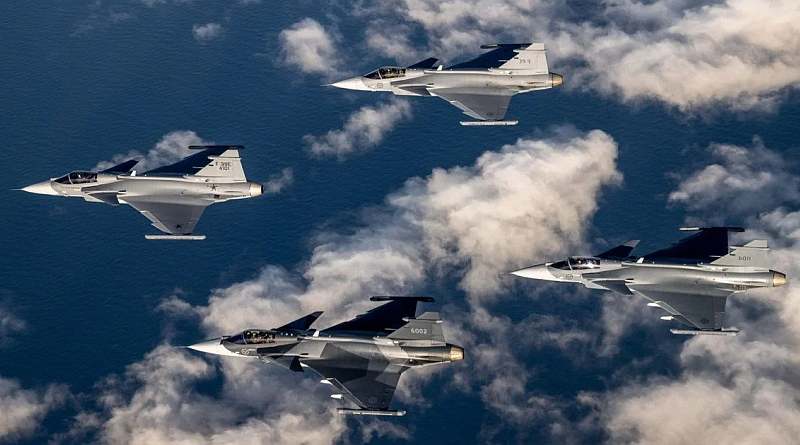
Remember back in 2024 when we were all eagerly eyeing the Swedish JAS 39 Gripen and wondering: will they give them or not? Here is my article on LB.ua from those times with a detailed analysis of why these “Griffins” are our ideal choice.
Sweden kept the process on hold for a long time due to requests from NATO allies (so we could first logistically “digest” the infrastructure for the F-16), but now the ice has finally broken. Political decisions, approvals, and package formations have been made. The process has started.
Of course, because Orban stepped down, aid was unblocked, money came in – this was the main stumbling block, not just logistics.
It’s time to lay out why the Gripen is not just “another plane” but a conceptual shift in our war. And a spoiler right away: it’s not just about the Meteor missiles.
While the MBDA Meteor is a masterpiece that makes Russian fighter pilots break into a cold sweat, reducing the “Griffin” to just a flying launcher is incorrect. There’s no “silver bullet.”
This aircraft was initially designed to counter the USSR under conditions of total numerical inferiority. The Swedes understood: the Russians would always be more numerous, and the fight would have to be through technology and maneuver.
The main bonuses of the “Griffin” lie in the realms of survivability, logistics, and geopolitics.
How many aircraft we will actually receive
Let’s move to the numbers because here Sweden has just revealed its hand: they are giving us 16 JAS 39 Gripen planes of the C/D version (a full squadron) with delivery at the beginning of 2027. But this is just the tip of the iceberg. Simultaneously, there is an open agreement to purchase another 22 new E-version aircraft by 2030 (to be financed from the same 90-billion EU credit). So we see not a one-time “give and forget” action but a systematic transition of the Air Forces of the Armed Forces of Ukraine to the Saab platform with an overall focus on a fleet of up to 100–150 machines in the future. This is already a full-fledged strike force that gives us time. Time to calmly exhaust the resources of post-Soviet aircraft, fully integrate the F-16 into the air defense system, and use up the stocks of “air-to-air” missiles that are nearing the end of their life cycle.
Partisan aviation: takeoff from the asphalt
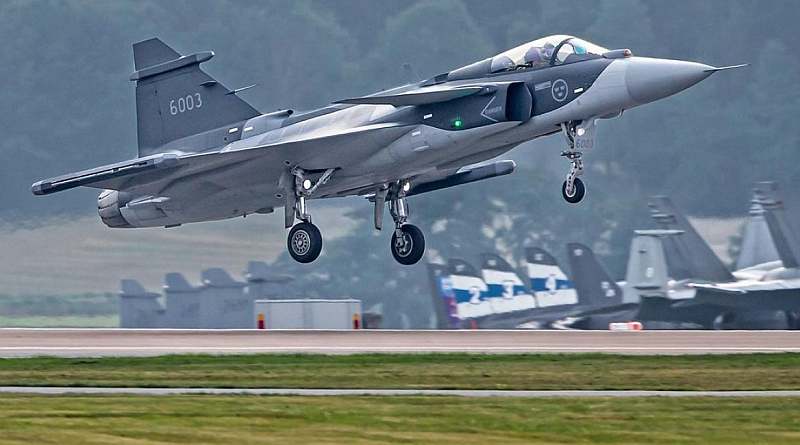
If the F-16 is a demanding thoroughbred that needs an ideally groomed long strip, the Gripen was created for the paranoia of the Cold War era. Their doctrine assumed that the Soviets would wipe out all stationary airfields in the first hours, even using nuclear “Tochkas.” That’s why the “Griffin” can land on regular highways. All the infrastructure for its refueling and reloading fits into a couple of trucks. They arrive, five conscripts refuel the aircraft in 10-15 minutes, arm it with missiles, bring the pilot thermoses with snacks – and he’s back in the air. The enemy simply cannot destroy aviation that can’t be found on stationary bases.
European Missiles: Independence from US Swings
This is a colossal strategic advantage. With the “Gripen,” we shift to a European weapons lineup (Meteor, IRIS-T, Taurus/Storm Shadow). Considering the completely unclear policy of the US with their constant internal crises and delivery delays, Gripen gives us independence from American political swings and tactical flexibility not to rely on a single manufacturer.
What about missile production? The European consortium MBDA is currently flooding factories with money. By the end of 2025, they have already doubled missile production, and for 2026 they have planned a growth of another 40% (the count of new missiles reaches hundreds of units per year). There are new lines, including a factory in Bolton, UK, and facilities in France. There is no shortage of munitions for the Swedish aircraft expected.
Why Meteor is Not Just “Another Missile”
An ordinary air-to-air missile (be it Russian R-77 or older Western models) works like a solid-fuel pellet: it burns out in the first few seconds, accelerates the projectile, and then it flies purely by inertia.
At the final stage, near the target, it rapidly loses energy. An experienced pilot can make a sharp maneuver, forcing the missile to turn, completely lose speed, and simply fall.
But with the “Meteor,” Russian Su-34 and Su-35 face a range of problems. The inevitability of the strike here is ensured by the synergy of the ramjet engine and unique self-guidance mathematics.
Ramjet Engine. The “Meteor” does not fly by inertia. The missile itself regulates fuel supply during flight. It conserves thrust on the cruise phase, and when approaching the target at strike distance, it ignites the afterburner and accelerates to 4 Mach. It maneuvers together with the target at full thrust. Even if an Su-35 pilot makes a brilliant 9G maneuver and momentarily confuses the missile, it won’t fall – its computer instantly recalculates the trajectory, accelerates, and performs the same maneuver, pursuing the target until it runs out of altitude or energy.
Data Link Immunity. Most missiles operate on the “fire and forget” principle. If Russian electronic warfare succeeds in blinding the seeker head, the missile loses the target. But the “Meteor” has a two-way link. If the missile becomes “blind,” it continues to be guided by the Gripen’s radar (or the ASC 890 AWACS aircraft), which flies 100 km outside the range of Russian jamming. It flies using external coordinates until it approaches so closely that electronic warfare can no longer physically block the signal.
Death by Own Defense (Home-on-Jam). Imagine a Russian pilot sees a launch and switches on their vaunted electronic warfare systems (like the “Khibiny”) to the absolute maximum, trying to fry the brains of the “Meteor” with white noise. This activates their worst-case scenario: the missile’s seeker head simply stops searching for the reflected radio signal. It switches to passive mode and starts homing directly onto the source of the interference. The stronger the Russian aircraft “screams” with its electronic warfare in the radio ether, the more precisely the “Meteor” targets the cockpit. Their defense becomes a beacon for their own death.
Doppler Selection (Decoy Rejection). A standard evasive maneuver is a sharp turn with the release of chaff (clouds of metallized foil), creating false targets. But the “Meteor’s” brains have phenomenal digital processing of Doppler shift. The missile perfectly “understands” the physics: the foil cloud instantly brakes in the air, while the real Su-34 continues flying at 800 km/h. The computer sifts through everything at lightning speed, ignoring static debris that doesn’t have the corresponding velocity.
The enemy’s conclusion: You can’t escape it (because it doesn’t lose thrust). You can’t jam it (because it will home in on your jammer). You can’t hide behind a cloud of decoys (because its radar sees the speed difference). That’s why the “Meteor’s” no-escape zone is several times larger than any competitor in the world. Once inside it, the pilot faces significant problems.
Rapid Replacement of Losses from Availability
Aviation always involves losses. Accidents, friendly fire, major repairs taking months. Here, the Gripen wins by being able to quickly cover losses from the active inventory of the Swedish Air Force and other operator countries. We don’t need to wait for years. Saab’s current production rate is about 18-24 new machines per year (with plans to increase to 36), but there is an already existing fleet in Europe. A total of 120 is not a small number. If necessary, we can urgently receive used aircraft or donor jets, and training technicians and pilots on them takes significantly less time.
Hunting KAB Carriers
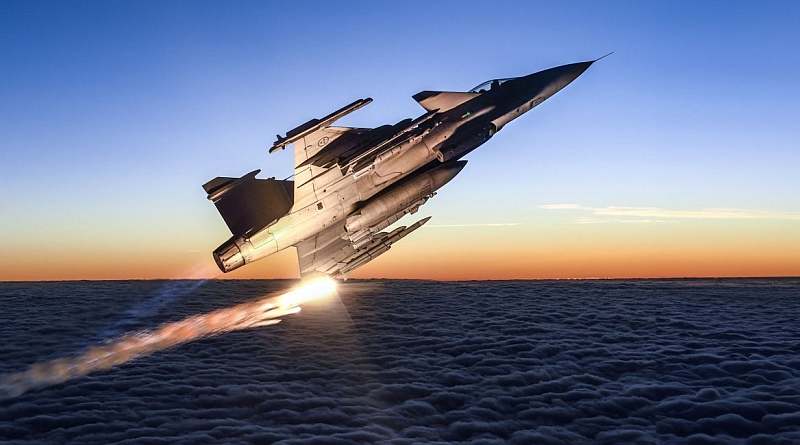
The Su-34s that are bombarding our positions with KABs are a fundamental problem at the front. The Gripen has a small radar cross-section (low observability), an excellent radar, and is perfectly suited for hunting these “geese.” Likely tactic: the “Griffin” flies at ultra-low altitude, remaining invisible to Russian air defense, receives targeting information from ground radars or Swedish AWACS aircraft (ASC 890) already provided to us, makes a sharp climb, launches a missile, and instantly drops back to low-level flight. By the time the Russians figure out where it came from, the “Swede” is already sipping coffee on a hidden highway.
Networked Swarm and “Silent Kills”
The “Gripen” boasts an excellent internal Data Link system for guerrilla tactics. Four aircraft take to the sky. Only one of them activates its radar (or receives an image from the ASC 890) and transmits coordinates to the other three via a secure channel. It is covered by a group with electronic warfare and reconnaissance containers – reaching this lone operator is a challenging task.
The other three fly in complete radio silence. The Russian Su-34 cockpit warning system remains silent because nobody is directly illuminating it. Then, one of the “blind” Gripens launches a Meteor using external coordinates from a distance of 150 km. The missile seemingly appears out of nowhere, creating an ideal airborne ambush.
The Gripen can function not only as a fighter but also as a Stand-in Jammer within the zone of destruction. How is this implemented? A swarm of our attack drones or a volley of Neptune cruise missiles head towards a Russian oil refinery. The Gripen stays at a safe distance from the air defense zone and uses its electronic warfare station to form a narrow, highly powerful jamming beam directed precisely at the Russian radars along our group’s route. It creates an invisible “blind corridor” through which our subsonic missiles and drones pass completely unnoticed by the Russian air defense system.
Offensive Electronic Warfare: Blinding Them
Historically, the Swedes have had one of the strongest schools of electronic warfare. The integrated electronic warfare systems of the Gripen are not just for defense. They are an active offensive weapon. It can effectively blind enemy radars, generate powerful interference, and harass their ground systems, clearing the skies for our drones and cruise missiles.
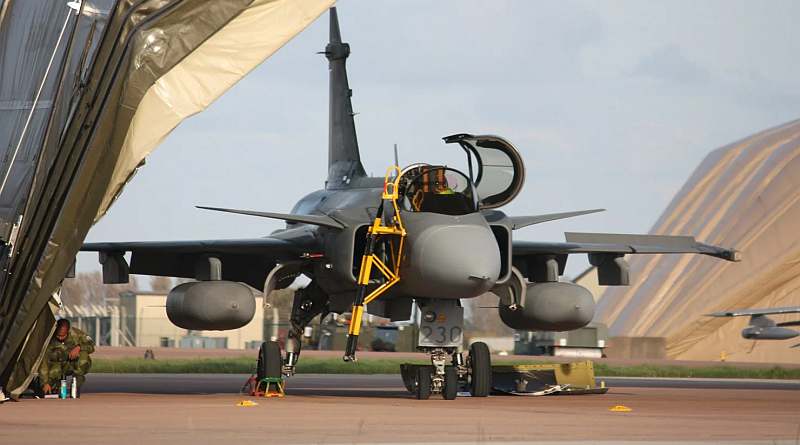
The Swedish approach to electronic warfare is radically different from the Soviet or even the classic NATO approach. From the beginning, they understood that their aircraft would have to operate in the coverage zone of Soviet S-300 and S-400 systems. If you simply switch on a powerful jammer that screams on all frequencies (white noise), you turn into a huge bright spot for enemy missiles that are guided to the source of interference.
Therefore, the Gripen’s electronic warfare system is not a sledgehammer; it’s a scalpel. It’s an intelligent system built around DRFM technology (Digital Radio Frequency Memory). When a Russian radar (for instance, from an S-400) sends a probing pulse to find a target, the Gripen does not try to jam it with noise. It captures this signal, instantly records its digital copy, modifies it (changes phase, time delay, Doppler shift), and sends it back to the enemy. What does the Russian operator see? Instead of a real aircraft, a flock of phantoms appears on the screen, flying in different directions, or the target mark shifts sharply five kilometers aside. The radar continues to operate, locks onto the target, launches a missile… and it flies into empty space. The Gripen system constantly “feeds” the enemy radar lies, perfectly mimicking its own reflected signals.
* * *
“Gripens” are not just about parity in the air. It’s an asymmetric response to the Soviet system that overwhelms us with mass. We gain a low-visibility mobile complex that doesn’t depend on the political climate across the ocean, strikes over long distances, and nullifies all efforts of Russian intelligence.
The Gripen is not a closed, dead-end project of one country. It is a global ecosystem with 300 manufactured machines, spanning from Thailand to South America (where Brazil has its own licensed production).
By switching to Swedish aircraft, we tap into a global logistics network where parts, software updates, training modernization, and production lines are guaranteed to operate for the next 30-40 years.
That’s exactly why we need the Gripens.
Pictured: JAS 39E/F Gripen. Photo: Defense Express
