
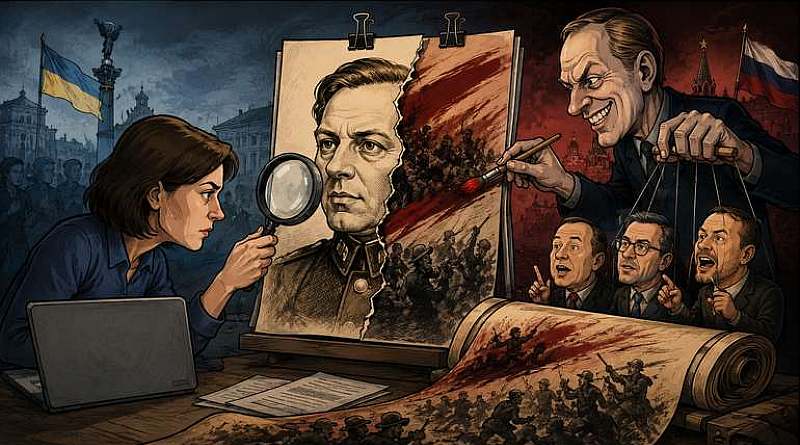
Information warfare is almost never conducted through direct fabrications. The most effective propaganda involves imposing the very structure of the discussion, where one side is forced to constantly justify itself within the framework imposed by the manipulator’s discourse.
Imperial centers very often work through the moral delegitimization of subjected peoples. For the Russian Empire, and later the USSR, the Ukrainian liberation movement was ideologically dangerous, so it was necessary not only to defeat it militarily but also to make it toxic in the consciousness of the West. Similar mechanisms, by the way, were used by imperial centers in regard to the Irish, Polish, Croatian, Algerian, or Baltic movements, as colonial power always tries to present anti-colonial movements as “extremism,” “chaos,” and “ethnic pathology.”
“Objectivity” in the humanitarian sphere often turns into the mechanical reproduction of existing discursive asymmetries. If one side has invested in a certain narrative for decades or even centuries, then simply “showing both positions” is not neutrality. It means reproducing an already prepared informational discourse. A formal procedure does not guarantee the truth if the very structure of perception is already distorted. Truth is not the arithmetic mean between truth and lies, and objectivity is achieved not by “equal distribution of time” between facts and Soviet-Russian propaganda, but by deeply researching primary sources.
Russian imperial policy has always sought to deprive Ukrainians of the status of a political subject, so the Ukrainian movement was presented not as a normal national movement of the modern era, but as a deviation, a creation of “dark forces,” “provincial fanaticism,” or “ethnic radicalism.” Russian propaganda has been forming a system of associations and moral labels for decades, intended to replace the analysis of real historical processes with predetermined emotional reactions. The image of Petliura as a “pogromist” worked precisely as a symbolic mechanism of such emotional triggers and the delegitimization of the Ukrainian national liberation movement.
The problem here is not only the lack of knowledge (or conscious ignoring) of facts but also the absence of a meta-level analysis. The article does not mention who created the framework of discussion, in what political conditions it arose, what interests it served, why these topics were promoted externally for decades, and by whom they were promoted. Russia has been creating a reality-detached game of signs for decades, and involvement in it means playing along with this game and distorting reality.
The very framing of the question “was Petliura an anti-Semite” is not historical but ideological in the sense that its function in public discourse is independent of its content. Even a correct, factual answer to it (no, he was not) reproduces the very fact of the need to respond (“justify”), which is the goal of propaganda discourse.
Particularly problematic is the unreflected “play of objectivity” in postcolonial societies, where part of the intellectual class perceives “distancing from the national narrative” as an automatic sign of intellectual integrity. But distance itself does not mean unbiased thinking. Sometimes it is the acceptance of an external system of coordinates, deliberately constructed as a “neutral position.” A postcolonial intellectual, raised within the framework of imperial narratives, often cannot step beyond their boundaries and continues to evaluate the history of their country through moral-political categories constructed by the former metropolis.
Part of the Ukrainian intellectual and media class, shaped within the framework of universal Western media models, was unable to confront colonial information strategies and methodologically unprepared to work with ideological information constructs, where the framework of “neutrality” itself is a product of long-term political engineering. Soviet functionaries once aptly called such people “useful idiots.”
This is not about banning critical analysis of Petliura (there are many questions regarding his real actions) or the UNR era, but about ensuring that any analysis of the topic considers the century-long context of Russia’s information war against Ukrainian statehood and understands how certain historical events were falsified and turned into political weapons.
In any case, it is now clear that the dissemination of Russian anti-Ukrainian propaganda during the genocidal war of the Russians against the Ukrainians is an editorial position that they do not intend to change. We have the Ukrainian “Free Radio and Television of a Thousand Hills.” It is enough to remind the obvious truth that spreading enemy propaganda during a war is complicity in the war on the enemy’s side.
P.S. In the theory of information operations, the technique used by The Kyiv Independent against Petliura is called the “dead herring method.” Its essence is not to prove the person’s guilt but to create a persistent, intolerable zone of stench around them. Propagandists try to erase reality, distorting its representation in the cultural-information space.
This is a technology of symbolic contamination, where it is not necessary to completely refute or destroy a historical figure (or if this is impossible); it is enough to attach a persistent moral association to them, which is automatically activated when the name is mentioned. This is done to block legitimacy. A person has not yet begun to think, but the associative chain has already worked. The very need to justify oneself already puts the side in a weaker position.
Even after refutation, the label continues to live as a cultural reflex. If a person or organization proves their non-involvement, the public still has a “bad aftertaste” on a subconscious level (“no smoke without fire”), similar to how difficult it is to remove the smell of rotten herring if it stains clothing.
Therefore, postcolonial societies are often forced for decades to fight not so much a historical, but a reputational war for the right to their own normality.
Pay attention to labels like “ambiguous,” “controversial,” and “disputed.” These are diversionary words meant to “smear.”
The main thing in combating this tactic is not to “clean up” the herring. Instead, you should point out who planted it. Not “let’s investigate whether Petliura was really involved in the pogroms,” but “let’s find out how and why the Soviet OGPU organized Petliura’s murder by Sholom Schwartzbard in Paris in 1926, and how the subsequent court process was turned into a large-scale media operation to discredit Petliura and the UNR.”
The stench disappears when you show that this “herring” is a typical tool of the colonizer, not a unique trait of Ukrainians. The standard imperial tactic is to deprive an enslaved nation of the moral right to resist. This is not Ukrainian “controversialness,” but the typical fate of any national liberation movement in the world.
It is necessary to firmly return the discussion from the field of moralizing (where the enemy draws us in) to the field of real analysis. We must teach the world (and first of all ourselves) to view these myths not as “problematic pages of Ukrainian history,” but as relics of Russian informational terrorism.
Illustration generated by ChatGPT at the request of Ostanniy Bastion
