

Information on the current losses of Russia due to sanctions as of 27.05.2026.
1. On May 27, Ukraine struck Russian military and fuel facilities — targeted were the aircraft repair plant in Taganrog, the military airfield “Baltimore” in Voronezh, and the refinery in Tuapse.
– In the Rostov region, after the work of the air defense, debris fell in the area of the 325th aircraft repair plant in Taganrog. According to eyewitness photos and videos, a large fire started on the enterprise’s premises. The plant repairs An-12, An-72, Il-76, Su-24, Su-25, as well as Mi-8 and Mi-24 helicopters and is under Western sanctions for participating in the war against Ukraine.
– In Voronezh, according to Ukrainian monitoring resources, Storm Shadow missiles were aimed at the “Baltimore” military airfield, where Su-34s are based. After the strike, thick black smoke rose over the airfield.
– Also at night, the refinery in Tuapse, Krasnodar Krai, was hit again.
2. The Russian authorities are preparing to introduce new restrictions on fuel exports following a series of Ukrainian strikes on oil refining infrastructure, which have seriously hit the country’s fuel sector.
– After the already existing ban on gasoline exports, the government is now considering restricting the export of diesel and aviation kerosene as well.
– The reason is the large-scale problems in Russian oil refining following the attacks by Ukrainian drones. It is estimated that by the second half of May, refineries with a total capacity of about 238,000 tons per day were stopped or partially shut down in Russia — this is approximately a quarter of all refining capacities in the country.
– The central part of Russia suffered the most, where the strikes affected large plants in Kirishi, Moscow, Nizhny Novgorod, Ryazan, and Yaroslavl. These enterprises provided more than 30% of gasoline production and about 25% of diesel fuel in the country.
– Russian refinery loading fell to the lowest level since 2009 — about 4.69 million barrels per day.
– The Kremlin is forced not only to lose export revenues but also to save the domestic market from fuel shortages using administrative bans.
3. The price of Russian oil in rubles in May fell by 11% compared to April — from 7,299 to 6,518 rubles per barrel.
– The strengthening of the ruble and the decline in global oil prices following the easing of tensions around Iran became the reason. This indicator is critically important for the Russian budget, as the oil price in rubles is used to calculate the MET, a key tax for the oil industry, which forms about a fifth of the federal budget’s revenues.
– As a result, the strong ruble began reducing Moscow’s ruble revenues even despite relatively high oil quotations.
– Although the current price is still approximately 20% higher than the budget-2026 benchmark of 5440 rubles per barrel, the “oil premium” for Russia is rapidly shrinking.
– After peaking above $120, global oil prices have already fallen below $100 per barrel, narrowing the Kremlin’s ability to earn windfall profits for financing the war.
– The strengthening ruble has become a problem for the budget: each ruble’s strengthening in the exchange rate costs the federal budget about 100 billion rubles of revenue per month.
– Russian businesses are already urging the authorities to effectively switch to manual control of the exchange rate to curb the fall in export revenues.
4. Russian airlines bypass sanctions to keep their planes flying.
– Despite extensive sanctions from the US, EU, and UK, Russian airlines continue to maintain flights of Western aircraft Airbus and Boeing by circumventing restrictions through third countries. After 2022, the sanctions were supposed to paralyze Russian civil aviation due to the ban on the supply of aircraft, engines, and components.
– However, Russian carriers have partially adapted: spare parts are coming through intermediaries in India, Turkey, the UAE, and Kazakhstan, and within the country, repair capacities are being actively expanded.
– A notable case involves the story of two CFM56 engines sold by Vallair through Indian intermediaries Aman Aviation and MEC with a formal ban on re-export to Russia. But just two months later, the engines ended up with the Russian airline “Rossiya.” After publicity, participants in the scheme began to distance themselves from each other.
– Meanwhile, China sharply increased the export of aviation components to Russia, effectively helping to maintain the operability of the civil aircraft fleet.
– However, even despite temporary adaptation, problems are accumulating. The Russian aircraft fleet is gradually aging, maintenance costs are rising, and dependence on gray schemes and intermediaries is only increasing.
– This means that Russian aviation is increasingly shifting to a “survival mode,” where flight maintenance depends on semi-legal imports and aircraft cannibalization.
5. The Russian government continues to roll back support for small and medium-sized businesses.
– In the first quarter of 2026, support for SMEs decreased by 27.5% to 52.5 billion rubles, compared to 72.3 billion rubles a year earlier.
– This downturn has continued for the second consecutive year: by the end of 2025, financing for the sector was also reduced. Almost all indicators are decreasing: fewer enterprises receive aid, financial support volumes are dropping, and the average payment size is declining.
– Financial assistance in particular has significantly decreased — by 17.3% year-on-year. Russian small business is rapidly losing stability.
– High credit rates, declining consumer demand, tax pressure, and a withdrawal of state support are accelerating a wave of company closures in trade, services, and public catering. The Russian economy is increasingly concentrating around large state corporations and the military sector, while civilian private businesses are in a state of prolonged degradation.
6. U.S. sanctions continue to complicate Russia’s fuel supply to allied regimes.
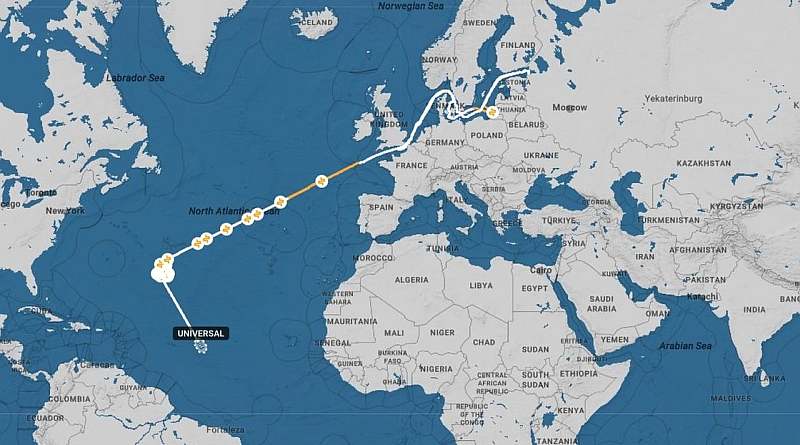
– The Russian tanker Universal, with 270,000 barrels of diesel fuel, failed to reach Cuba and after a month adrift in the Sargasso Sea, altered course towards Brazil.
– The vessel departed from the port of Vistino in the Leningrad region and left the Baltic Sea in April. The tanker passed through the English Channel under the protection of a Russian military convoy, followed by the Black Sea Fleet frigate “Admiral Grigorovich.”
– Despite this, the ship, which is under U.S., EU, UK, Swiss, and Canadian sanctions, was unable to dock in Cuba. Currently, the tanker has set its destination as “For order,” indicating the waiting for new routing instructions.
– Even military escort doesn’t guarantee the Russian “shadow fleet” the ability to conduct fuel deliveries unimpeded.
7. The United Kingdom has increased sanctions pressure on Russia by imposing restrictions on cryptocurrency platforms and financial networks used to circumvent Western sanctions and finance the war against Ukraine.
– Sanctions targeted the Kremlin-linked crypto network A7, which UK authorities call one of the key tools supporting Russia’s war economy.
– This system facilitated transactions for Russian oil exports and fund transfers through cryptocurrency channels. London particularly focused on the use of Kyrgyzstan’s financial infrastructure.
– According to British estimates, more than $90 billion could have passed through the A7 network in 2025 — a sum comparable to roughly half of Russia’s annual military expenditure.
– The sanctions list includes 14 companies and four individuals. Among them are the crypto exchange EXMO, the HTX exchange company (formerly Huobi), the P2P service Bitpapa, the payment system “Rapira,” as well as several legal entities from Kyrgyzstan, including the “Eurasian Savings Bank.”
– UK Home Secretary Yvette Cooper stated that London intends to block financial channels that help the Kremlin fund the war and bypass international restrictions.
8. Turkey has reduced sea imports of Russian Urals oil in May to the lowest level since the beginning of 2025.
– Purchases fell to 161 thousand barrels per day, which is 15% less than in January-April, and almost half the figure for May 2025, when imports were 302 thousand barrels per day.
– One of the reasons was the sharp increase in the price of Russian oil: Urals prices exceeded $100 per barrel and reached their highest levels since 2014. Traders note that Turkey is accustomed to buying Russian oil at a significant discount and is not willing to overpay for raw materials from Russia.
– Ankara compensated for the drop in Urals shipments by increasing imports of CPC Blend Kazakh oil from the Tengiz, Karachaganak, and Kashagan fields. An additional factor was the redirection of significant volumes of Russian oil to Asia, primarily to India, leaving almost no free batches on the market.
– Trade between Turkey and Russia continues to decline for the third consecutive year. By the end of 2025, it decreased by 6.6% to $49.1 billion, while deliveries of Russian goods to Turkey in January-April 2026 plummeted by 22.8%, the worst performance among all the country’s trading partners.
