

Information on the current losses of the Russian Federation due to sanctions as of 26.05.2026.
1. After the drone attack on May 21, the Syzran Oil Refinery of Rosneft completely stopped oil processing.
– This is the sixth major Russian plant to lose part or all of its capacity since early May. The key primary processing unit AVT-6, which provides more than 70% of the plant’s production capacity, was disabled. Repairs may take at least a month.
– The Syzran Oil Refinery can process up to 8.5 million tons of oil per year and produces about 1.5 million tons of diesel fuel and 800 thousand tons of gasoline.
– The loss of such volumes further complicates the situation in the Russian fuel market. Earlier in May, due to drone attacks, the Ryazan Oil Refinery, Moscow Oil Refinery, “Nizhnekamskneftekhim”, “Permneftekhim”, and “Kirishi Oil Plant” were forced to reduce or completely stop operations. In total, this has already affected a significant part of the Russian oil refining capacity.
2. The Russian authorities have begun selling key state assets in an attempt to cover the growing deficit in the federal budget.
– After the announcement of the privatization of part of “Aeroflot”, the government included the sale of 20% of the shares of the Novorossiysk Commercial Sea Port — one of the largest port operators in the country — in the plan. The sale is planned for 2026–2028.
– This concerns the entire state package of NMTP, which includes strategically important oil ports Novorossiysk on the Black Sea and Primorsk on the Baltic. Together they provide more than a third of all Russian oil exports.
– From the sale of a share in NMTP, the budget will receive only about 33 billion rubles — a symbolic amount against the backdrop of a federal budget deficit that has already approached 6 trillion rubles for January–April.
– The Kremlin is starting to sell infrastructure that is critically important for oil export and budget replenishment.
3. The Russian import substitution program in the aviation industry continues to fail.
– The project for the light aircraft LMS-901 “Baikal,” intended to replace the Soviet An-2, has been postponed for the third time in the last three years. Now, the first planes are promised to be delivered only in 2027 — and not for passenger transport but for technical aviation work.
– The serial production of “Baikal” was initially planned for 2024, then postponed to 2025 due to the replacement of the American General Electric engine with the Russian VK-800. However, due to the unpreparedness of the new engine, the project launch has been deferred to 2027.
– The story with “Baikal” has become yet another example of the degradation of Russian civil aviation manufacturing following sanctions and the loss of access to Western technologies. For years, the Kremlin has promised to quickly replace imported components and revive its aviation industry, but in practice, even a simple regional aircraft project has turned into a multi-year failure with constant delays.
4. The Russian construction market has begun losing momentum after the phasing out of accessible preferential mortgages.
– In the first quarter of 2026, almost 73% of developers did not meet their housing sales plans — this is the worst figure in the last two years.
– By comparison, at the end of 2025, 87% of companies reported meeting or exceeding their plans. The decline was caused by a sharp deterioration in the conditions of state-supported mortgages and a fall in housing demand amid high rates.
– A market that has been supported for years by cheap loans and budget injections has begun to lose solvent buyers. Developers are increasingly pessimistic about the industry’s prospects.
– More than half of the companies expect profitability to decline and the situation in construction to worsen further within the next year. The share of companies predicting a reduction in the volume of new construction is also increasing.
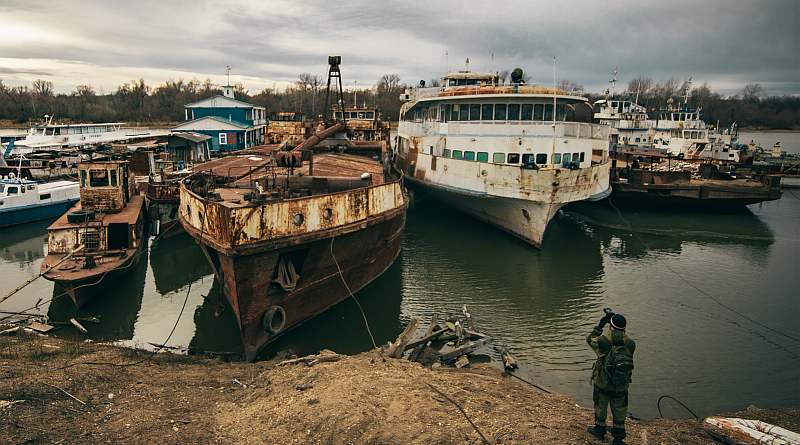
5. The Russian authorities have effectively admitted that they have no money to update the critically worn-out civil fleet.
– The program for replacing ships over 40 years old is proposed to be financed not from the budget but through additional levies from businesses. By 2030, Moscow planned to write off outdated “river-sea” class ships and build about 500 new dry cargo ships, tankers, and container ships. They aimed to spend 290 billion rubles of budget funds on this from 2026 to 2030. But the state found no money for it.
– Now, the government proposes to shift the costs onto shipowners and shippers — by raising inspection fees for old ships and introducing new surcharges to port fees. The Kremlin increasingly shifts costs onto businesses and the population.
– The logistics sector also takes an additional hit: new fees will increase transportation costs and further affect the competitiveness of Russian exports.
6. Russia may conduct large-scale jamming and spoofing of GPS signals in Europe.
– According to Darius Kulešius, the deputy head of the Lithuanian communications regulator, Moscow has sharply increased the infrastructure for GPS spoofing—a technology that transmits fake navigation signals and disorients positioning systems. While only three such antennas were recorded in Kaliningrad at the beginning of 2025, there are now 36.
– The Lithuanian side believes that this is no longer about isolated incidents but a systematic electronic interference campaign against European security. According to Vilnius, the potential impact zones cover the Baltic countries, a significant part of Poland, areas of Finland and Sweden, as well as the Baltic Sea waters. Such actions create risks for civil aviation, maritime navigation, logistics, and critical infrastructure.
– After the full-scale war against Ukraine began, European countries repeatedly accused Russia of electronic attacks and navigational interference, although the Kremlin traditionally denies everything.
– Notably, the intensification of such operations takes place specifically from the Kaliningrad enclave—one of Russia’s most militarized regions near NATO borders. This again demonstrates how Moscow uses hybrid pressure tools not only against Ukraine but also against the entire European security system.
7. The United Kingdom is preparing a new sanctions package against Russia’s financial and energy sectors.
– The United Kingdom is preparing a new sanctions package against Russia, which increases pressure on the financial sector, cryptocurrency exchanges, and payment services, and expands export restrictions for the defense industry.
– Plans include a ban on the import and transit of Russian uranium, strengthened control over dual-use goods (including chemicals, metals, and microelectronics equipment), as well as restrictions on some construction services for Russian-related entities.
– Sanctions are also being expanded on ships transporting Russian liquefied gas and coal, to complicate energy exports and schemes to circumvent restrictions through maritime logistics.
8. Despite the G7 sanctions against Russia, Japan continues to maintain working contacts with Moscow to protect its business interests.
– Tokyo has sent high-ranking officials to Russia for talks with Russian authorities and companies. Masayoshi Arai, head of the Trade Policy Department at Japan’s Ministry of Trade, and Masaki Ishikawa, Deputy Director of the European Affairs Department at the Ministry of Foreign Affairs, have arrived in Russia.
– According to Japan’s Minister of Trade Ryosei Akazawa, the purpose of the visit is to “maintain dialogue” and protect the assets of Japanese companies still operating in Russia.
– Tokyo emphasizes that this is not about renewing economic cooperation, but about technical contacts that Japan has maintained since 2023. However, the fact of such negotiations demonstrates that energy and corporate dependence on Russian resources has not completely disappeared even after the start of the full-scale war against Ukraine.
– It is particularly noteworthy that the activation of contacts is taking place against the backdrop of instability in the Middle East and risks to the global energy market due to the war around Iran.
– Japan is forced to seek ways to secure its own energy interests, particularly in the “Sakhalin-1” and “Sakhalin-2” projects, where Japanese companies remain involved.
– Meanwhile, Russia’s dependence on Asian partners is only increasing: after losing a significant portion of Western markets, the Kremlin is increasingly forced to balance concessions to China, India, and other Asian purchasers of energy resources.
