
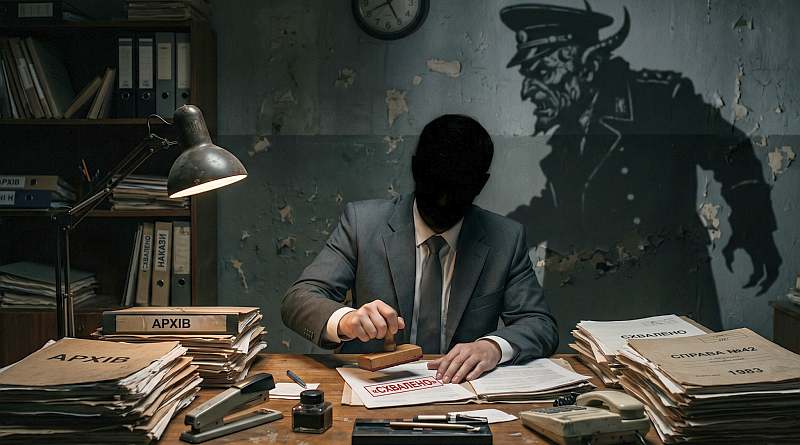

We are accustomed to thinking that dictatorships rely on fanatics. Ideological, ruthless, ready for anything. A recent study by two German political scientists on the “Dirty War” in Argentina turns this picture upside down.
Who joined the Argentine Battalion 601, which was a secret police force that tortured people and arranged “perpetual disappearances” for regime enemies? Underachievers. Officers who couldn’t advance in a regular military career. The worse the results in the academy, the higher the likelihood of ending up in the unit that did the dirtiest work. And the better the career went afterward.
Because Battalion 601 was a “shortcut” or “fast-track” around meritocracy. Are you mediocre? That’s okay, just agree to torture. In three to four years, you’ll return to the regular army with a promotion, overtaking your classmates. A longer career, higher salary, better pension. Profit.
Researchers traced this pattern in many examples.
The NKVD intentionally recruited people “with poor formal skills,” often with primary education, recalling the famous “we didn’t finish academies” or the modern meme “programmiruy”.
Einsatzgruppen (the notorious Nazi execution squads) were compiled of those with “stains on their reputation”: non-obvious Aryan origins, disciplinary issues, zero military experience. For them, this was also a social lift.
Modern autocrats do the same, just less bloodily.
Orbán built an “electoral autocracy” not through millions of fanatics but through 5-10% careerists in the judiciary and state administration systems. Maduro relied on the National Guard, which before him was seen as “the lowest rung of the armed forces, where those not taken into the army went.”
The recipe is the same everywhere:
1. Create a parallel structure that will be a “shortcut” for a career.
2. Fund it generously.
3. Lower the entry barrier, giving a chance to those who have no prospects elsewhere.
4. Clearly communicate and signal impunity — “we don’t betray our own.”
5. Reduce other state jobs to increase the pool of the desperate (recalling the utterly senseless reduction of the US state apparatus through the utterly senseless DOGE by Elon Musk).
Do you now find yourself feeling a sense of recognition? This is literally what’s happening in the USA with ICE. The budget has been inflated to the point where it exceeds any other federal agency. Admission standards have dropped: newcomers now take 9 practical exams instead of the 25 required in 2021.
Vance and Stephen Miller, after an ICE agent killed a protester in Minneapolis, explicitly guaranteed “immunity.” Meanwhile, other federal agencies are being slashed, creating an army of unemployed ready to go anywhere.
Classic genre.
The study explains the mechanics of how the regime recruits. But there’s another question: what about these people themselves? How do they live with what they do?
Remember or watch, if you haven’t seen, the Iranian film “There Is No Evil” (Sheytân vojūd nadârad) by Mohammad Rasoulof. Four stories about ordinary Iranians involved in the death penalty system. The first novella is the harshest precisely in its ordinariness. A man lives ordinarily: in the morning, he collects his mother’s pension, drives his daughter from school, goes to the supermarket with his wife, and dyes her hair. Then he goes to the night shift. To work. To press a button.
Rasoulof shows what political scientists and researchers cannot measure, namely: what the soul of an “average executor” looks like from the inside. Spoiler: it doesn’t look like anything. It’s no longer there. Only a function remains.
Why this is important for us.
Historically: we’ve already seen this mechanism. The NKVD, which created the Holodomor and the “Great Terror,” is a classic “system shortcut” for Soviet underachievers, for humanoid creatures without education but with a “hot heart and cold mind.” This is not a theory. This is our immediate history.
Here and now, in the occupied territories, the Russians are building exactly such a system: parallel bodies, low thresholds, career elevators for those who, before the occupation, were discontented losers. Collaborators are mostly not fanatics of the “Russian world.” These are people who feel they were not given something, underpaid, or undervalued. Now they’ve been given.
In the long term: any creation of power structures with low standards, high budgets, and promises of impunity is not “strengthening the state.” It is laying a mine for the future.
Democracies die not because fanatics with flags come. They die because thousands of mediocre clerks find themselves a decent career in the wrong place.
In our modern realities, what’s described here occurs in various parts of the state administration system and all branches of power. Also, it must be acknowledged and discussed, in various GONGOs, which have evidently become our reality. Therefore, one must be very careful.
We must be cautious with calls for the creation of “military democracy,” an idea that might seem appealing in current conditions, but due to misunderstanding certain aspects, very dangerous details and mechanisms can be embedded in it.
The scariest thing in this story is not the dictators. The scariest thing is that they don’t need monsters. They just need gray mediocrities with ambitions.
* * *
TL;DR (short summary) regarding the study:
• “Loyal Losers”: Autocrats don’t need true fanatics. They need disillusioned and ambitious people with mediocre abilities who have no other good career prospects.
• Career shortcut through cruelty: Participation in repressive structures becomes a “shortcut” for those unable to achieve in a normal system.
• Systematic phenomenon: By performing the most heinous work, these people receive promotions, better salaries, and immunity. This pattern has been repeated for years from Nazi Germany and the Soviet NKVD to modern autocracies.
__________________
This post was inspired by an article in The New York Times.
