
The self-proclaimed dictator of Belarus, along with his Kremlin accomplice, played around with “tactical nuclear weapons” this month. What does it look like from the perspective of a local psychiatrist?
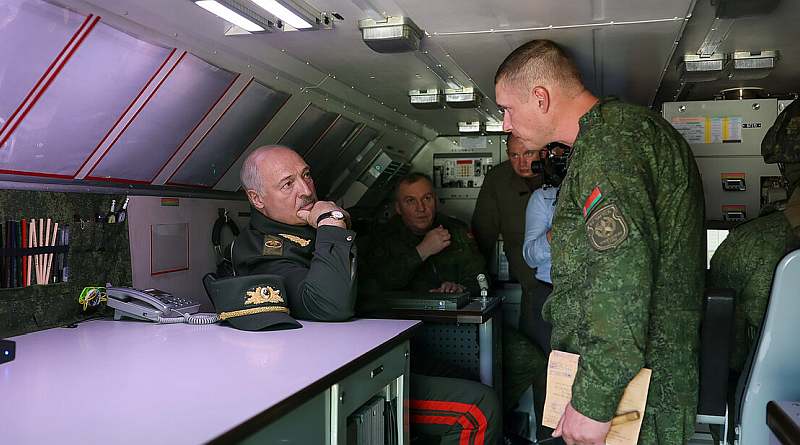
On May 18, Belarus announced the start of exercises, during which they worked on readiness checks, skill improvement, organization of nuclear warhead deployment from unplanned areas, and stealthy movements. It was stated that the exercises were routine and “not directed against third countries.” Sure, everyone believed that!
The main phase of the joint actions of the Armed Forces of Belarus and Russia took place from May 19-21. On May 22, the exercises concluded. Belarus practiced the delivery, reception, and preparation of special (i.e., nuclear) warheads for Iskander missile systems and simulated nuclear strikes with aviation (Su-25 attack aircraft). In Russia, large-scale strategic nuclear forces exercises involved RVSN, submarines, and strategic aviation. Overall, more than 64,000 military personnel, over 7,800 units of weapons and equipment, including over 200 missile launchers, were involved. Eight of these were Belarusian. In other words, all of them.
To understand what happened in Belarus, let’s briefly describe the theoretically suitable potential for using nuclear warheads:
– The 465th Missile Brigade (two divisions with four 9k720 “Iskander-M” launchers each. A standard Russian missile brigade consists of 12 launchers; brigade sets with 12 launchers and all specialized vehicles are supplied to the troops, totaling 52 units, including guard facilities, dining facilities, etc.). The presence of “Tochka” tactical missile systems is not confirmed by international sources, but they must have gone somewhere;
– The 51st mixed artillery group (36 152mm SAU 2S5 “Giatsint-S”, 36 152mm howitzers 2A65 “Msta-B”);
– The 11th and 231st artillery brigades of operational commands and artillery of mechanized brigades (125 SAU 2S3 “Akatsiya”, 71 SAU 2S5 “Giatsint-S”, 72 howitzers 2A65 “Msta-B”).
Formally, the ground component has enough means of using special warheads. But it’s not that simple. At one point, the thought arose in Belarus to have their own nuclear bomb carrier. The gloomy Belarusian genius chose the Su-25 at the 116th assault airbase in the city of Lida for the role of strategic bomber.
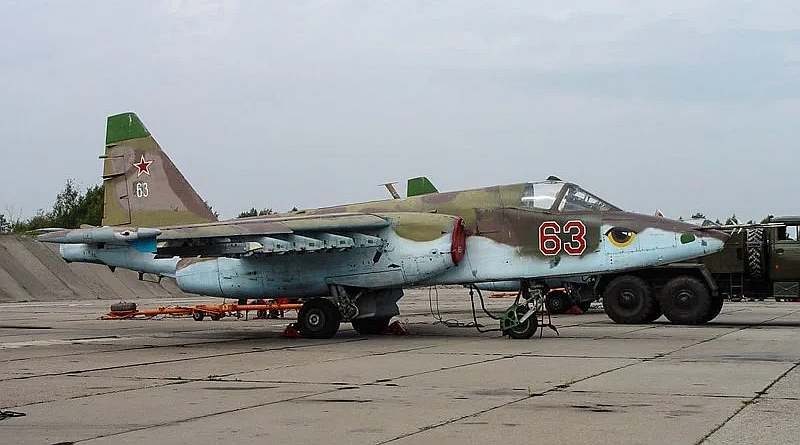
This aircraft is not a certified carrier of nuclear weapons; it has always been a carrier of conventional bombs, unguided rockets, and air-to-ground missiles. Russia, generating chaos and panic worldwide, has upgraded some of the Belarusian Su-25s (according to statements – 10 aircraft, which is an incomplete squadron). These attack aircraft are now formally carriers of tactical nuclear bombs, likely RN-40/RN-41 or similar free-falling types.
The Su-25 is a subsonic attack aircraft with low altitude and short flight range. As a nuclear weapon carrier, it is extremely vulnerable to modern NATO army air defenses, and not to mention ours. It is more of a political and psychological tool than an effective combat system. It’s akin to a Kremlin toy – a bell that does not ring and a cannon that does not shoot.
Thus, if we soberly look at the situation, the real threat is 8 Iskander launchers, with a potential threat of 340 152 mm guns and 10 attack aircraft.
Now, about the main point – the ammunition.
The main (and generally the only) storage place is the 1405th artillery ammunition base near the village of Bolshaya Goroha in the Osipovichi district of the Minsk region. There has been a significant increase in security there, with the enhancement of the engineering barriers system (several rows of wire fencing, special gates typical for nuclear storage facilities). Nearby is the 465th missile brigade’s military camp. A few facilities remain from Soviet times, which were under the control of the 12th Main Directorate of the Soviet Ministry of Defense, but they are quite neglected and would require significant resources and time to restore.
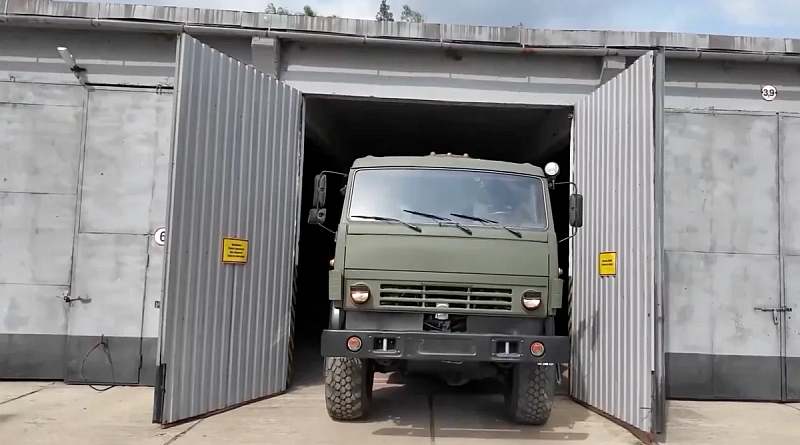
Nuclear munitions are under Russian control (12th Main Directorate of the Russian Ministry of Defense), and Belarusian military personnel can only use its carriers. The same nuclear briefcase, the codes necessary for activating the munitions, are managed by the same 12th Directorate in Moscow, meaning that even if Lukashenko suddenly decides to strike somewhere, nothing will come of it. Statements about the transfer of tactical nuclear munitions from Russia to Belarus are just statements. Meanwhile, an advanced infrastructure has been created in the form of a special storage facility at the 1405th base.
Returning to the exercises. It is known that Russia demonstratively delivered tactical nuclear munitions to field depots in Belarus (presumably in the Osipovichi area), and Belarusian OTRK crews practiced the docking of special warheads with carrier rockets.
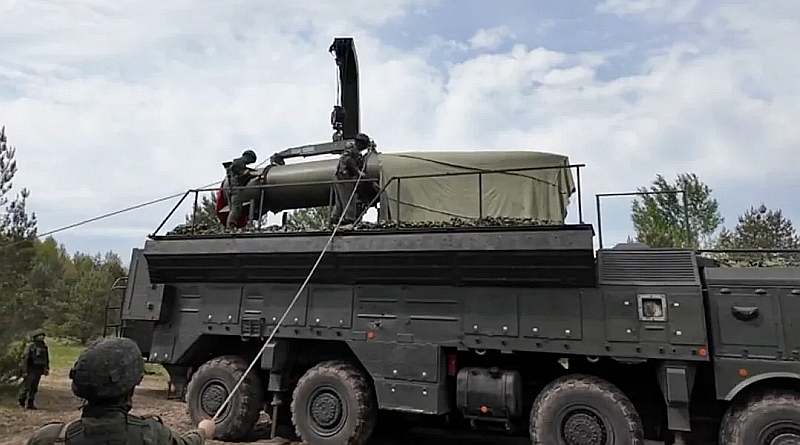
What does the delivery of a nuclear warhead from the 12th Directorate’s arsenal to the positional area of a missile unit designated for a nuclear strike look like? So from an object type “C” or “B”, where such munitions are stored in peacetime (in Borisoglebsk, for example, where “Wagner” with its bald leader could have visited during his memorable march, since he was passing nearby), the warheads travel:
a) in a specialized thermo-car equipped with environmental control systems;
or b) on special transport-loading machines of the 12th Directorate;
or c) by plane or helicopter, again specialized.
This transportation process is accompanied by not necessarily large-scale, but very serious measures: a special convoy is formed under the protection of the 12th Main Directorate of the Ministry of Defense and Rosguard or FSB units. They provide radio-electronic, physical, and operational coverage of the route, along with constant coordination with the Belarusian side. Any unauthorized attempt to access such a cargo is considered an act of nuclear terrorism.
The train arrived in Belarus on a special railway branch and further — on a platform near the 1405th base. There, the warheads were reloaded using cranes and other special equipment (cranes with a lifting capacity of 3.2 tons were spotted near the base). Then the nuclear warheads were moved to a field storage point and later to the missile-technical battery of the 465th missile brigade. The storage and docking of warheads and missile carriers were carried out by specialists from the 12th Main Directorate of the Ministry of Defense of the Russian Federation.
Photos surfaced online with signs characteristic of a large explosive detonation — the mushroom cloud. There is information that an explosion occurred during the loading of the missile onto the Iskander launcher. Thus, the exercise was successfully completed. There is currently no information about changes in the radioactive background.
Overall, this Russian-Belarusian pseudo-nuclear fuss is the first attempt to deploy Russian nuclear weapons outside Russia since the 1990s. Formally, it appears as “nuclear sharing” (analogous to the storage of US nuclear weapons in forward sites in Europe), but under full Moscow control. The goal of all this, including the exercises, is to deter NATO, pressure the West and Ukraine, and demonstrate the unity of the allied state. Essentially, for Belarus, this looks like enriched potatoes.
All information in the article is based on open sources.
Cover photo: Lukashenko at the Belarusian Ministry of Defense command post announcing the start of exercises. Photo: President of Belarus website
