
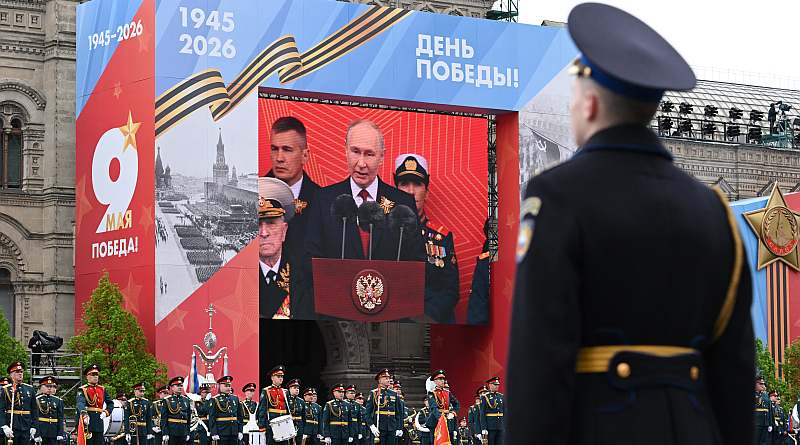

First, the purely technical side.
Parades are not conducted in a vacuum. These are recurring events. At the very least, there is a comparison with last year’s parade.
The Kremlin began lowering expectations in advance by telling stories about how last year was an anniversary of Victory, and this is just another anniversary. Nevertheless, they failed to lower it to the desired level, which caused disappointment. As it went on, the thought arose – why bother conducting this sadness-inducing dullness at all? It only made things worse.
45 minutes of parade, 5 minutes of preparation, and 15 minutes of laying flowers give some clues for capturing the atmosphere.
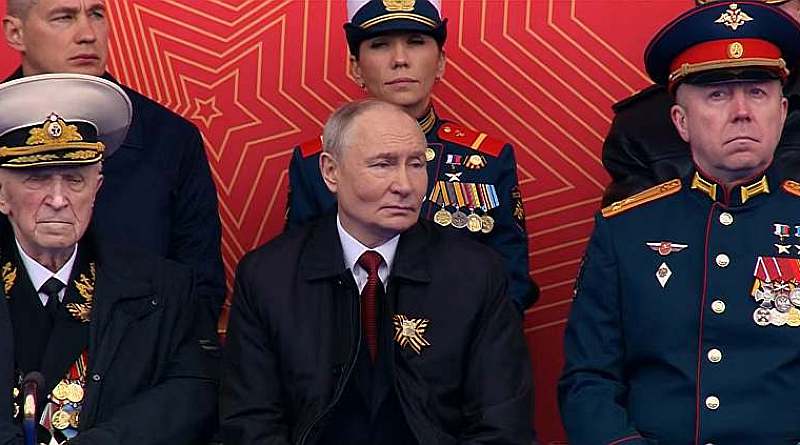
1. The main trend that can be caught in the commentary from some dear Russians, quite jingoistic and pro-military, is the growing disgust towards Putin.
Not fear, not protest, but specifically disgust, like towards something slippery, dirty, and miserable.
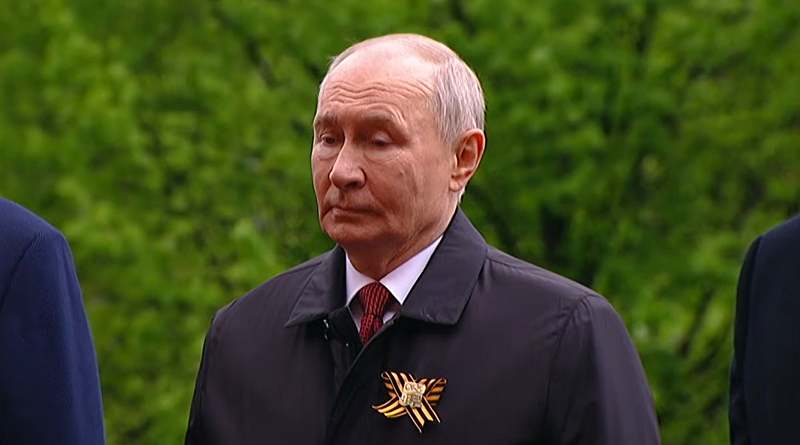
At the parade, the focus was not on the leader of a superpower, but on a tired old man with shifty eyes, who is tolerated for now.
 |
 |
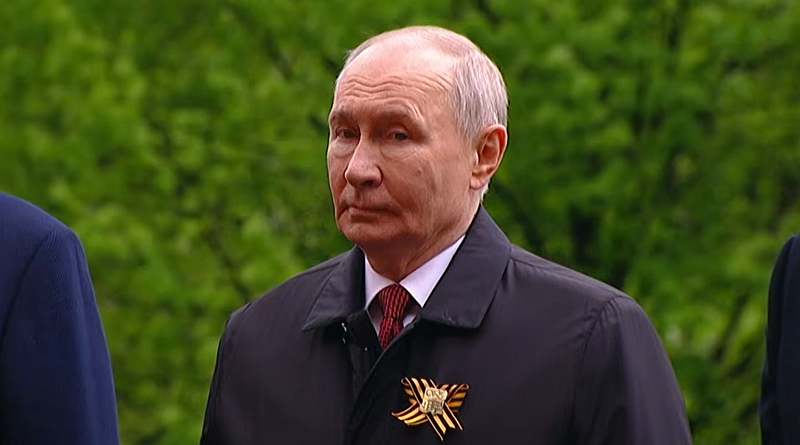 |
And he feels it.
Experience and skills still help him put on the right mask in communication, but when he is alone with himself for a second, it all shows on his face. A short, aging man bending under the pressure of a weight he can no longer bear.
The strained mournful faces of Putin’s entourage periodically appeared on screen. In general, there was no enthusiasm or celebration.
2. Zelensky’s decree to hold a parade in Moscow nullified the scenario with a possible incident initiated by internal Russian forces.
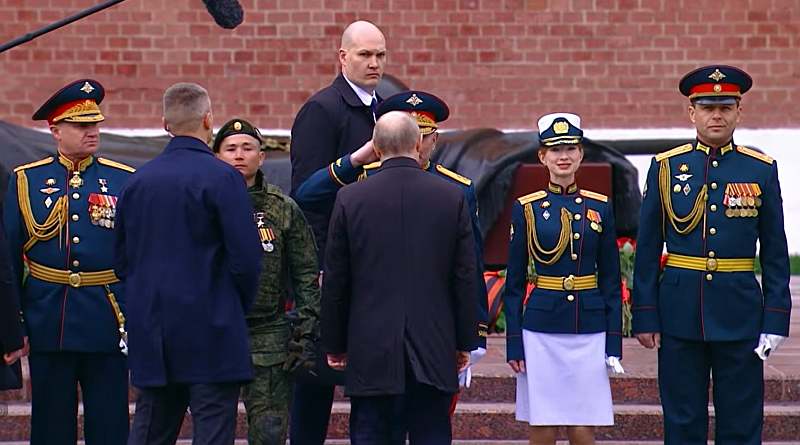
Because the chance to blame Ukraine disappeared. But look at the photo, how Putin is being guarded.
In the photo, he shakes hands with the parade box commanders. Behind the military and half a meter from Putin is the security. You can compare parades from past years. Security is everywhere; it’s protocol, but this hovering was not present. Either Putin himself is afraid, or he is being wound up and intimidated (as a result of which he begins to fear and become paranoid).
Look at the photo where he walks to the car.
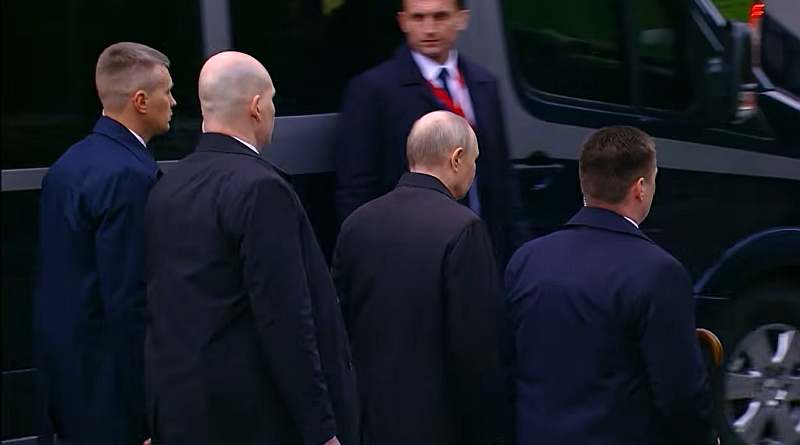
This happens within a thrice-filtered perimeter, among the most vetted individuals. And yet he moves in a box of physical coverage.
3. The derivative of such a situation is the maximum emphasis on how isolated and lonely Putin is.
Previously, he acted as the master of the ball, to whom guests came to express respect. The moment of communication was emphasized in every way. Putin strolled surrounded by leaders of other countries, highlighting that he and Russia were the center of attention. Now everything is different.
The role of the first lady was traditionally performed by Lukashenko. The hastily brought to Moscow Tokayev and Mirziyoyev, to somewhat raise the frankly shameful level of foreign guests, were clearly burdened by what was happening, as well as by their role as decorative furniture.
If Russia’s position appeared as a success, everyone in sight would rush to ‘lean against’ it. Few are eager to associate with losers.
4. The absence of equipment at the parade is a sharp decrease in the spectacle’s status.
Also categorically unfortunate is the moment of the parade being received by Defense Minister Belousov. He is the second-to-last person who should symbolize Russia’s military might. Even the alco-blogger Medvedev looks more aggressive. Even Gundyaev would be more appropriate.
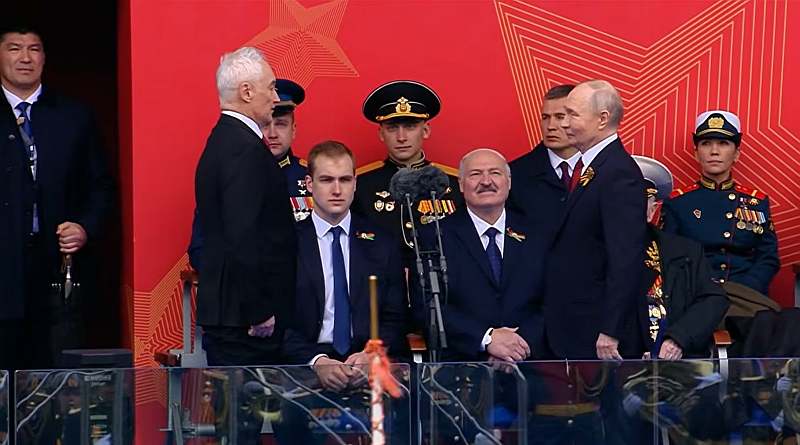
Worse than Belousov is only Putin in his current state, for he is a walking symbol of degradation. Two elderly men struggling to represent superpower military ambition is a visual fiasco. Marshal Shoigu looked much better.
5. Putin’s speech – 8 minutes of emptiness.
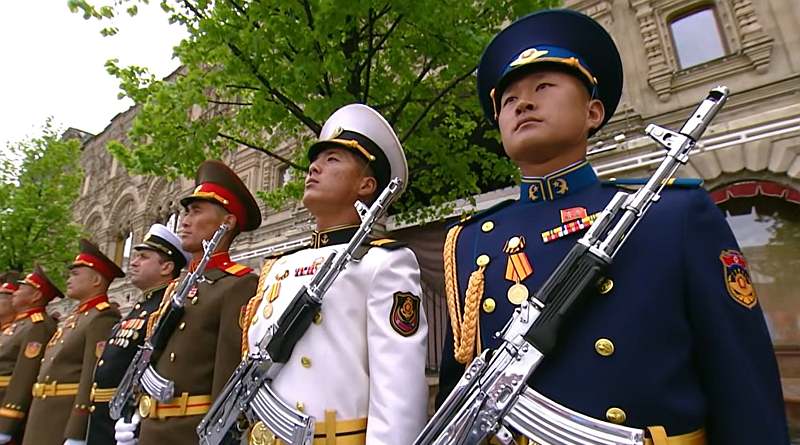
6. The brightest moment of the parade – North Koreans adorned with badges down to their underwear with shiny rifles.
 |
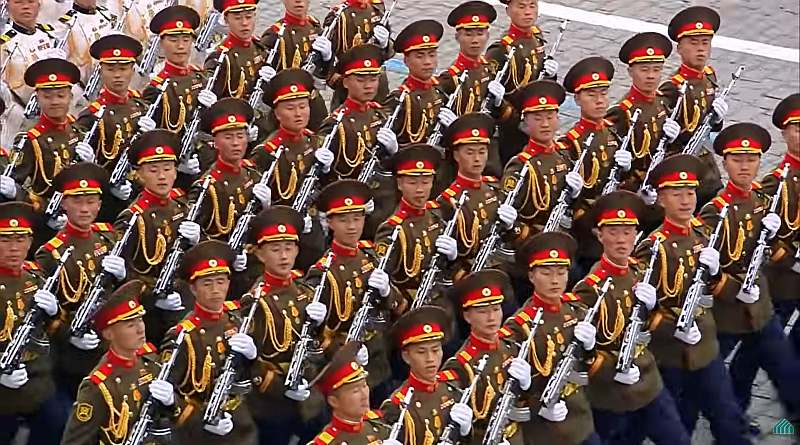 |
Koreans, an orangutan in Novosibirsk, and a column of widows/mothers of occupiers in Chita are symbols of the 2026 parade in Russia.
The quintessence – the words of a journalist addressed to a woman in the column of the “Immortal Regiment” in Kemerovo with a photo of her grandfather and missing son: “Ah, so you have a double celebration! Congratulations!”…
* * *
Political context, background, and consequences.
A parade is a spectacle in context. By design, it should inspire some and intimidate others. According to the unanimous opinion, both in Ukraine and Russia, the spectacle in Moscow was pathetic. Quite the opposite of the parade’s essence.
But the context of what happened is utterly devastating.
It must be emphasized that everything significant happened long BEFORE the parade and was escalating, ultimately allowing for an impressive cognitive operation.
1. Literally on the eve, the Kremlin, through Ushakov, declared that there would be no negotiations with Ukraine until Russian demands are met.
The Americans, through Rubio, said: well, so be it, as we have other priorities. Suddenly, within a few days, the concept completely changes. And Russia crawls to Trump, begging him to persuade Ukraine not to interfere with the parade.
About ten days ago, Moscow was counting on everything going as usual: it would be enough to indicate intent on their part for the U.S. to pressure, and Ukraine to agree. But the exact opposite happened.
Moscow’s first cries for a truce on May 8-9 ended with a counteroffer to start from 06.05, which the Kremlin brushed off. As a result, unknown drones flew over Moscow.
The situation arose:
1) at least on the eve of the parade, some important objects will certainly burn (and if there’s a fire like Perm-Tuapse, the backdrop will be maximally unceremonious);
2) it is highly likely that air traffic will be paralyzed, leading to a loss of face in the eyes of a few guests;
3) with a higher than zero probability, something will fly directly into Moscow and force them to scramble, which is unseemly.
As a result, the Kremlin urgently asked the U.S. to intervene and, as a concession to Ukraine, offered an exchange.
Note that Ushakov’s statement indicated that there would be no exchanges for a long time. Parameters are rarely voiced before exchanges (100×100, 200×200, etc.) because the topic is extremely delicate. Mostly – on the spot. And here, they directly and preliminarily presented a figure. Comments indicate that the list agreement has just begun. That is, the exchange is a consequence of recent moves and the accumulation of results over a couple of months.
In essence, Russia demonstrated another “gesture of goodwill”: it was forced to take steps it had not planned.
2. This “gesture of goodwill”, like all previous ones, is the result of the resilience of all structures of Ukraine’s Defense Forces and our entire society.
However, there are quite specific combat, organizational, and technological achievements that programmed a “parade of shame” for Putin.
If we look at the sequence of events, I would take February 7, 2026, as a hypothetical starting point, when CSO “A” SBU paid a visit to the Redkinsky Experimental Plant (Tver region), which produces components for rocket fuel.
On one hand, it turns out to be exactly three months. On the other hand, if you recall, a number of officials and objective factors indicated that in February, the period between the phases of the Russian offensive would begin, opening a window for negotiations until April.
It can be considered that the “negotiations” were conducted, and the miserable parade in a dreadful context for the Russian Federation is one of the intermediate results of these “negotiations.”
3. Negotiation arguments from the Ukrainian side throughout the period:
• The annihilation of Russian air defense in the temporarily occupied territories and the first echelon in adjacent regions of the Russian Federation as a fundamental way to increase the weight of the entire set of arguments;
• Demobilization from the “special military operation” of more soldiers than Russia recruits mercenaries;
• Exponential increase of medium-range strikes (50-150 km), which (along with the previous point) sharply hindered the Russian Federation from achieving tangible results on the ground, slowing the pace of advancement;
• Increasing long-range drone strikes;
• Increasing combined missile-drone strikes;
• Comprehensive impact on Russian occupiers in Crimea.
Main targets in Russia include oil industry facilities (refineries, pipeline stations, ports), chemical plants, defense industry enterprises, airfields, and ships.
Targets in the Occupied Territories – (in addition to air defense) support infrastructure and UAV launch sites, deployment locations of occupying personnel, logistics and fuel depots, repair bases, missile launchers, MLRS vehicles.
In spring, the tactic of “double” strikes became clear – targeting refineries and nearby oil pumping/transfer stations.
In three months, the Security Service of Ukraine (SSU), along with colleagues from the State Border Service (SBS), Special Operations Forces (SOF), Intelligence Directorate, State Emergency Service, National Guard, Regional Administration, Ukrainian Navy, and other Defense Forces of Ukraine, have conducted a substantial assault both in temporarily occupied territories and up to 1700 km deep into Russia.
The main rounds of negotiations and random incidents of unknown nature appear as follows.
February 2026:
• 07.02 – Redkin Experimental Plant (Tver region). Military-industrial complex, rocket fuel;
• 11.02 – Volgograd Refinery (Lukoil);
• 12.02 – Refinery in Ukhta (Komi Republic);
• 12.02 – Arsenal GRAU (Kotluban, Volgograd region);
• 12.02 – Progress Plant (Michurinsk, Tambov region). Defense industry, equipment for missile and aviation sectors;
• 15.02 – “Tamangaz” facility (Port Taman, Krasnodar region);
• 16/17.02 – Ilsky Refinery (Krasnodar region);
• 17.02 – Metafrax Chemicals Plant (Perm region). Chemical plant;
• 18/19.02 – Oil depot in Velikiye Luki (Pskov region);
• 18/19.02 – “Kirishinefteorgsintez” Refinery (Leningrad region), acoustic monitoring;
• 20.02 – “Novovelikochkovskaya” pumping station (Krasnodar region);
• 28.02 – “Albashneft” mini-refinery (Krasnodar region).
This is routine. At the end of February, more intense strikes emerged:
• 21.02 – Votkinsk Plant (Udmurtia). Defense industry, ballistic missiles;
• 23.02 – Kalyekkino PPS (Almetyevsk, Tatarstan). Opening of a fire season like “Perm-Tuapse”;
• 25.02 – PJSC “Dorogobuzh” (Smolensk region). Chemical plant.
March 2026:
• 02.03 – Comprehensive visit to Novorossiysk: “Sheskharis” Terminal, several ships and air defense systems damaged;
• 04.03 – Kirovo-Chepetsk Chemical Plant (Kirov region);
• 08.03 – Oil depot of “Southern Oil Company” (Armavir, Krasnodar region);
• 09.03 – Akron Chemical Plant (Novgorod region);
• 10.03 – “Kremniy EL” Plant (Bryansk). Defense industry, military electronics;
• 12.03 – “Tikhoretskaya” pumping station (Krasnodar region);
• 14.03 – Port Kavkaz and Afipsky Refinery (Krasnodar region);
• 16.03 – Aviastar Plant (Ulyanovsk);
• 17.03 – 123rd aircraft repair plant (Staraya Russa, Novgorod region);
• 21.03 – Saratov Refinery (Saratov region);
• 21.03 – “Bashneft” Refinery in Ufa;
• 26.03 – “Apatit” JSC (Cherepovets, Vologda region). Chemical plant;
• 28.03 – Yaroslavl Refinery;
• 31.03 – “Strela” JSC (Bryansk region). Defense industry.
The most prominent operations. From March 22 to 31, a comprehensive focus on Leningrad region was conducted: Primorsk and Ust-Luga ports, “Kirishinefteorgsintez” Refinery.
The petrochemical cluster in Tolyatti was visited three times in March.
An enterprise related to “Almaz-Antey” in Sevastopol was highlighted on March 18.
There are also incidents involving Russian ships transporting oil or working for the occupational group in Crimea (e.g., the “Slavyanin” ferry and others).
Among important technical innovations: in March, the interceptor drone “Litavr” (manufacturer: F-drones) was used for the first time to hit a Shahed while the interceptor operator was at a significant distance from the launch site. Later, similar technology was presented by other companies.
In Crimea, GUR tracked and destroyed one launcher of the “Bastion” complex (launches “Zircon” missiles), and damaged another.
April 2026:
• 02.04 – “Bashneft-Novoil” refinery (Ufa, Bashkortostan);
• 03.04 – “KuybyshevAzot” plant (Togliatti, Samara region);
• 05.04 – “Shesharis” terminal (Novorossiysk, Krasnodar region);
• 05.04 – “Lukoil-Nizhnegrodnefteorgsintez” refinery (Kstovo, Nizhny Novgorod region);
• 8/9.04 – “Krymskaya” LPDS (Krymsk, Krasnodar region);
• 10.04 – “Tinguta” GPS (Volgograd region);
• 11.04 – “Lukoil” drilling platforms in the Caspian Sea;
• 11.04 – “Krymskaya” LPDS (Krymsk, Krasnodar region);
• 13.04 – “Apatit” JSC (Cherepovets, Vologda region). Chemical plant;
• 15.04 – Sterlitamak Petrochemical Plant (Sterlitamak, Bashkortostan);
• 18.04 – Novokuibyshevsk refinery (Samara region);
• 18.04 – Syzran refinery (Samara region);
• 18.04 – “Tikhoretskaya” LPDS (Tikhoretsk, Krasnodar region);
• 18.04 – Port Vysotsk;
• 19.04 – “AtlantAero” plant (Taganrog, Rostov region). Defense industry;
• 23.04 – “Gorky” NPS (Meshikha, Nizhny Novgorod region);
• 26.04 – “Apatit” JSC (Cherepovets, Vologda region). Chemical plant;
• 26.04 – Yaroslavl refinery;
• 30.04 – refinery in Orsk (Orenburg region).
On April 16, the fire season began in Tuapse. Over two weeks, there were 4 visits by friendly drones.
On April 29 and 30, Perm ignited: “Perm” LPDS and “Lukoil-Permnefteorgsintez” refinery.
On April 25, friendly drones visited a military airfield in Chelyabinsk and an arsenal in Sverdlovsk region.
In the second half of April, a series of visits took place in Sevastopol (initiated by SBU, continued by GUR and SSO, then SBU again, etc.), resulting in damage to 5 ships, an oil depot, air defense elements, and command points. Overall, in Crimea, an entire detailed account could be written (amidst the events, even a series of strikes on the oil depot in Feodosiya is overshadowed).
May 2026:
• 03.05 – Primorsk port (Leningrad region);
• 05.05 – “Kirishinefteorgsintez” refinery (Leningrad region);
• 05.05 – “VNIIR” plant (Cheboksary, Chuvashia). Defense industry, navigation;
• 07.05 – LPDS and refinery in Perm;
• 08.05 – again LPDS and refinery in Perm;
• 08.05 – Yaroslavl refinery;
• 08.05 – UAV warehouse in Rostov-on-Don industrial zone;
• 08.05 – FSB location in Chechnya (Grozny area).
The Ukrainian Navy also began helping disoriented Russian tankers (3 units) with navigation.
The number of incidents is already overwhelming. And we should still add many purely military actions, such as strikes on small missile ships of project 22800 “Karakurt” (one in the Baltic, one in the Caspian), a plant in Dzerzhinsk, facilities in Naro-Fominsk, and dozens of targets on the occupied territories…
The list is far from complete, but the pattern is evident.
5. It’s clear that the strikes cause varying degrees of damage. Some are precise with minimal harm, while others put enterprises out of action for months. But everywhere the adversary expends air defense missiles and depletes aviation resources.
The main thing here is the trend. Expanding geography, increasing density and destructive power of attacks, gradually incorporating our missiles.
In February, there were painful but isolated strikes. In March, as seen in Primorsk and Ust-Luga, we observed a series; in April-May, Tuapse and Perm became targets of raids.
One can only imagine what will happen in the next three months. The outcome of the second quarter for Russia could be grim; high oil prices won’t save it.
Russians are objectively interested in pauses, and then in freezing the war. Therefore, chances in the realm of diplomacy remain, as competition between different groups within Russia inevitably intensifies. Putin’s fear is evidence of this. It’s time for him to find a way to “flip the board.”
In the parade story, he showed weakness. How this will play out within Russia and in relations with Washington will become clear in the coming weeks.
We have our own work to do.

Notes on the sidelines of a silent May 9th
The recent parade on the occasion of the 81st Anniversary of Victory became perhaps the most paradoxical in Russia’s modern history. If in 1945 steel that crushed the Third Reich marched through, in 2026 we saw the triumph of “virtual power” and unprecedented silence.
At the same time, the main message of Putin’s speech remained unchanged but acquired new, tougher features: generational continuity. The President of the Russian Federation equated the feat of the Soviet people with the actions of today’s occupying forces, stating that “the feat of the victorious generation inspires the soldiers carrying out their tasks today.”
This means that the Kremlin has finally turned May 9 from a day of remembrance of a concluded tragedy into fuel for the current conflict. In 2026, the holiday, unfortunately, is no longer about “never again,” but about “once more and to the end.”
The aging Russian president emphasized that Russia is confronting an “aggressive force supported by the entire NATO bloc.” This is a key element of survival rhetoric.
We continue to observe the framing of the invasion of Ukraine as a war with the “collective West,” not just Kyiv. Such scaling allows for justifying the lack of quick victories and economic difficulties. The speech stated that the goals are “just,” which is a direct attempt to legitimize the protracted nature of the confrontation.
One of the most discussed topics in recent hours was Donald Trump’s announced three-day truce. This was felt physically on Red Square: the parade took place without heavy equipment, only with aircraft flyovers and the precise marching of military units. The agreement to the truce and the absence of tanks on the square were officially explained by “operational circumstances” and safety concerns. However, analysts, even from the Kremlin-loyal The Spectator, see this not as strength, but as vulnerability. The absence of real equipment on the cobblestones, replaced by footage on giant screens, symbolizes both a resource deficit and fear of drone attacks.
From the innovations of Victory Day 2026: for the first time, units from North Korea participated in the parade. This is a powerful visual signal of the formation of a new axis. Russia no longer claims to be part of “Greater Europe.” Now its allies are those ready to march together against the liberal world order.
A critical analysis of Putin’s speech today shows a deep divide between the rhetoric of “eternal victory” and the reality of a “besieged fortress.” The shutdown of mobile internet and communication in Moscow during the parade is the clearest metaphor for the current state of the nation. Security above festivity. Against the backdrop of GDP contraction in the first quarter and inflation, Putin avoided economic promises, fully focusing on ideology.
Previously, the parade was a demonstration of “analog” strength, like “Iskanders” and “Armaty,” but now it has turned into a media product. Bright images on screens were meant to compensate for the emptiness in the square.
Putin’s theses on May 9, 2026, are an attempt to cement society around the idea of “just defense.” However, the contrast between the grandeur of the words and the modesty of the parade’s technical aspects suggests that the magic of the main national holiday as a mobilization tool is beginning to clash with the harsh reality of prolonged exhaustion. And it is doubtful that today even a handful of radicals would rally around the worn-out phrase “We can repeat.”
