

Information on current losses of the Russian Federation due to sanctions as of 01.05.2026.
1. The fifth Russian refinery this month has been halted after a drone attack.
– A series of strikes on Russia’s oil refining infrastructure is becoming systemic, directly affecting the industry’s production capabilities.
– After the drone attack, Permnefteorgsintez, one of the country’s largest refineries with a processing capacity of about 17 million tons per year, was partially halted. A fire at the primary processing unit AVT-4, which provides over a third of the plant’s capacity, caused a chain shutdown of related technological processes, including reforming and hydrotreating.
– An additional risk factor was the incident at the Transneft facility in Perm, where a fire affected the tank farm. This may complicate the transportation of oil to western ports and refineries in the European part of Russia, creating bottlenecks in logistics.
– Notably, this is already the fifth case of a refinery being halted or partially halted in April. Previously, the Syzran, Novokuybyshev, Tuapse refineries, and Nizhegorodnefteorgsintez were taken out of operation or limited their operations.
– The combined effect of such strikes is not only temporary disruptions but also increasing structural pressure on the fuel sector. Damage to key primary processing units is particularly critical, as their restoration takes time and access to technologies, which are restricted for Russia by sanctions.
2. Ukrainian strikes on Russian oil assets have reached a four-month high.
– Oil refining in Russia has fallen to its lowest level since 2009 amid systemic strikes by Ukrainian Armed Forces on energy infrastructure. According to OilX, processing volumes have dropped to 4.69 million barrels per day. This is 12% less than last year and 18% below the 2021 level — nearly 1 million barrels less daily.
– In April, at least 21 attacks on Russia’s oil infrastructure were recorded — one of the highest figures since the beginning of the war (more were only in November and December 2025 — 23 and 26, respectively). At least 9 refineries were hit, of which 5 were completely or partially halted.
– Additionally, at least 5 attacks targeted the pipeline system, and 6 on maritime infrastructure, including Baltic Sea ports. The combined effect is not only a decline in processing but also logistical disruptions.
– The Russian oil industry increasingly operates under disruptions, undermining production stability and reducing its export potential.
3. Russia’s largest steel manufacturing asset, Novolipetsk Steel, completed the first quarter of 2026 with losses, signaling a deepening crisis in basic industries.
– The enterprise incurred a net loss of 5.9 billion rubles — 4.8 times more than last year (1.23 billion). Revenue decreased by 10% to 145.57 billion, with a sales loss of 6.1 billion rubles.
– This is a sharp turnaround after 2025 when there was a profit of 86.7 billion rubles: quarterly financial results worsened by tens of billions. The reasons are systemic: steel demand in Russia fell by about 15%, and sanctions reduced exports — losing about a third of deliveries (up to 10 million tons).
– As a result, the steel sector, which has traditionally been one of the key export drivers, is entering a phase of prolonged decline. Without substantial state support, the industry risks returning to the early 2000s level — with low profitability, limited sales markets, and a degraded production base.
4. The overall financial performance of Russian businesses is deteriorating against the background of structural economic problems and rising costs.
– According to Rosstat, in January-February 2026, companies earned 3.4 trillion rubles, which is 33.1% less than the same period last year. This is one of the deepest profitability declines in modern history, comparable to the crisis periods of 2008, 2014, and 2017.
– The decline covers key economic sectors: profit in the manufacturing industry nearly halved (-45%), in the extractive sector by 32%, and in agriculture by 38.5%. The proportion of profitable enterprises decreased to 63.1% from 68.1% a year earlier, indicating an expansion of the unprofitability zone even in basic industries.
– This dynamic is associated with a combination of negative factors: weakening domestic demand, increasing tax burden, high cost of credit resources, and a shortage of working capital. Additional pressure is created by logistical limitations and disruptions in infrastructure operations, including digital.
– Long-term prospects are also worsening: decreasing profitability undermines business investment opportunities and limits the potential for economic recovery, which is increasingly dependent on government spending and military orders.
5. The Russian government has imposed a ban on the import of foreign-made satellite communication equipment, including Starlink terminals.
– The corresponding decision provides for restrictions on the import of radio-electronic devices used for receiving and transmitting satellite signals, unless they are approved by the State Commission on Radio Frequencies.
– Essentially, this is about further tightening control over the information space, as alternative internet access channels, independent of state infrastructure, become unavailable. This limits the ability to bypass censorship and increases user isolation from global networks.
– The decision was made against the backdrop of systematic internet access disruptions. Since May 2025, Russian authorities have regularly shut down mobile connections under the pretext of countering drones, with these restrictions now covering more than 60 regions.
– According to relevant studies, the total duration of outages in 2025 exceeded 37,000 hours, affecting most of the population.
– Additionally, the situation is complicated by the practice where telecommunications operators themselves have begun to restrict internet access, indicating a centralization of control over digital infrastructure and a further rollback of market mechanisms in the telecom sector.
6. Russia increasingly depends on China for the supply of critical military technologies.
– The share of Chinese supplies in this sector exceeds 80%. This support allows Russia to maintain and increase the production of weapons, including missiles and drones, despite restricted access to Western technologies.
– In addition to components, Beijing provides Russia with geospatial intelligence, including satellite images for military needs and supplies drones. Meanwhile, China is reducing the export of similar products to Ukraine and other countries, indicating the asymmetric nature of its policy.
– Despite this, EU countries refrain from harsher sanctions against China, fearing economic retaliation. Beijing, in turn, does not openly acknowledge the sanctions and declares the continuation of “normal” trade relations with Russia, while responding to the inclusion of Chinese companies in sanction lists.
– As a result, a critical dependency is formed: Russia loses the ability to independently ensure its military-technological cycle and increasingly integrates into the Chinese technological ecosystem under subordinate conditions.
7. Russia and Iran are increasing trade across the Caspian Sea, forming an alternative route to bypass sanctions and reduce dependence on routes controlled by the West.
– Transportation between the two countries is increasingly carried out through the Caspian, often involving a “shadow fleet” or ships with disabled transponders, complicating control and monitoring. Satellite data indicate that at least ten Russian ships have recently headed to the Iranian port of Amirabad.
– For Tehran, this route is critically important. It allows receiving basic goods — from food to medicines — and creates opportunities for importing weapons and drones.
– At the same time, a channel opens for exporting oil products bypassing the Strait of Hormuz through Russia’s inland waterways — the Volga, Don, and further to the Black and Mediterranean Seas. Although volumes remain limited, even partial functioning of this corridor allows Iran to withstand sanction pressures longer and take a tougher stance in relations with the USA.
– For Russia, the cooperation is also beneficial. It not only helps maintain sanction evasion but also creates additional geopolitical risks: tensions in the Middle East can distract resources from the USA and allies, increase oil prices, and thus partially compensate for losses in the Russian budget.
– Ultimately, a joint sanction evasion ecosystem is formed, where Moscow and Tehran mutually enhance the ability to circumvent restrictions, undermining the effectiveness of international pressure.
8. Sweden has arrested the cargo ship Caffa, linked to Russia’s so-called “shadow fleet,” at the request of the General Prosecutor’s Office of Ukraine.
– The decision to arrest was made on April 29 by the Swedish state prosecutor Håkan Larsson. According to him, the aim is to assess the possibility of transferring the vessel to another country for investigation. However, the details of the request were initially not disclosed.
– The cargo ship Caffa, which was en route from Casablanca to St. Petersburg under the Guinean flag, was detained on March 6 in the Baltic Sea off the southern coast of Sweden. The vessel is listed in Ukraine’s sanctions list on suspicion of involvement in the illegal export of grain from occupied territories.
– Specifically, according to the Ukrainian side, Caffa was involved in the delivery of wheat from Sevastopol to Syria in July 2025. The incident increases pressure on Russian logistics schemes used to circumvent sanctions and support export flows amid international restrictions.
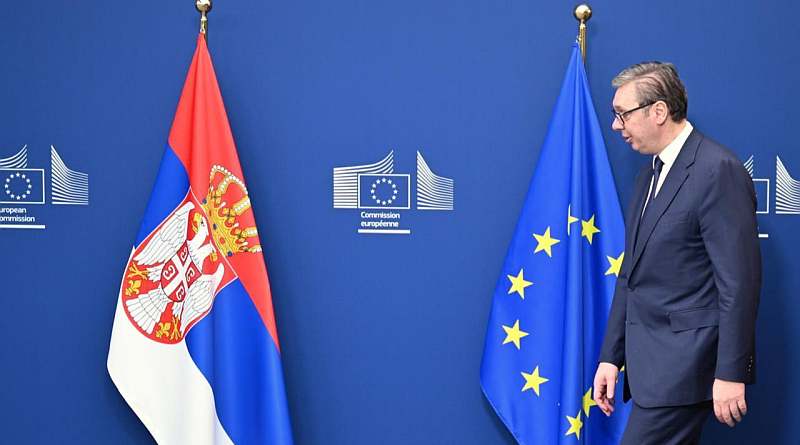
9. The European Union has suspended funding to Serbia as part of the development plan due to a setback in the rule of law and an increasingly apparent political drift towards Russia.
– EU Enlargement Commissioner Marta Kos stated that payments will not resume until issues in the judicial system are resolved. She explicitly emphasized that the country cannot simultaneously aspire for EU membership and deepen cooperation with Moscow.
– In Brussels, the situation in Serbia is being assessed more harshly. This includes not only pressure on the courts, restrictions on independent media, and suppression of protests but also maintaining close economic and political ties with Russia amid the war against Ukraine.
– According to EU estimates, up to 1.5 billion euros of funding could be at risk. In effect, Serbia is being signaled that balancing between the EU and Russia no longer works. Further rapprochement with the Kremlin will lead to direct economic losses and complicate European integration.
