
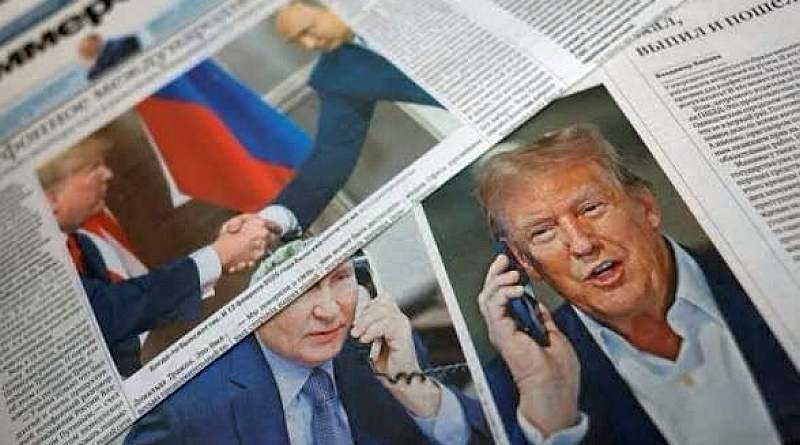

The recent phone contact between Vladimir Putin and Donald Trump, lasting an hour and a half, became another attempt by the Kremlin to convert a military stalemate into diplomatic capital. Amid burning oil refineries, an environmental catastrophe in Tuapse, and growing technological military lag, Moscow is desperately seeking a way to “freeze” the situation on its terms, cloaked in peaceful rhetoric.
In the spring of 2026, the “stability” of Putin’s regime began to experience significant disruptions. Analysts from Western and even “nongovernmental” Russian sources paint a grim picture.
Firstly, the Russian economy is on its last legs: constant strikes by Ukrainian drones on energy infrastructure, the recent “oil rain” in Tuapse, and fires in Nizhny Novgorod undermine foreign currency earnings.
Secondly, the current guard change in Europe, namely the rise to power in Germany of Friedrich Merz and the fall of Orban in Hungary, has toughened the EU’s position, leaving Putin with only a “window” in the form of Trump.
Thirdly, there is fatigue from the war. Despite the propaganda, the Kremlin vitally needs a pause for regrouping forces before the summer campaign.
But let’s return to the Putin-Trump conversation.
The main point on the agenda was Putin’s initiative for a “truce during Victory Day.” Here is a classic example of manipulation with sacred dates. By proposing to cease fire on May 9, the Kremlin pursues three goals: probing the readiness of the White House to pressure Kyiv for a “quick deal,” which Trump promised his voters; legitimization of the occupation, since any formal truce without troop withdrawal de facto fixes the front line, turning captured territories into a “new status quo”; and finally a logistical breather, as Putin uses military pauses exclusively for pulling reserves to the front, not for genuine peace-seeking.
In return, Putin offered Trump “services” in mediation with Iran. Amid the escalation in the Persian Gulf, the Kremlin tries to sell its influence over Tehran as a valuable asset. However, it seems more like “selling air”: Moscow’s dependence on Iranian drones makes it more of a client than a master in this relationship.
The results of the call appear ambiguous for both parties but catastrophically unfavorable for Europe’s long-term security. For Putin, the conversation is sold as a PR victory domestically. Propaganda already blares that “Russia is once again being reckoned with.” In reality, it’s 1.5 hours of begging for legitimacy from the US president.
In turn, Trump confirmed his image as a “peace-making dealmaker,” stating that the Ukrainian agreement is “almost ready.” But behind this rhetoric lies a dangerous willingness to sacrifice allies’ interests for a momentary media effect.
Against this backdrop, anxiety is growing in Berlin and Paris. Putin’s attempt to build a “directive peace” over the heads of Europeans and Ukrainians only deepens the rift in NATO, which is Moscow’s strategic goal.
The conversation on April 29 is not a step towards peace; on the contrary, it is a diplomatic detox for the Kremlin. Putin is trying to buy time while Russian infrastructure literally crumbles under the blows of the new military reality. The tragedy is that Trump, in his pursuit of a “big deal,” risks being led by a dictator whose only resource today is in prolonging the agony of the Russian Empire.
Behind the beautiful words about “Easter” and “victory” truces lies a cold calculation: keep what has been captured, gather strength, and strike again. The West must not allow Moscow to use May 9 as a screen for preparing a new phase of the war.

I do not wish to scorn those who still (unfortunately) out of inertia celebrate Russian “victory day” on May 9, instead of marking May 8 – the Day of Remembrance and Victory over Nazism in World War II 1939 – 1945, which, by the way, is defined by a separate Law of Ukraine.
But the personal pleading by the Russian leader to the US President for a ceasefire specifically on May 9 during the parade (interestingly, did they ask for a day or by the hour?) – is humiliating for Russians and completely unacceptable for Ukraine. The Kremlin pretends that the US position will be sufficient. I doubt it.
The reaction from official Kyiv is swift but, in my opinion, incomplete. Ukrainian President Volodymyr Zelensky announced via the “Telegram” controlled by Russian special services that he “instructed our representatives to contact the US President’s team to clarify the details of Russia’s proposal for a short-term silence. Ukraine strives for peace and ensures the necessary diplomatic work for the actual end of this war. We will find out specifically what is being discussed: a few hours of safety for the parade in Moscow or something bigger. Our proposal is to cease fire long-term, guarantee reliable security for people, and long-lasting peace. Ukraine is ready to work for this in any worthy and effective format.”
In my opinion, an official statement from the Ministry of Foreign Affairs of Ukraine is needed, stating that in Ukraine, the US, and Europe, Victory Day over Nazism is celebrated precisely on May 8. Therefore, Ukraine proposes to cease fire on May 8. And not for one or two days, but indefinitely.
If a ceasefire does not begin on May 8, then on May 9, we and our European partners celebrate Europe Day. Europe, including Ukraine, is under Russian attacks and needs protection.
Therefore, either from May 8, a ceasefire for at least a month (preferably indefinitely) or the Armed Forces of Ukraine must act against the aggressor to protect Europe.
All equipment and concentrations of Russian army personnel are legitimate targets. Both at the parade and beyond it.

The strangest result of the latest phone conversation between Putin and Trump is that the US effectively becomes a guarantor of Russia’s security. At least for the period of the May holidays.
It is known that the call was made at Putin’s initiative. In a press release on the Kremlin’s website, it is stated that “the presidents’ communication was conducted in a friendly manner.”
Let me remind you that just a few weeks ago, Trump killed the leader of Iran — a member of BRICS, with whom Russia had entered into a strategic partnership agreement a year ago. And a little earlier, the US president captured the president of Venezuela, who last year, along with Putin, received the parade on Red Square. Therefore, the “friendly manner” mentioned on the Kremlin’s website raises many questions…
Putin needs to hold a parade on Red Square. For decades, this has been a key entertainment for Kremlin pensioners, which was not even hindered by the COVID quarantine of 2020. In 2023, the parade took place against the backdrop of drone strikes on the Kremlin that occurred days before the event. This parade was memorable for the participation of a T-34 tank taken from a museum and the use of presidents from Tajikistan, Turkmenistan, and some other countries as a human shield. Since the entire Russia is now ablaze—from the Baltic to the Urals—finding foreign leaders willing to cover for Putin with their presence this time is unlikely. All hopes rest on Fico 🙂.
This is why Putin called Trump—to have him act as a guarantor of security so that Ukraine would not strike Russia for a certain period. After all, if the live broadcast of the parade is “decorated” with Ukrainian drones, it will once again show the world the lack of any strategic thinking on Putin’s part. Therefore, he decided it was simpler to humiliate himself and ask Trump for security guarantees from Ukraine than to agree to the really tough conditions for a ceasefire that Trump has already managed to pressure out of Ukraine and Europe.
And here lies the main tragedy of Russian political thinking. Putin does not need peace; he needs an image of his own significance. Turning to Trump is not just an act of humiliation but an acknowledgment that Russian sovereignty today ends where the range of a Ukrainian drone begins. In fact, Putin admits he cannot win and is forced to bargain for peace during his own celebration from his main existential enemy.
Putin made two strategic mistakes: the first when he began the war against Ukraine, and the second when he refused to end it in 2025 on terms proposed by the Americans. And as we can see right now, things will only get worse for the Russians.
A truce according to the Kremlin calendar?
Recently, there was a phone conversation between President Trump and Putin, from which we all learned about a new ceasefire initiative (on Russia’s day of “victory obsession” on May 9). And, apparently, not only we found out but also the entire Ukrainian diplomacy, along with all the main negotiators.
If this were the first such initiative, it could still be considered as a potential step towards de-escalation. But this is happening for the second time. After the so-called “Easter truce”. So it seems that Ukraine is now and further being offered to adapt to Russian dates and “truce under holidays.” This has nothing to do with a lasting and just peace.
Such initiatives seem more like an information-political move, a smokescreen, and imitation, rather than a real intention to stop the war. A truce cannot be tied to the calendar of the aggressor country. If there is a genuine readiness for a complete and unconditional ceasefire, then this readiness must be constant and systematic, not situational and symbolic. This logic should be conveyed to our partners.
And most importantly. Where is Ukraine in this? Where is the direct contact between Washington and Kyiv? If previously there could be doubts, now we see a worrying trend: the principle “nothing about Ukraine without Ukraine” is being replaced by “everything about Ukraine without Ukraine.” And this is no longer just a matter of diplomacy and negotiations, but something more.
However, there is always a way to turn this unfortunate situation to Ukraine’s advantage…

For the first time in a long while, the Russian president called his American counterpart, seemingly with one single purpose: to create opportunities for the safe conduct of the May 9 parade.
This day has long become the main date of Putin’s ideology – so much so that the victory in World War II in modern Russia has turned into a disgusting “victory obsession”. Of course, the desecration of this date began back in Soviet times when events and periods of the war’s history were erased, and soldiers’ truths were replaced with the memoirs of marshals and political officers. However, during Putin’s time, when there are practically no participants of the war left, and even “children of war” are approaching 90 years old, victory in World War II has been turned into a convenient tool for justifying the aggression and crimes of the chekist state. And that’s why it is so important for Putin that the parade takes place.
What else, apart from this parade, unites modern Russians? All other dates on the festive calendar have long since turned into anachronisms. Even the formally main “national holiday” – Russia Day – is celebrated to mark the adoption of the declaration of sovereignty from the…Soviet Union by the Congress of People’s Deputies of the Russian Federation. And, of course, no one in today’s Russia, overflowing with nostalgia for the USSR, can explain what they are celebrating on this day.
But even with the parade on May 9th this year, things are not going so well. The fact that Ukrainian drones and missiles can reach Moscow is obvious to Putin. His paranoid obsession with his own security is well known, let’s recall at least the long white table during the coronavirus times, where Putin received his guests, or the weeks of quarantine that Russian officials had to go through before meeting the pandemic-fearing president. Therefore, Putin does not want to stand on the podium and wait for an air raid alert.
The parade has already been significantly reduced. There will be no military equipment, and the Kremlin does not even hide their fears of possible Ukrainian strikes. There will also be no cadets from military academies and colleges, who traditionally participated in the parade. It is even unclear whether Putin himself will attend. But he would very much like to demonstrate that the parade will take place under any circumstances and with the participation of the supreme commander-in-chief.
Last year, the Kremlin organized the arrival of Central Asian country leaders, effectively trying to turn them into a “human shield” for Putin. This year, there has been no information on who is planning to go to Moscow. The only politician from the European Union who expressed readiness to visit Moscow is Slovak Prime Minister Robert Fico. However, it is still unknown how he will get to the Russian capital after a number of countries have already announced that they would refuse his plane the use of their airspace if the Slovak leader decides to attend the parade. Moreover, does Putin himself wish to speak with Fico after he had a warm conversation with Zelensky and emphasized that there could be no peace agreement without Ukraine.
A call to Trump remains. However, things are not simple here either. The American president does not want to hear about Russian assistance in his negotiations with Iran and cannot simply offer Ukraine not to fire at Russia while regular deadly Russian attacks continue. Putin must offer something that would appear as a compromise. At least as a compromise in Trump’s eyes.
The paradox of the situation is that Putin does not want to seek compromises. He just wants to safely hold the parade and continue the war on May 10th, no longer tied to dates important to him. The main question here is – what is in it for Ukraine.
