
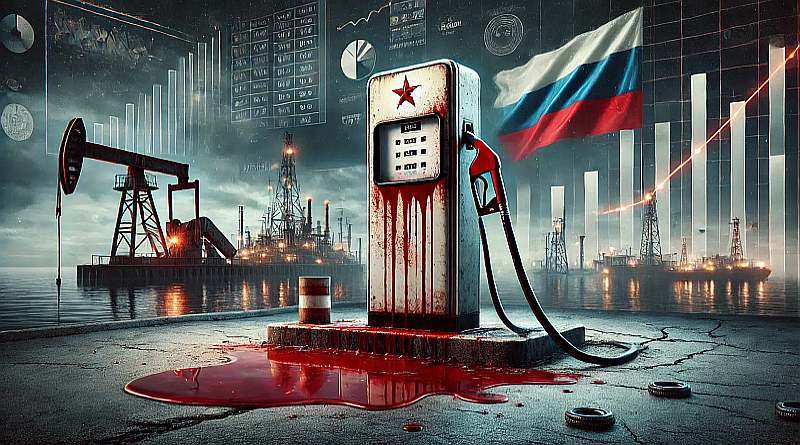

Information on current losses of the Russian Federation due to sanctions as of 04/28/2026.
1. The oil refinery in Tuapse, owned by Rosneft, was hit by a new drone attack, resulting in a fire.
– According to the operational headquarters of the Krasnodar region, the fire occurred after drone debris fell on the premises. Previously, the plant had to halt oil processing from April 16 after an attack on the port infrastructure of Tuapse.
– Thus, the strikes on this site have a systematic nature rather than being a one-time event.
– The Tuapse refinery is an export-oriented enterprise with a capacity of about 12 million tons per year and mainly produces semi-finished products — oil, fuel oil, and vacuum gas oil.
– Disruptions in its operations directly impact export flows and foreign currency income, increasing pressure on the Russian oil and gas sector, which is already facing restrictions, logistical disruptions, and growing risks to infrastructure.
2. Russia’s revenues from oil and gas taxes will remain lower than last year until the end of May, despite the conflict in the Middle East.
– Russia’s budget revenues from oil and gas in May may rise to approximately 650 billion rubles ($8.65 billion). Compared to May 2025 (512.7 billion rubles), an increase is expected. However, revenues for January–May will amount to about 2.94 trillion rubles compared to 3.16 trillion a year earlier, indicating continued pressure on the Russian budget.
– The key factor for the decline was the weak results of the first quarter when oil prices remained relatively low until the situation around Iran intensified.
– Additionally, the strengthening of the ruble exerts a negative impact by reducing ruble income from exports.
– Even taking into account the growth in May, Russia doesn’t gain a full benefit from the price spike. Strikes on energy infrastructure, production limitations, and logistical problems constrain export opportunities.
3. Consumer sentiment in Russia is deteriorating due to economic uncertainty.
– In April, the consumer confidence index dropped by 3.7 points to 94.5 points, reaching the lowest level since October 2022.
– The inclination to save is increasing: the share of citizens who prefer to save extra money instead of spending on expensive purchases rose to 52.8% (+1.6 pp). This indicates decreased confidence in economic prospects and a restraint on domestic demand.
– At the same time, the trend of accumulating cash is strengthening. The share of those who choose to keep money “under the mattress” increased by 3 pp in a month to 35%, the highest level since January 2024.
– This behavior reflects deteriorating inflation expectations and increased caution among Russians.
– For the Russian economy, this means additional pressure: weaker consumer demand limits recovery opportunities, and distrust in the financial system undermines the effectiveness of monetary policy.
4. The Russian banking sector is transitioning to large-scale cost optimization.
– In 2025, the largest credit institutions cut over 22,000 employees, reducing total staff by 4% to 557,000, effectively returning to the 2023 level.
– Reductions were recorded in most market players, indicating a systemic trend.
– The main impact was on state banks: in “Sber” and “VTB,” staffing decreased by a total of approximately 21,500 people, or about 5%. Smaller reductions also occurred in other institutions — for instance, about 700 employees were laid off at “Sovcombank,” and about 800 at “Rosselkhozbank.” The most drastic staff reduction — nearly 40% — was observed at “Unicredit Bank,” which is preparing to wind down its operations in the Russian market.
– Simultaneously, banks continue to reduce their physical presence: the number of branches decreased by 1,700, or 7%, over the year, to 22,400. This contrasts with previous years when the network remained stable or even expanded.
– This trend indicates growing pressure on the banking system, which is forced to cut costs amidst a slowing economy, reduced business activity, and structural constraints.
– The reduction of staff and branch networks indicates not only digitalization but also market contraction and decreased operational efficiency, which in the long term intensifies risks for the financial sector.
5. Russia is experiencing an unprecedented labor shortage that is already directly affecting economic dynamics.
– Estimates show that the labor reserve, i.e., potential workforce, has decreased to 4.4 million people, which is 40% less compared to 2021. In absolute terms, this is a reduction of approximately 2.6 million people.
– The causes were mass emigration and the withdrawal of a significant number of able-bodied individuals due to mobilization and contract service.
– The labor shortage has become systemic: in industry, the shortage is estimated at approximately 2 million workers, in Moscow — at the level of 400–500 thousand, in the Ministry of Internal Affairs system about 170 thousand employees are missing, and in the agricultural sector — more than 130 thousand. This situation is already hindering production, investment, and overall economic activity.
– Businesses face limited growth opportunities, and personnel costs are rising, further pressuring profitability. Ultimately, the labor shortage becomes one of the key structural factors weakening the economy, intensified by demographic losses and the consequences of the war.
6. Russia has increased its maritime export of crude oil to the highest level in over a month.
– On average, over the four weeks to April 26, supplies amounted to 3.52 million barrels per day, which is about 350 thousand barrels more than the previous week. On a weekly basis, volumes reached 3.79 million barrels per day — the highest since the end of March.
– The key factor was not so much an increase in demand as a decrease in processing volumes due to strikes on oil refining infrastructure.
– Attacks on plants, particularly in Tuapse and Yaroslavl, effectively freed up additional volumes of crude oil for export, highlighting the vulnerability of the domestic processing segment.
– At the same time, previous strikes on export ports — Primorsk, Ust-Luga, and Novorossiysk — previously led to a sharp drop in shipments, indicating the instability of the entire logistics system.
– Despite increased flows, a significant portion of the oil remains in transit, rather than sold: the volume of raw materials at sea increased to approximately 114 million barrels from 100 million two weeks earlier. This is explained by the extension of routes, including the reorientation of shipments to India — at least 10 ESPO shipments in April are heading there, whereas previously the main direction was China with a significantly shorter delivery route.
– The financial effect appears contradictory: despite increased volumes, prices for Russian oil are decreasing. Urals quotes in the Baltic region fell to about 98.41 dollars per barrel, in the Black Sea — to 96.67 dollars, while the Pacific ESPO fell to 91.97 dollars.
– As a result, weekly export revenue decreased to approximately 2.31 billion dollars, which is 130 million less than the previous figure. An additional factor of uncertainty is the partial recovery of pipeline supplies to Hungary through Ukraine, which could potentially reduce maritime exports by another 150–200 thousand barrels per day.
– Consequently, even through temporary increases in shipments, the Russian oil sector remains dependent on external shocks, unstable logistics, and price fluctuations, undermining the predictability of income.
7. Russia has increased oil exports to Georgia to a historical maximum.
– Russia exported oil to Georgia worth almost 70 million dollars, with its share of petroleum products in Georgia’s external purchases amounting to 42.5%.
– According to Georgia’s National Statistics Office, Russian oil shipments reached record highs in March alone, totaling 69.2 million dollars. This is the highest in modern history. Just the previous month, oil exports from Russia to Georgia were only 34.1 million dollars.
– However, oil shipments from Russia are irregular – in the past 2025, Russian oil was delivered to Georgian refineries only for four months, and the same situation occurred the previous year, as noted by the country’s statistical office.
– In March, Georgian importers also increased imports of petroleum products from Russia one and a half times in monthly terms – up to 55.1 million dollars.
– By the end of last month, Russia became the leader in exporting its petroleum products to Georgia, with a share of 42.5% of all supplies.
8. India Concealed Data on Russian Oil Imports.
– India refused to disclose statistics on oil purchases from Russia, citing confidentiality and national interests. This decision was made by the Petroleum Planning and Analysis Cell under the Ministry of Petroleum and Natural Gas.
– It concerns the refusal to publish import details for the period from June 2022 to June 2025, including a breakdown by major Indian refineries — both state-owned and private. The request was made under the right to public information law, but the authorities rejected it, citing risks for foreign economic relations and strategic security.
– In effect, this means further closure of one of the key channels of transparency regarding Russian oil exports. Despite formal restrictions and sanction pressure, supplies to India remain significant: in 2023, they reached about 1.7 million barrels per day, and in the first half of 2025 they exceeded 2 million barrels. Market estimates suggest that flows in March were 2–2.3 million barrels per day.
– The presence of permits from the US Department of the Treasury allows India to continue purchases, but the refusal to publish data effectively puts these volumes in a “grey zone.”
– This complicates the assessment of Russia’s actual export revenues and indicates increasing opacity of the schemes through which Moscow attempts to maintain oil revenues under sanctions.
9. Entrepreneur in Latvia Fined for Attempt to Bypass EU Sanctions Against Russia.
– A court in Riga fined a local entrepreneur 10,140 euros for attempting to violate EU sanctions against Russia. According to the investigation, in 2023 he tried to organize an export to Russia of special equipment for transformers (including Buchholz relays) worth over 161,000 euros.
– The case also involved two companies: one was liquidated as the violations were in its interests; the other was fined 17,940 euros for insufficient control.
– The prosecution made agreements with the accused and the companies, which the court approved. The case is another example of strengthened control over the enforcement of EU sanctions.
10. Estonia Prepares to Tighten Restrictions for Russian and Belarusian Citizens, Banning Them from Purchasing Real Estate in the Country Without Permanent Residency.
– The relevant legislative amendments were developed by the Ministry of the Interior, arguing the initiative was necessary to minimize risks to national security.
– It is about preventing the use of real estate for intelligence activities, sabotage, or influence operations potentially conducted under the control of hostile states. The ban will apply not only to individuals but also to companies registered in Russia and Belarus, as well as legal entities where citizens of these countries are ultimate beneficiaries.
– The restrictions will not have retroactive effect and will not apply to individuals with long-term residency who have already undergone state checks.
– Thus, Estonia is effectively closing another channel of Russia’s economic and potentially intelligence presence in the European Union, strengthening the overall deterrence regime.
